Ramón Masats Spanish, 17/03/1931–4/03/2024
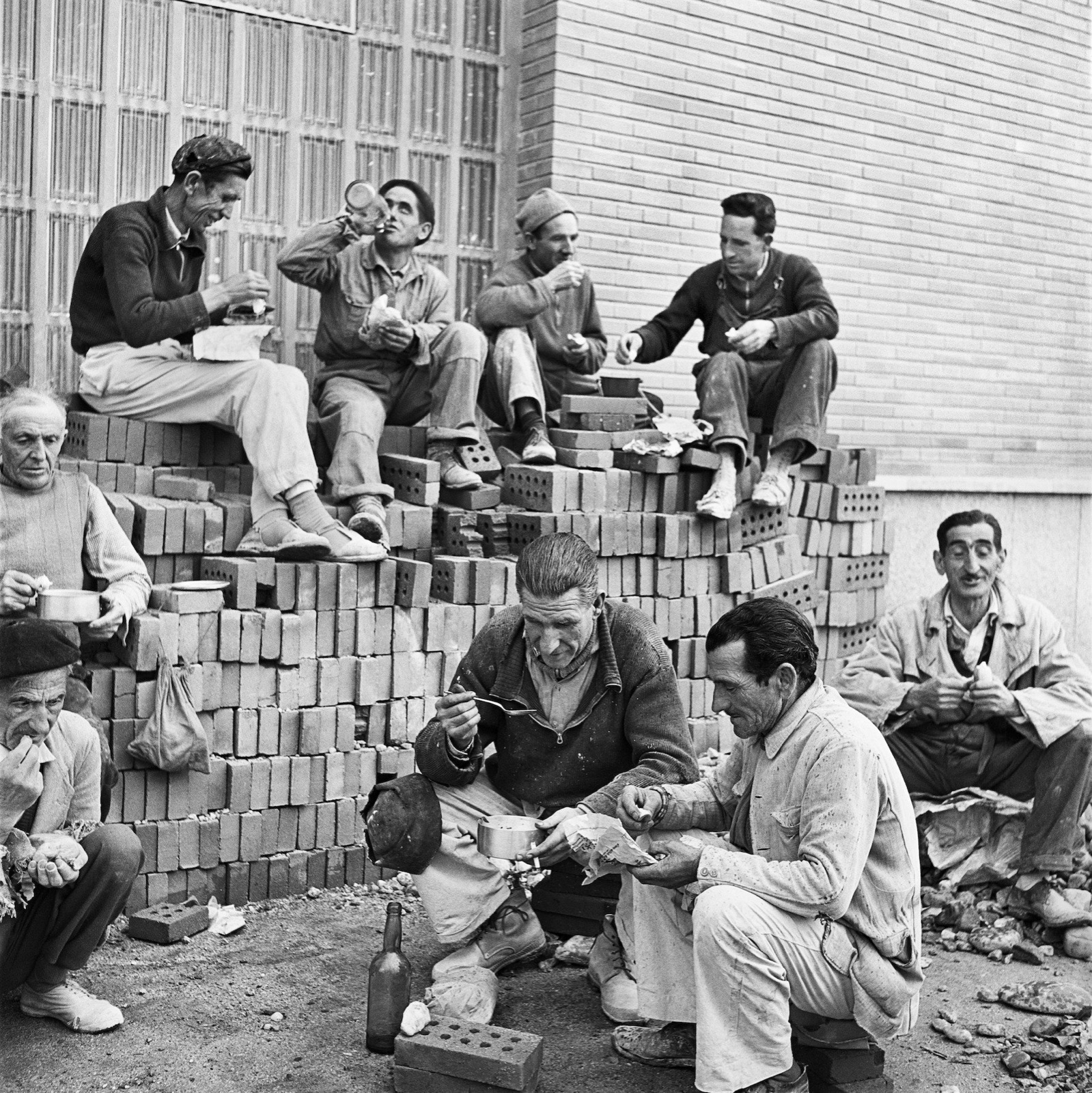
Nine men eating their midday meal on a stack of perforated bricks, four along the top, against a tall grid of glass panes and a plain brick wall, five lower down on the ground and the rubble. One drinks with his head thrown back; the man beside him grins over a hunk of bread; in the foreground a man in a dark zipped jumper lifts a spoon from a small tin, his cap resting on his knee, while the man crouching beside him unwraps something from paper. A bottle stands on the dirt at the lower left beside a single loose brick. Terrassa, 1953: a self-taught photographer of twenty-two choosing to photograph a building site at the one moment when nobody is building.
How considered the picture is, for someone with no training. The square frame is held level, the brick stack reads as a staircase or a small amphitheatre, and every face is caught in a different state of eating, talking or looking, so that the group is a group without being a pose. The workers have noticed him, and two of them are grinning, but the camera does not ask anyone to stop. That is a decision, not luck: to stay at a slight distance, to let the architecture of the bricks organise the bodies, to refuse both the heroic worker and the picturesque poor.
Photographers now who work with people at their jobs would recognise the negotiation here. The picture does not claim a solidarity it has not earned; it records a lunch break with the attention one would give a ceremony. Within a few years Masats would be photographing fiestas and boxers, but the way of standing among others that those pictures depend on is already fully formed on this pile of bricks.