Ramón Masats Spanish, 17/03/1931–4/03/2024
Edition of 15
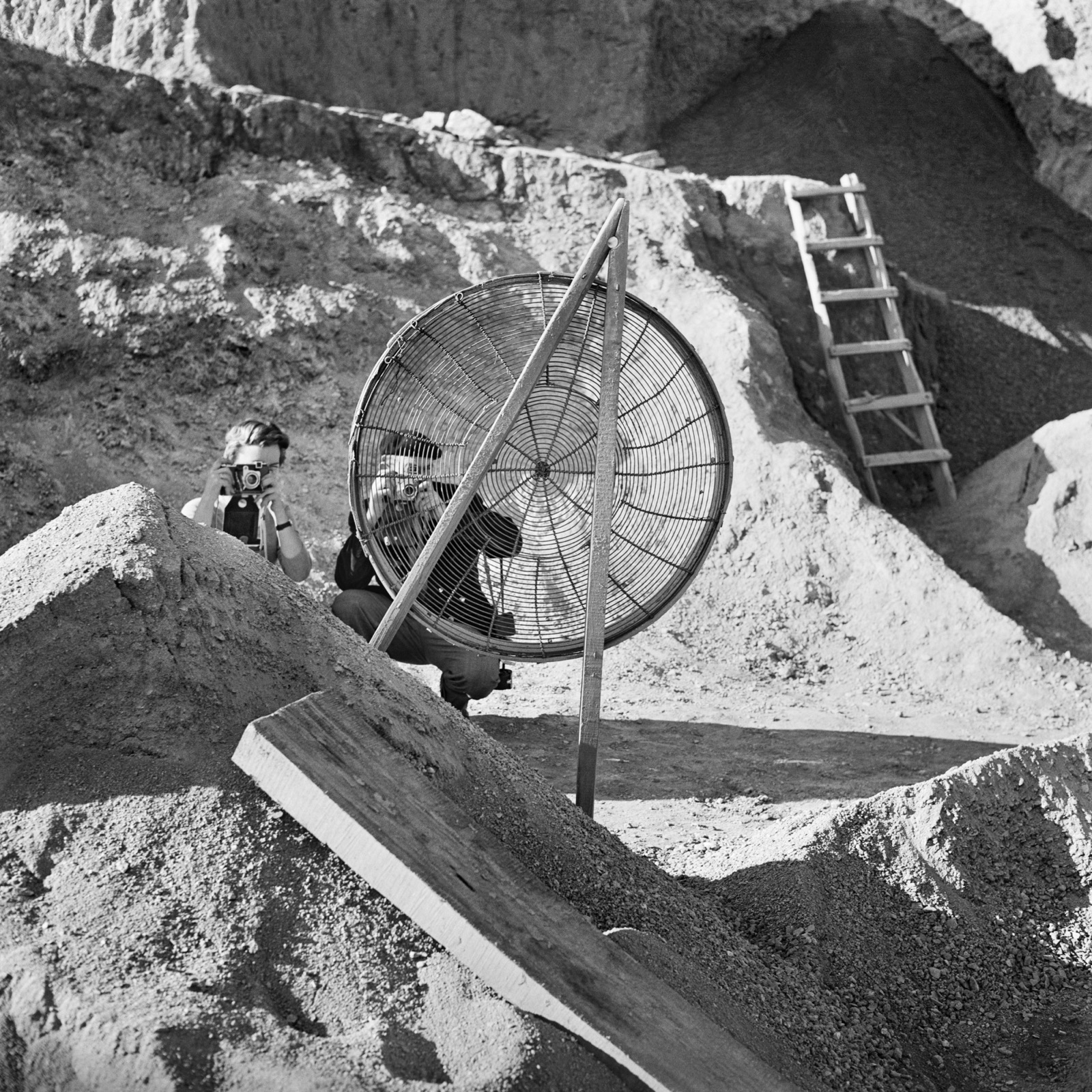
A sand yard, all mounds of pale grit and darker gravel, and standing in the middle of it a great circular wire sieve on a wooden frame: concentric rings, radiating spokes, a screen you could put a quarry through. A young man crouches at the left with a camera up to his eye, aimed straight at us. Behind the sieve a second young man crouches in exactly the same posture with a camera of his own, also aimed at us, his hands and his white shirt broken into small squares by the mesh. A wooden ladder leans against a bank of earth at the right, going nowhere. A plank lies across a mound in the foreground.
Three cameras are at work in this picture and only one of them belongs to Masats. Whatever else was going on that afternoon, the young men of Terrassa had worked out that a camera pointed back is funnier than a camera pointed at a landscape. The sieve makes the joke exact. It is a machine for separating what gets through from what does not, and one of the photographers is standing behind it being separated into little squares.
None of this is documentary, and none of it is faked either. The sand yard is a real sand yard and the sieve does the job it was built for. Then somebody noticed that it looked like a lens, or a web, or an eye, and arranged three men and their equipment around it. This is 1953, in the town where Masats started, and the whole apparatus of the thing he would spend his life doing is already lying about in the gravel, being played with by people who have not yet decided to be serious.
