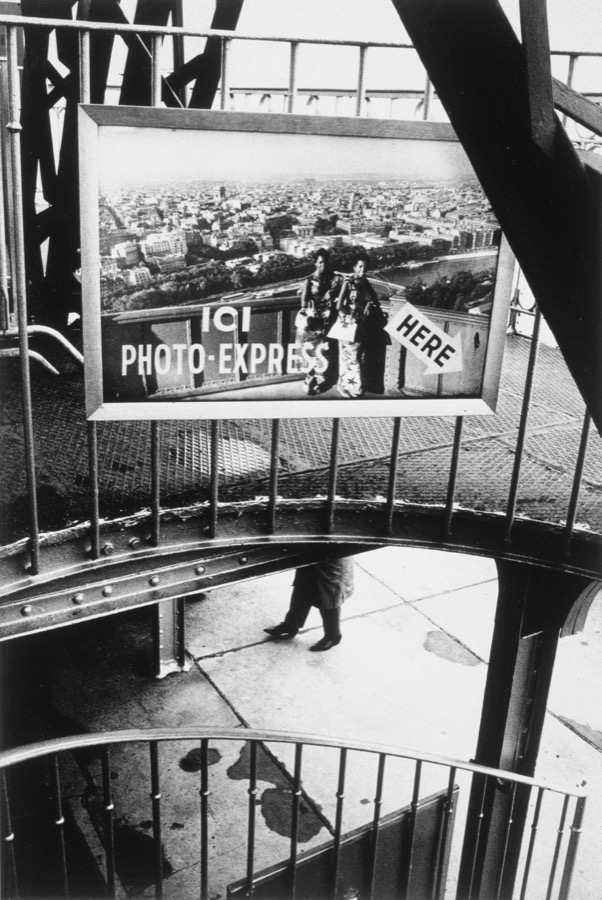
Ramón Masats Spanish, 17/03/1931–4/03/2024
Edition of 15
Edition of 5
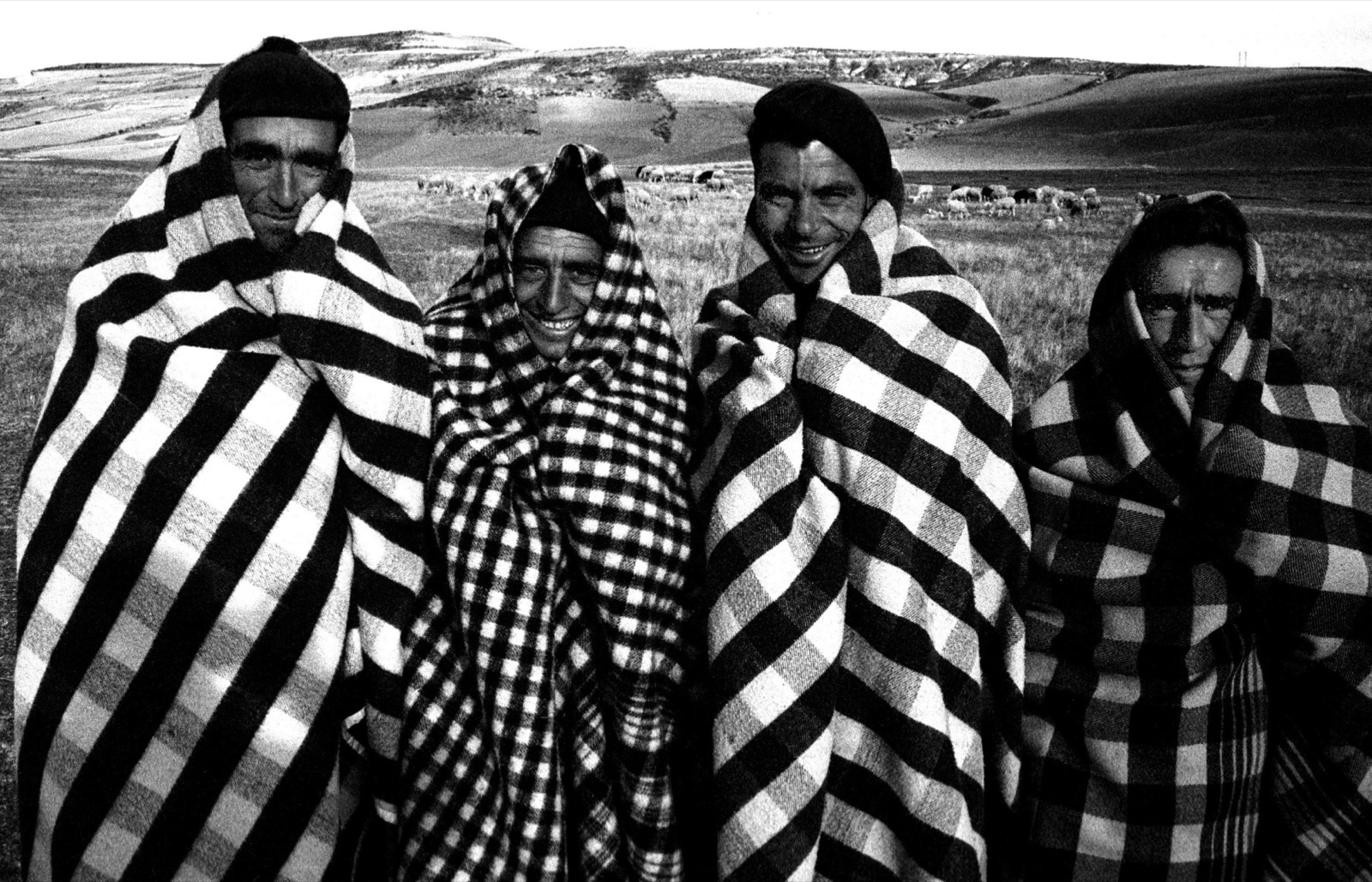
Four men stand shoulder to shoulder in a field, each wrapped to the eyes in a checked woollen blanket. The checks do not match: broad stripes on the first, a tight gingham on the second, a bold diagonal on the third, a smaller square on the fourth. Behind them a flock of sheep grazes on a flat, pale plain, and beyond the sheep the land rises into bare, ploughed hills under a white sky. Three of the men are smiling at the camera. The fourth, on the right, is not.
The studium is easy to name: the Castilian plain, the shepherds, the blankets they use against the wind, a rural Spain that the title fixes in Tierra de Campos in 1962. The picture is almost comic in its repetition, four heads, four parcels of cloth, a pattern played in four keys. It could be read as a costume study, or as a group portrait that happens to be outdoors.
But what pricks me is the man on the right. His blanket is pulled tighter, up over his head like a hood, and he looks at the lens without the grin the others offer. He has not agreed to the joke. Because of him I cannot look at the other three as simply cheerful; their smiles become something performed for the stranger with the camera, and his reserve becomes the true temperature of the morning. It is his face I keep, and the cold he is keeping out.