Ramón Masats Spanish, 17/03/1931–4/03/2024
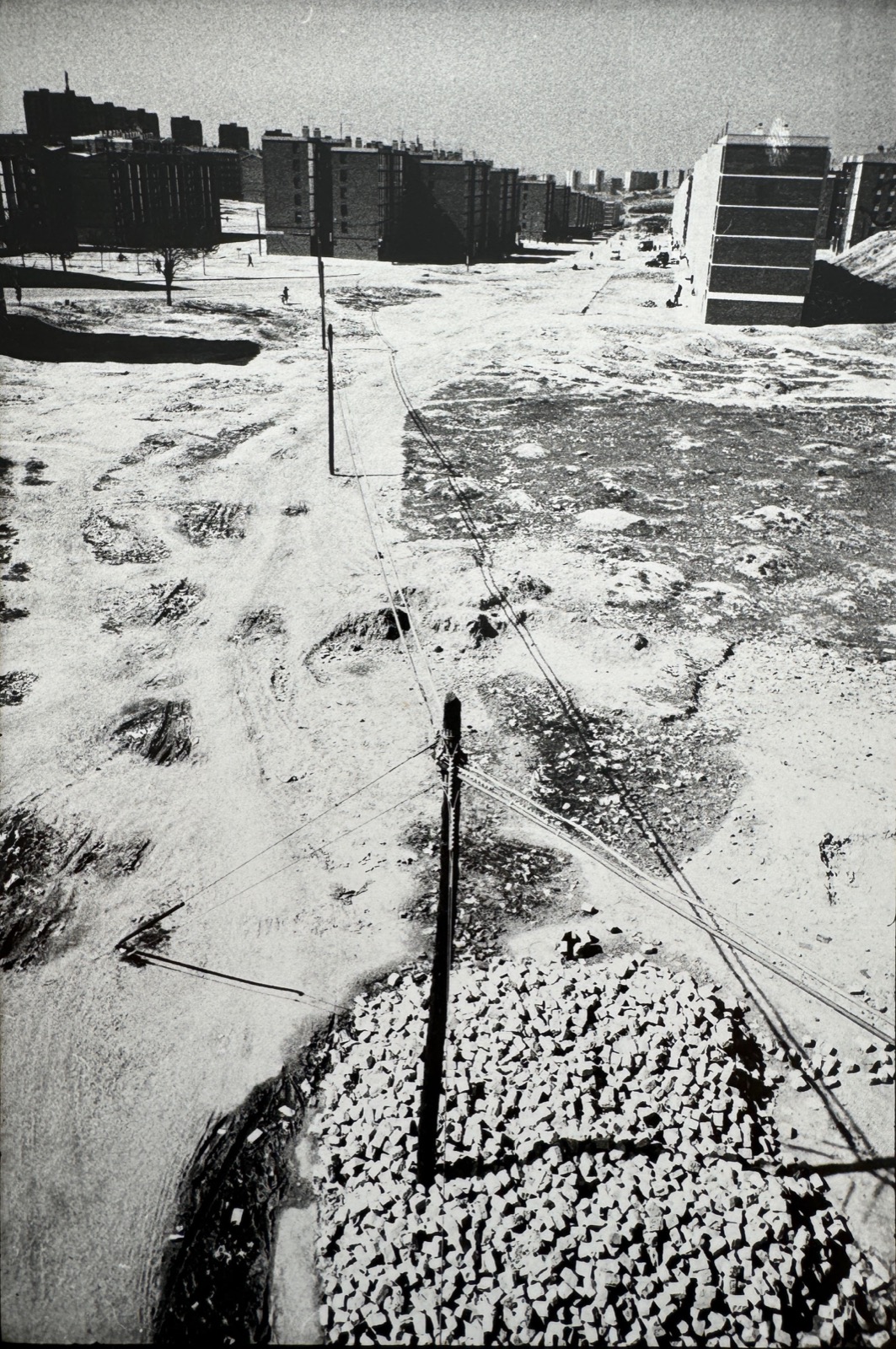
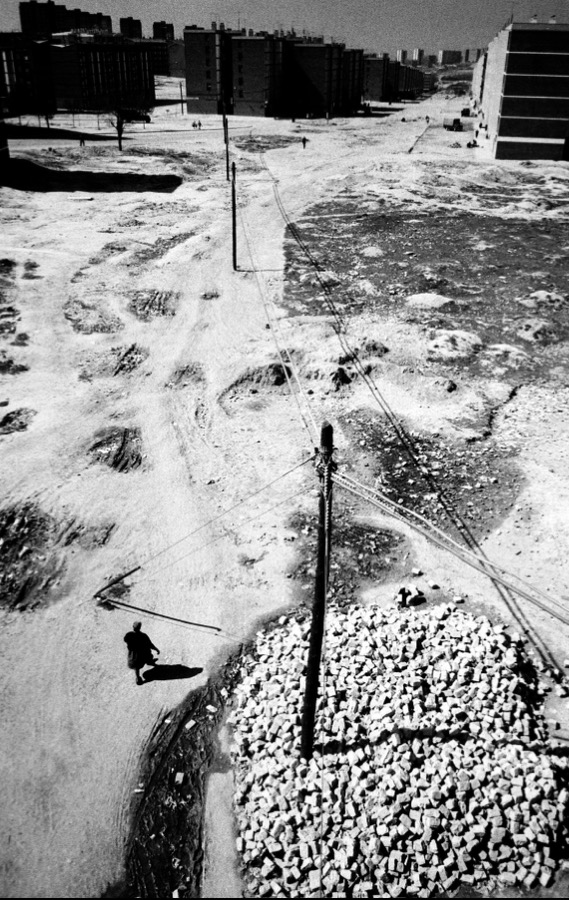
The camera looks down from an upper floor, straight along a line of telegraph poles that runs from the bottom edge of the frame to the far end of a new street. Under the nearest pole sits a heap of paving setts, hundreds of small cut stones piled like sugar cubes. Beyond it the ground is raw: tyre ruts, trenches, dark scraped patches, a bare tree, a few walkers no bigger than commas. Apartment blocks stand in rows on either side, and more of them repeat into the haze along the horizon.
Everything here is waiting. The stones are waiting to become a pavement, the ground is waiting to become a street, and the blocks, already finished and already inhabited, are waiting for the city to catch up with them. Only the wires have arrived, sagging from pole to pole across the empty lots. The picture records the moment when housing comes before everything a neighbourhood is supposed to have.
What makes it a photograph and not a planning document is a set of formal decisions. Masats chooses the vertical frame, so the eye travels the full depth of the site instead of sweeping across it. He lets the contrast run hard, until the earth turns almost white and the blocks go black. And he gives the heaviest weight in the picture to the pile of stones in the foreground, not to the buildings. The subject is Madrid, but the argument is about scale: a city made of small pieces, one cube at a time.