Joel Meyerowitz American, b. 6/3/1938

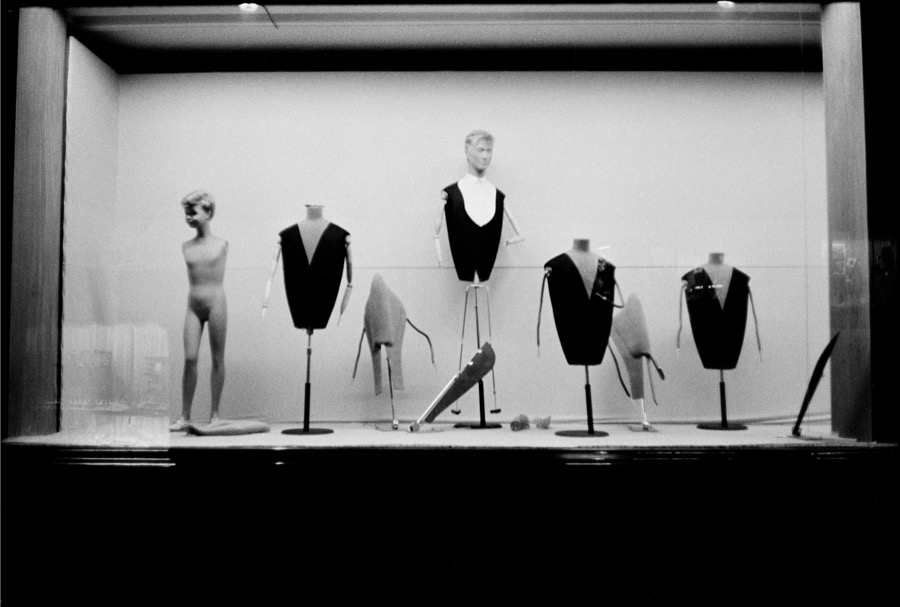
A shop window in Paris fills most of the frame, a lit box of saturated yellow between wooden pilasters. At the left a child mannequin with short fair hair and white shoes stands naked and armless, a detached limb at its feet. Beside it stand dress forms on metal stands, their busts covered in black cut into a deep V, some with jointed arms that end in metal pins, others with limp dark arms. Only one of the forms has a head: a young man with painted features above a white collar and shirt front. An elongated display form leans across the floor on a metal arm, two small parts lie on the floor, one of them a hand, and at the far right a curved black form rises from its own stand.
What the window offers is not a wardrobe but the apparatus behind one: forms, limbs, stands and a single collar, set out with a care that turns the parts into the display. The window is already a picture, framed, lit and composed, and Meyerowitz meets it head on, letting the yellow do the work. The yellow makes it strange, a stage where the props wait for actors who never arrive.
Atget photographed the mannequins of Paris shop windows in the 1920s, and the Surrealists claimed him as one of their own: through Man Ray, a few of his photographs appeared in "La Révolution surréaliste" in 1926. Meyerowitz inherits the motif and changes its terms. Atget's best-known window is thick with reflections of the street; here the street is a ghost at the edge of the glass, and the colour flattens everything else into one plane, closer to a painted stage set than to a record of a shop. An old subject turns new when the medium shifts under it: the same displaced bodies, seen by a camera that treats colour as the subject itself.