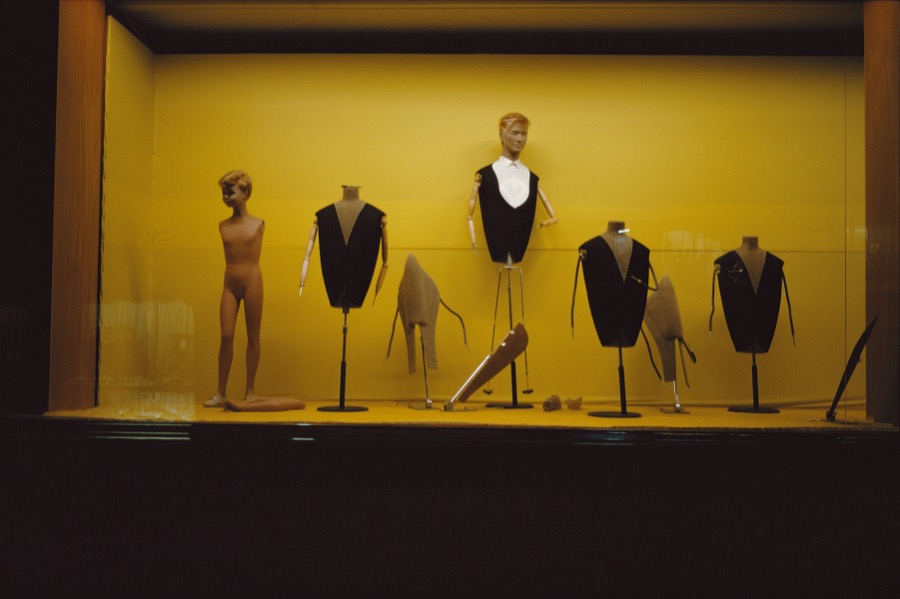
Joel Meyerowitz American, b. 6/3/1938
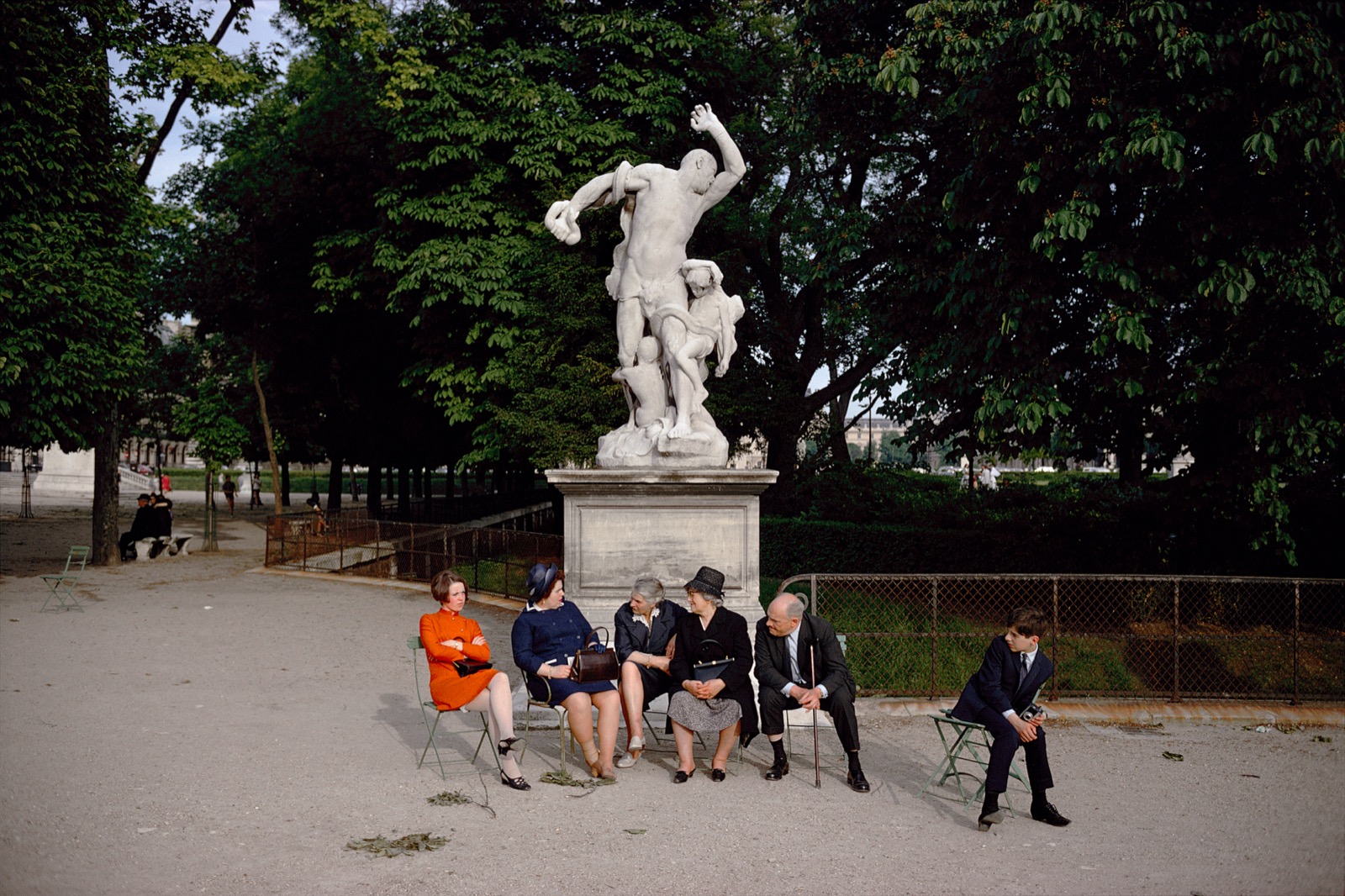
In a Paris garden, under horse chestnuts, a marble group stands on a tall pedestal: a muscular man flings up one arm and holds a serpent away with the other while two children cling to his legs. It is Jean-Baptiste Hugues's "La Misère" of 1907, in the Tuileries. Below it, on the gravel, six people sit on green metal chairs. A young woman in a bright orange dress, arms folded and legs crossed, turns her head towards the others. Beside her sit a woman in navy with a blue hat and a brown handbag, a grey-haired woman in a dark coat, an older woman in a black hat with her bag on her knees, and a bald man in a dark suit with both hands folded over a cane. A little apart, a boy in a suit and tie holds a camera and looks towards them.
They could be a family, and they sit like one: the women turned towards each other as if in conversation, the bald man turned towards them over his cane, the boy on a chair of his own with a machine of his own, near enough to belong and far enough to be separate.
Above them the marble man is all anguish, his children clinging to him, misery raised to the scale of a monument. Below, real people get through an ordinary afternoon with their handbags and good shoes, and the young woman in orange, the brightest thing in the garden, keeps her arms folded against all of it. I love the gap between the statue's grand suffering and the modest, dressed-up endurance of the living. And I love the boy most, sitting apart with his camera. I like to imagine him as the one learning to look, left to decide which of these two dramas deserves his attention.