Joel Meyerowitz American, b. 6/3/1938
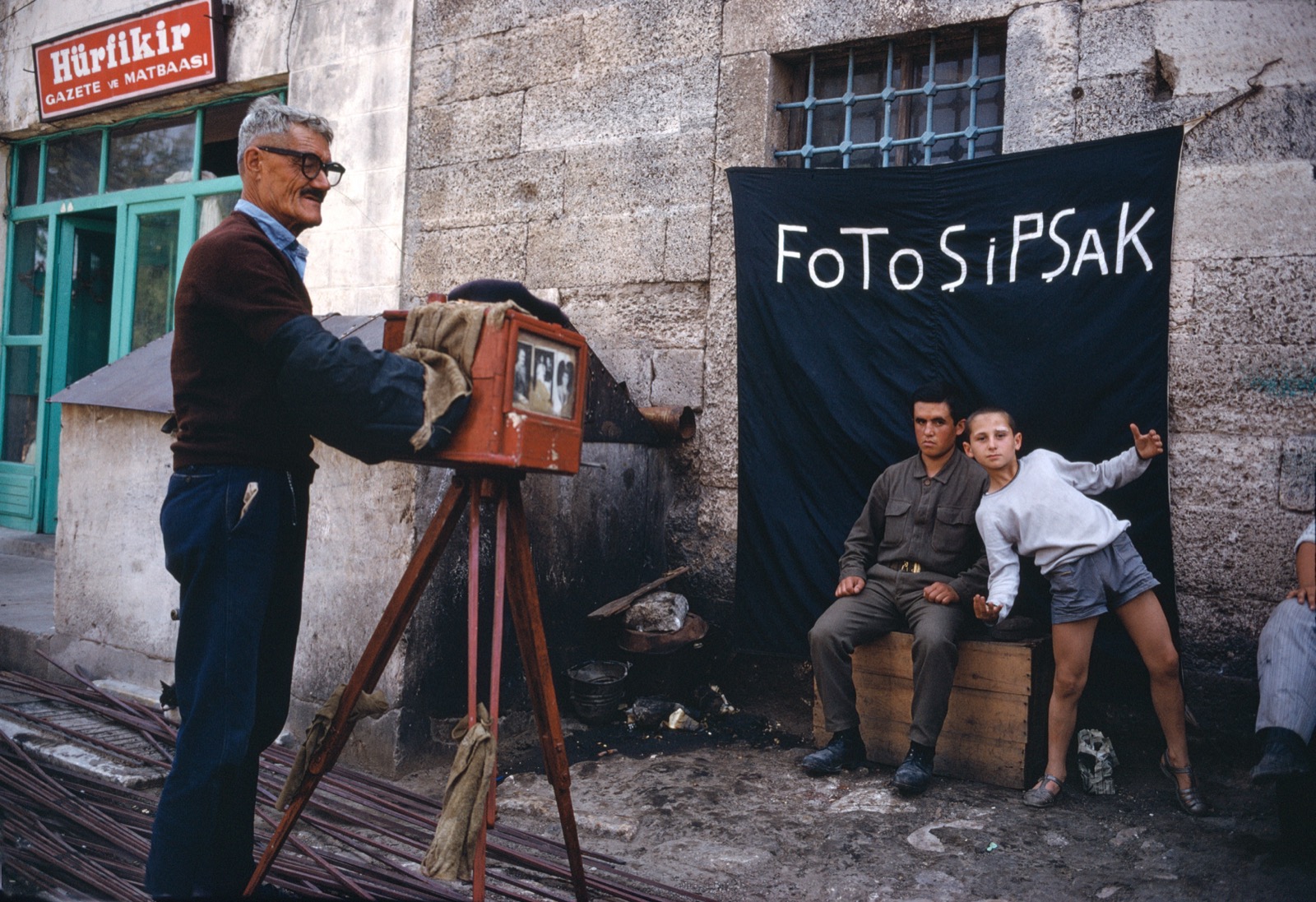
A street photographer is at work in front of a wall of big stone blocks. He is an old man with a shock of grey hair, heavy black spectacles and a moustache, in a maroon cardigan over a blue shirt, and his right arm is buried to the shoulder in a dark cloth sleeve fixed to the side of a red wooden box camera. The box stands on a wooden tripod whose legs are bound with rags; a beret lies on top of it, and on its front, under glass, three small black-and-white portraits advertise the trade. Beside him a black cloth hung beneath a barred window reads, in white letters, FOTO ŞİPŞAK. In front of it a young man in olive work clothes sits on a crate, and a boy with cropped hair, in a white sweater and grey shorts, leans in beside him and flings out an arm. A black-and-white cat peers from a heap of iron rods at the old man's feet.
The words are Turkish, and they promise the whole of photography in two of them: a photograph in a flash. Street cameras of this kind were camera and darkroom at once, with a light-tight cloth sleeve through which the photographer's hand could develop the picture inside the box. Here his arm has vanished into it up to the shoulder, and he smiles at his sitters as he works.
Histories of photography mostly follow the pictures that end up in museums, and rarely the millions made on pavements like this one, which served their purpose and vanished. Here the two economies of the medium meet across a few yards of street: the street portraitist with his wooden apparatus and his samples under glass, and the visitor with his own camera who takes him as his subject. We will never see the portraits the old man made on that pavement. We have only the one made of him making it.
