Joel Meyerowitz American, b. 6/3/1938
76 x 101 cm / 30 x 40 in
121 x 152 cm / 48 x 60 in
Umbrella edition of 25
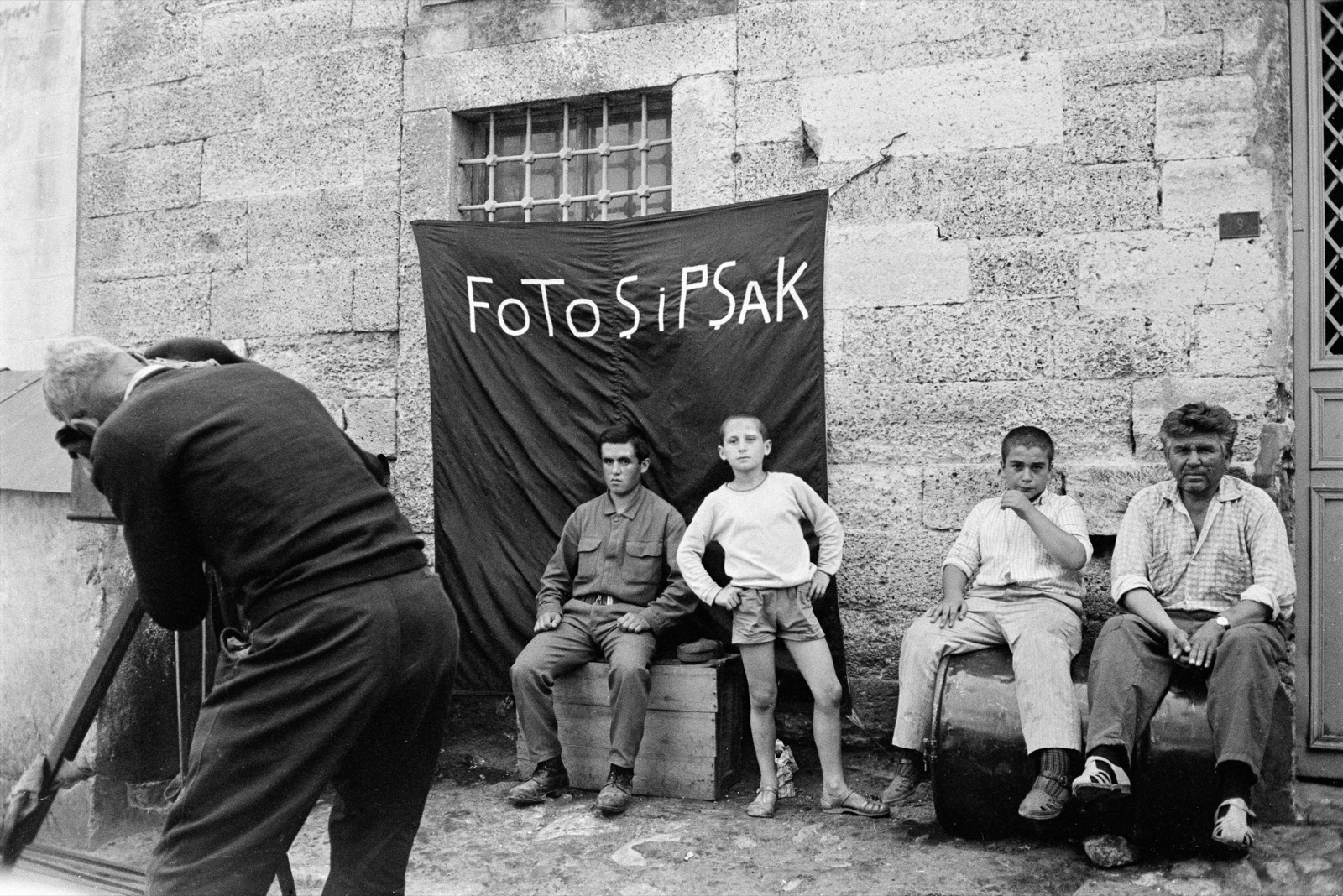
The painted cloth hangs beneath a barred window on a wall of heavy stone blocks, its white letters reading FOTO ŞİPŞAK, and this time the sitters face the lens squarely. A young man in work clothes sits on a wooden crate, hands on his knees, his expression guarded. Beside him a boy with cropped hair stands with his hands on his hips and one foot turned out in its sandal, as grave as a statesman. To the right, outside the cloth, a boy in a striped shirt with his hand at his chin and a heavy man in a checked shirt, a watch on his wrist, sit on an oil drum and look on. At the left edge the photographer bends over his camera with his back to us, his grey head pressed to the box.
The sitters have taken their places for the old man's camera, but it is the stranger's lens they look into. The boy in particular has fixed his pose, and he offers it to whichever machine is watching. The pair on the drum sit beyond the edge of the cloth, outside the portrait, and their frankness is of another kind.
I love this picture because it shows the scaffolding of a portrait. A cloth is hung to erase a wall, a crate is set down to make a seat, a boy is told, or tells himself, to keep still: the old man's photograph, framed on the cloth, would show two figures against a black ground, as if they came from nowhere. Meyerowitz shows us the nowhere being manufactured, with the stones, the drum and the onlookers left in. Every portrait is a small fiction built from a backdrop and an agreement, and the honest photograph is the one that lets us see the backdrop.
