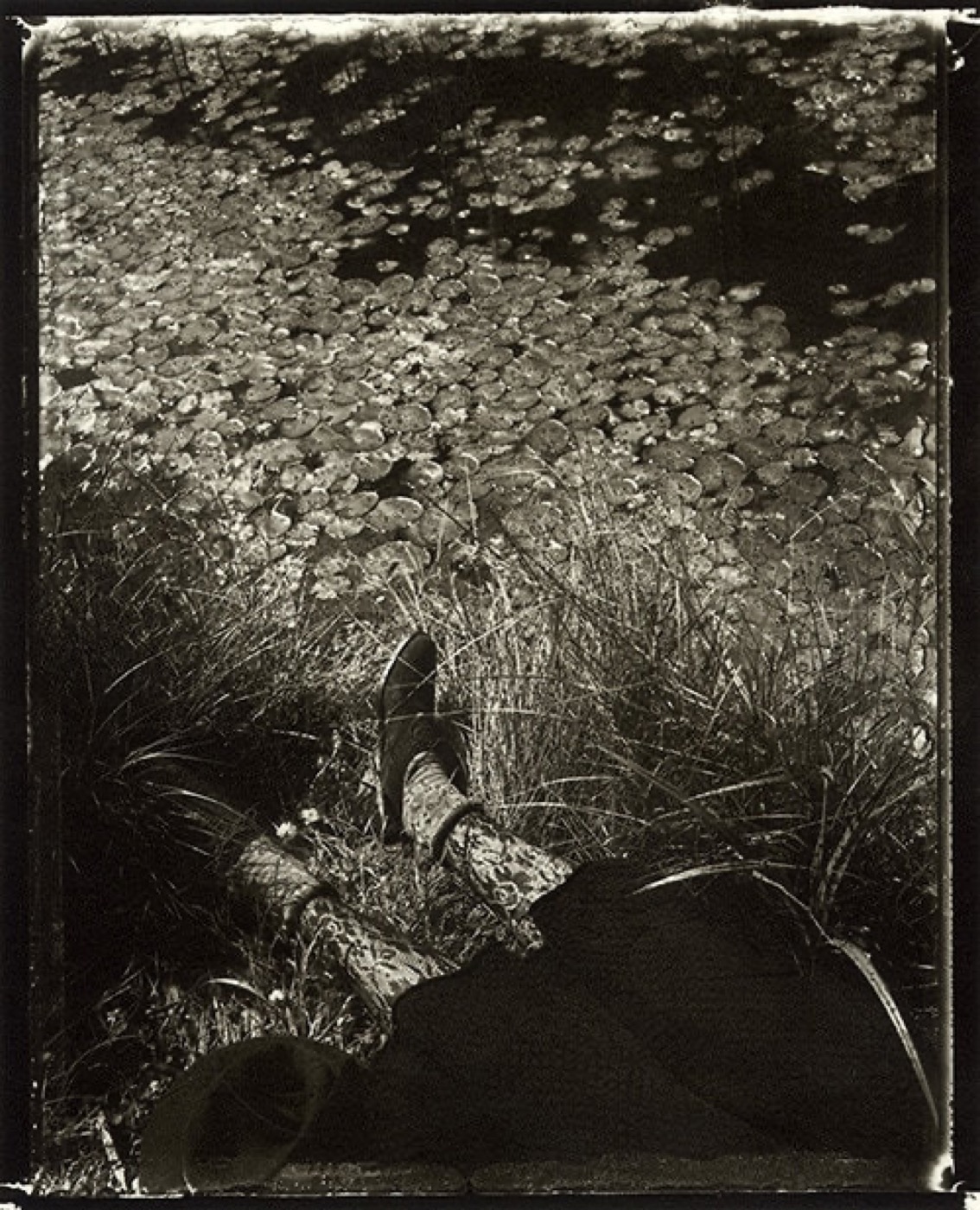
Sarah Moon French, b. 1941
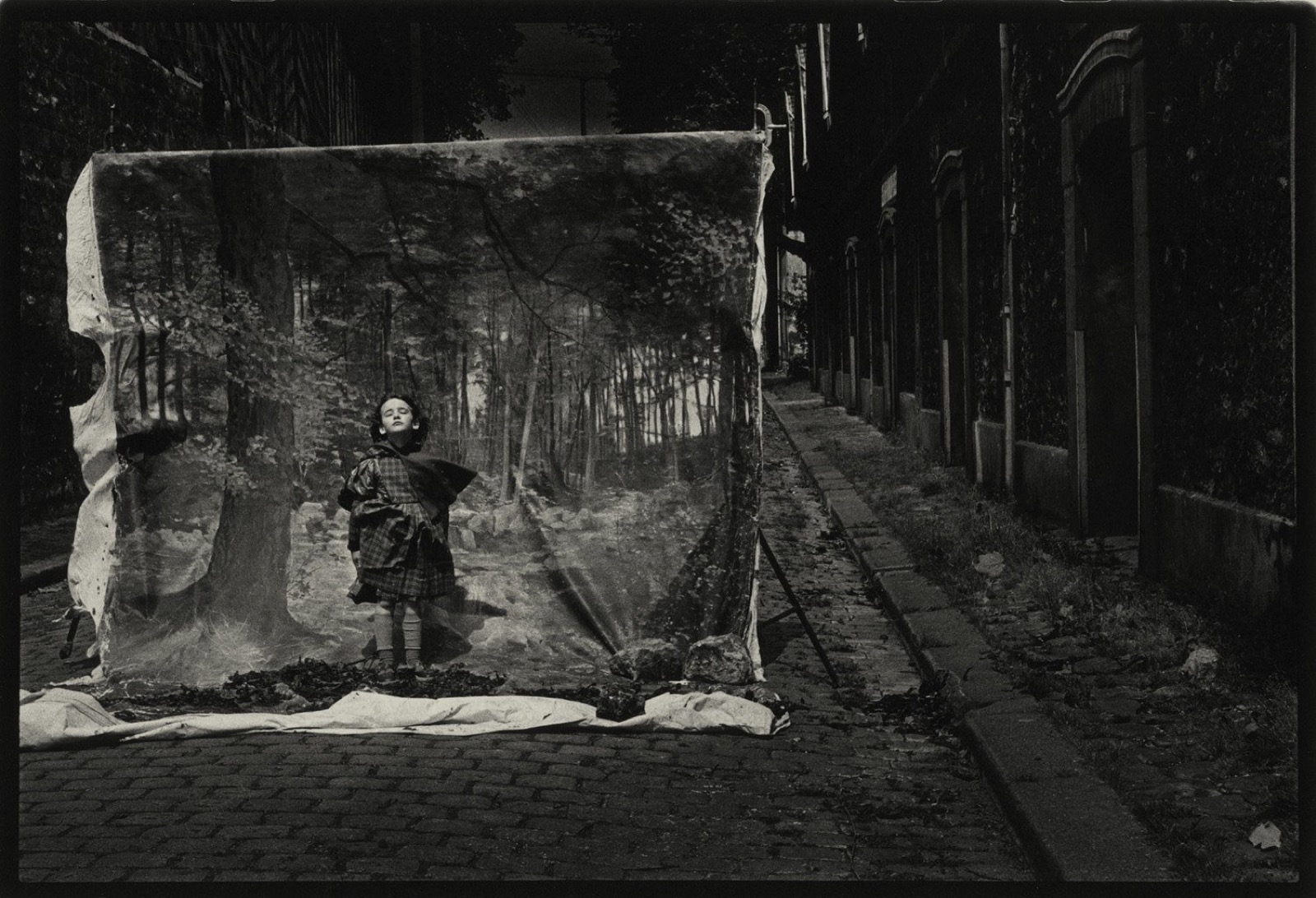
A painted backdrop of a forest has been hung from a pole across a cobbled alley, sagging and creased, its lower edge weighted with stones and lengths of white cloth. A small girl in a tartan coat stands in front of it with her eyes shut and her chin lifted. To the right the real street continues: a gutter, a strip of weeds, doorways in a dark facade. The illusion occupies the left half of the picture and stops dead at its own edge.
Everything I care about is in that edge. The backdrop is a lie about a wood, made of canvas and held up with rope, and the photograph does not hide the rope. Moon made this in 1985 and left the whole apparatus in the frame: the pole, the stones, the crease across the painted trunks. It is a fiction that has been openly assembled in the street, in front of the neighbours.
We are supposed to conclude that the picture is therefore honest. I would go further. The cobbles at the right are no more reliable than the canvas at the left; they are equally flat, equally grey, equally the product of a lens and a chemical. The difference is that one half admits to being a construction. A photograph that shows its own scaffolding does not become truthful. It becomes a photograph that has told us where to look for the next lie.