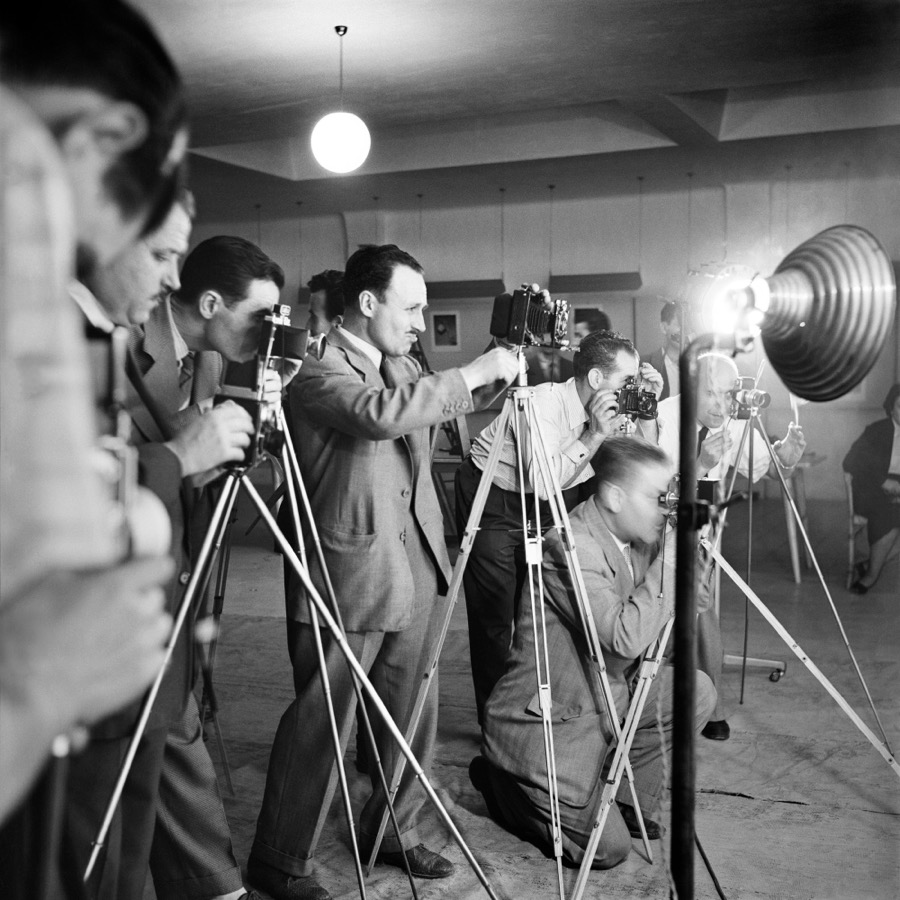
Ramón Masats Spanish, 17/03/1931–4/03/2024
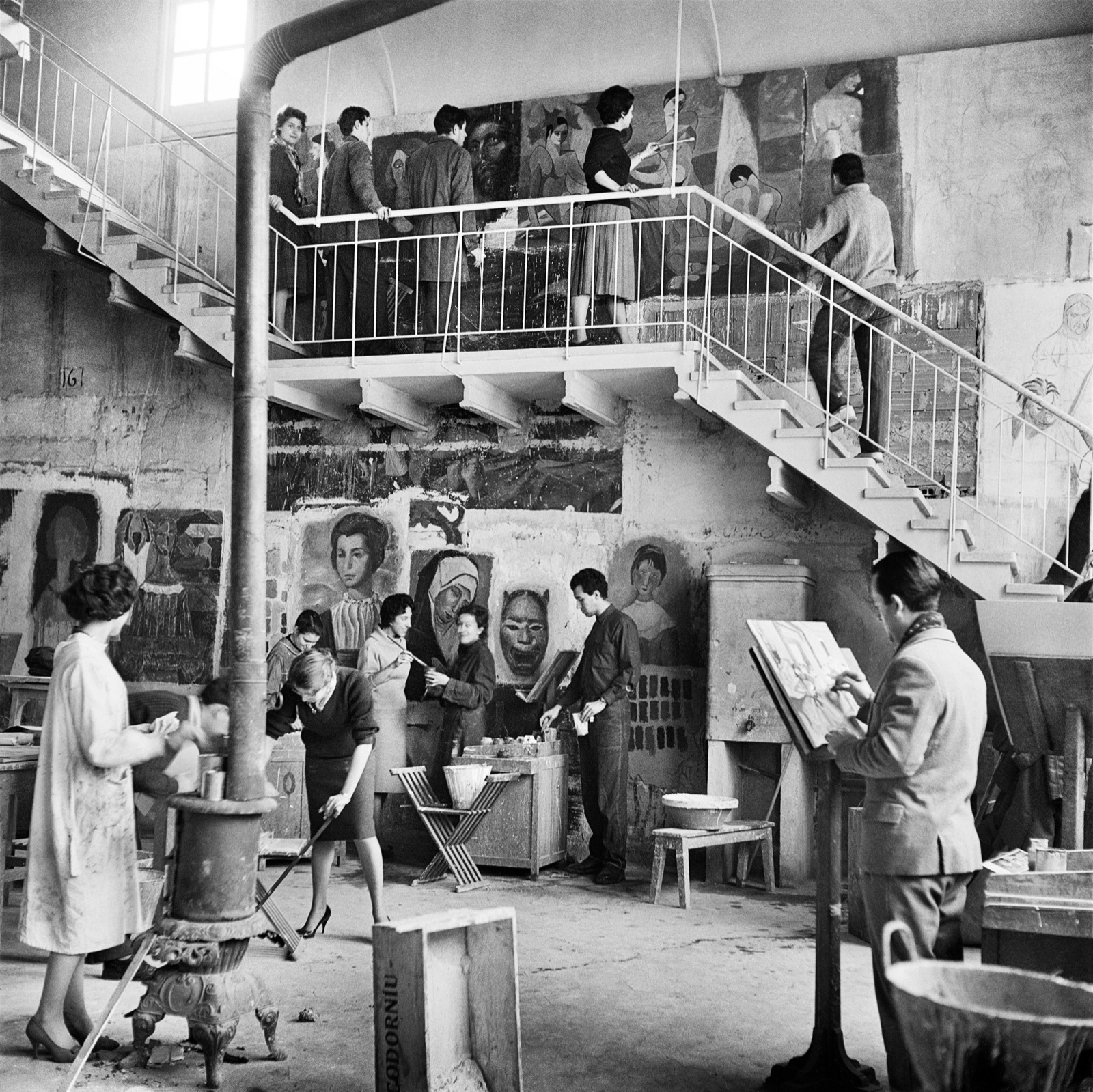
An art school in Terrassa in 1953, housed in a tall brick hall with a white iron staircase. The walls are a palimpsest of student murals: a nun in a veil, a screaming mask, a seated nude, a saint sketched in charcoal, portraits of women with the sober faces of the period. On the mezzanine, students lean on the rail while a woman in a pleated skirt paints. Below, a young man in a black shirt sorts paints, another works at an easel in jacket and scarf, a woman in a white smock stands by a cast-iron stove whose flue pipe climbs the whole height of the frame. In the foreground, a wooden crate stencilled CODORNIU.
This is a photograph made of pictures. Masats found a room where every surface was already an image, and rather than isolating one he let them crowd the frame, so that painted faces and living faces share the same wall and the same tonal range. The photograph does not compete with the murals; it absorbs them. Its square format and deep focus turn the whole hall into a single flat field, in which a student's back and a painted Madonna are equal citizens.
What interests me is the timing. In 1953 Spanish photography was still expected to be pictorial, to imitate painting. Masats walked into a painting school and did the opposite: he showed painting as something made by people in cold rooms, with brooms and stoves and crates of cava. The camera's realism became the argument.