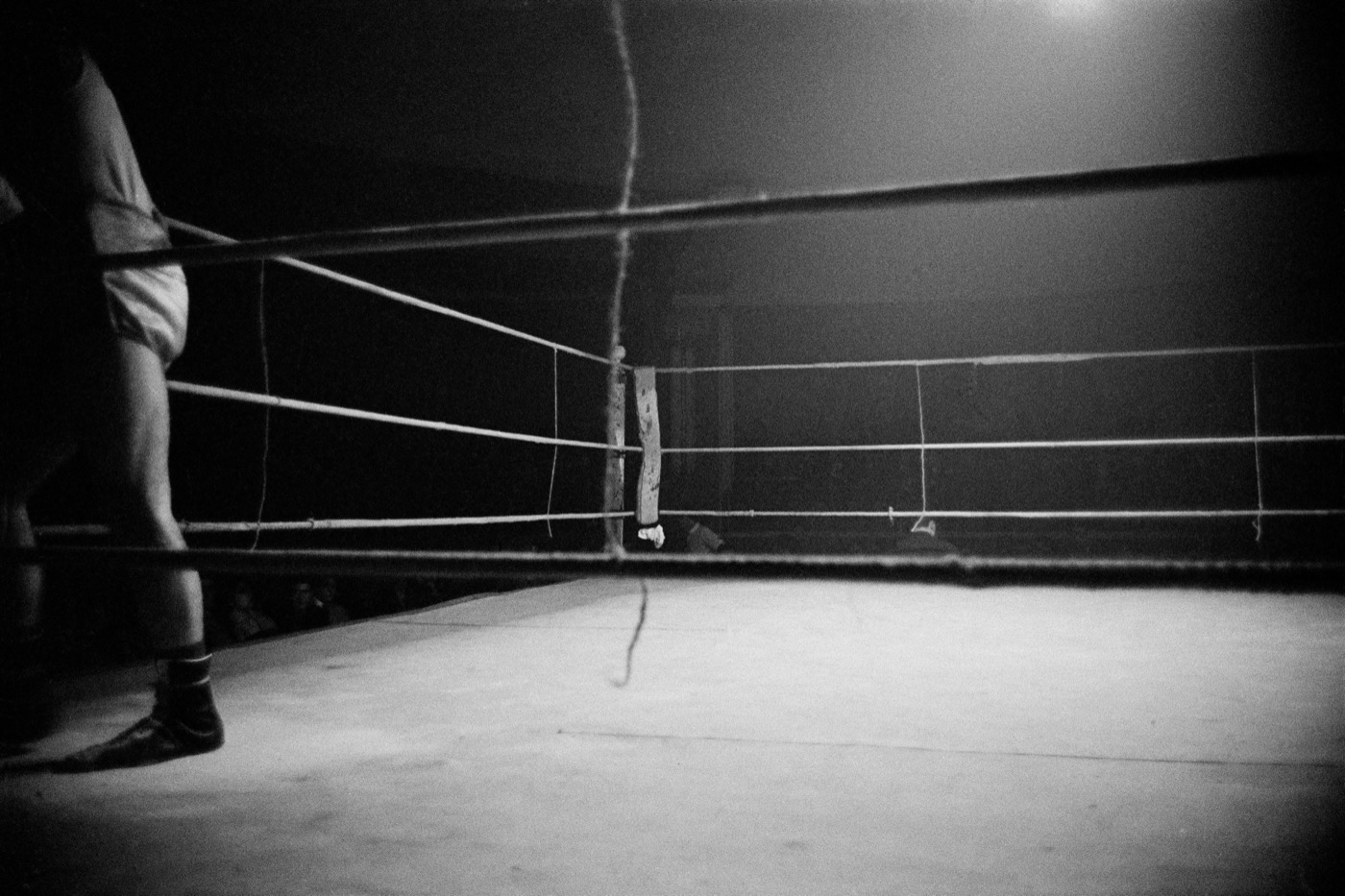
Ramón Masats Spanish, 17/03/1931–4/03/2024
Edition of 15
Edition of 5
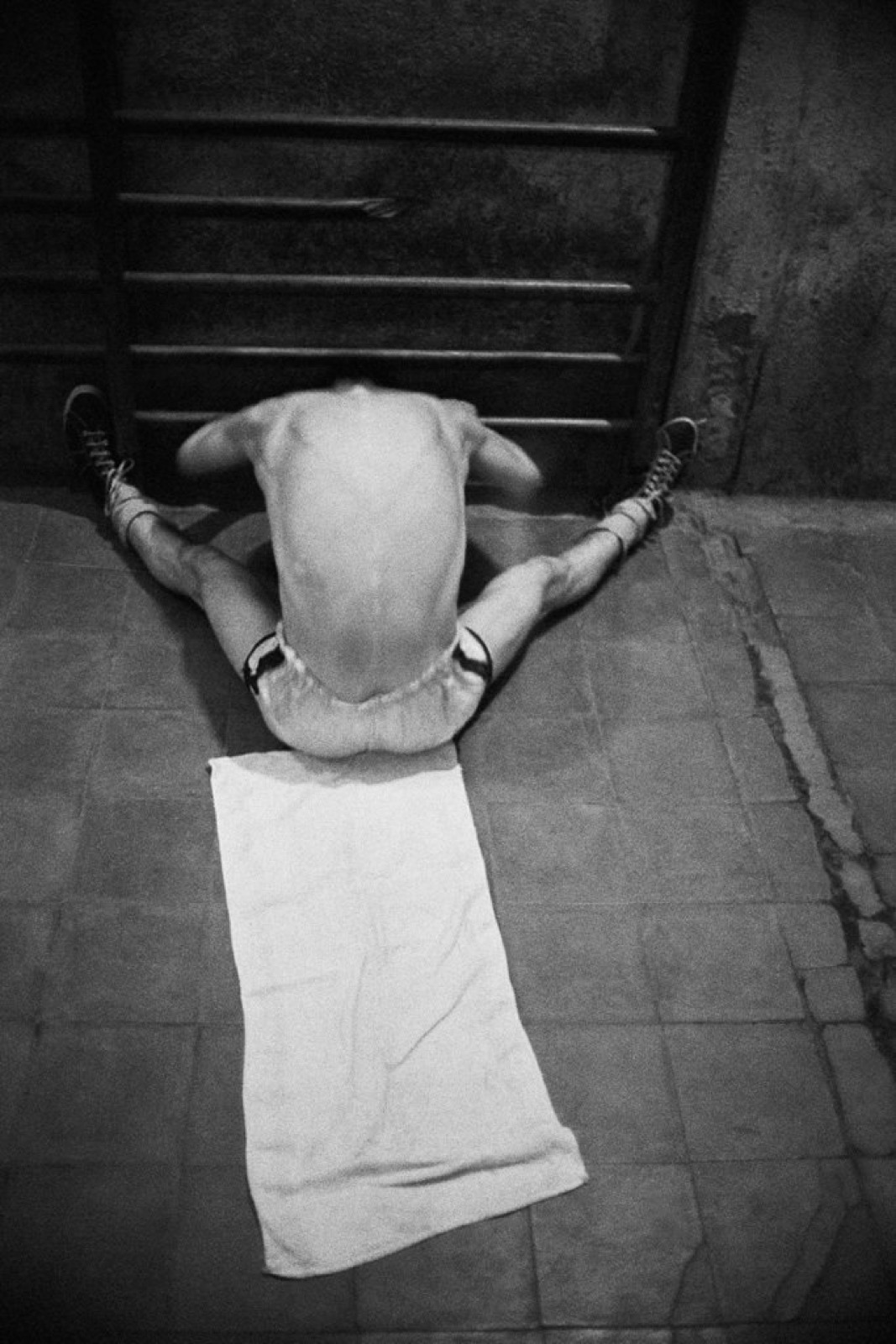
Discipline photographed always risks looking like devotion, and the bowed spine at the center of this frame proves the point. Seen from directly above, a boxer folds his bare torso toward the floor in a punishing split, feet hooked at the base of a wooden wall-bar, the back ridged with effort, a white towel laid before him like an offering. The body assumes the posture of prayer without meaning any; what the camera turns into iconography is only a man loosening his hips before he can be hit in the ring.
The overhead angle is what does the aestheticizing. From above, the tiled floor becomes a grid, the towel a bright axis, the arched back an anatomy lesson in shoulder blade and vertebra; the picture is undeniably beautiful in a way the exertion it records is not. Masats knows this and lets the seduction stand, trusting us to feel the ache beneath the design. To photograph training is to convert labor into form, and the honest picture admits the conversion rather than hiding it.
Neutral Corner belongs to the years when Masats and the AFAL circle taught Spanish photography to look plainly at ordinary bodies at work, a modernizing project that decades later brought him the Premio Nacional. This gelatin silver print, made later from the negative, gives the skin its full range of greys and keeps the cracked tiles and the towel’s creases legible under the low light, so the austerity is physical, not merely pictured. It is an image of preparation that carries all the gravity of an ending.