Ramón Masats Spanish, 17/03/1931–4/03/2024
Edition of 15
Edition of 5
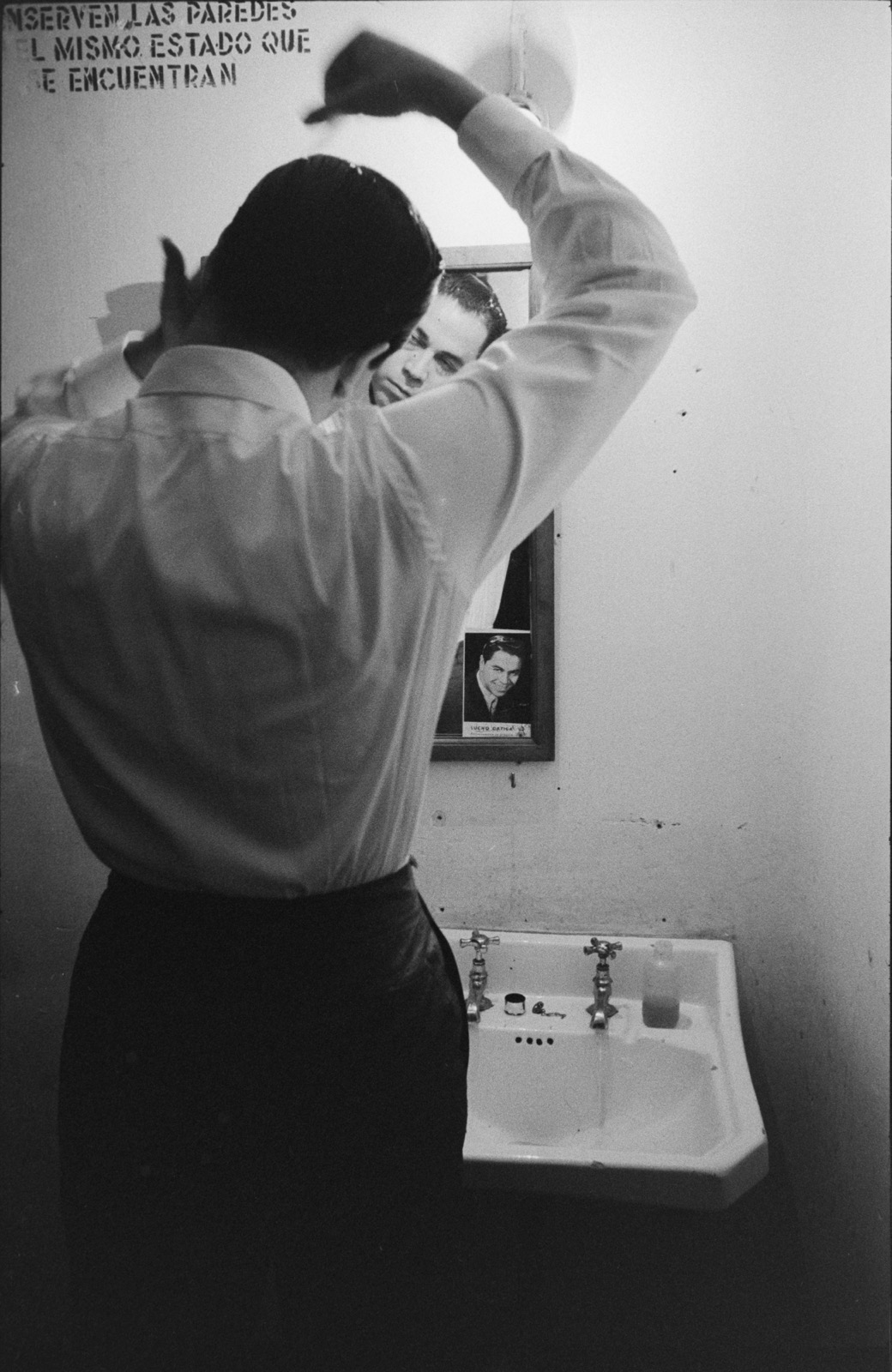
A man in a white shirt stands at a washbasin with both arms raised, working a comb through his hair. We see him from behind. His face arrives in the small mirror on the wall, lowered, entirely absorbed in the job. Tucked into the bottom of the mirror frame is a signed publicity photograph of the same man, smiling out at the room. Below him a porcelain sink with two cross-head taps, an open tin of pomade with its lid set beside it, a bottle. Stencilled across the top of the wall, an instruction: keep the walls in the condition in which you find them.
Two Lucho Gaticas, then. The one in the card is finished, lit, signed and ready to be handed to a stranger. The one at the sink has his elbows up and about ten minutes in which to become him. Every performer has this half hour and hardly anybody photographs it. Masats got into the room and kept quiet, and what he came away with is a man doing his own hair in a lavatory.
The wall gives the place away. Scuffs, nail holes, the accumulated marks of everyone who has stood at this basin before tonight, all of it directly under an order to leave no marks at all. Nobody has obeyed it and nobody is going to. In a few minutes the voice goes out onto a stage and the room gets handed on to the next man exactly as it was found, which is to say in a state. This is not a glamorous picture, and it is the one that tells you what the job actually involves.
