Ramón Masats Spanish, 17/03/1931–4/03/2024
Edition of 15
Edition of 5
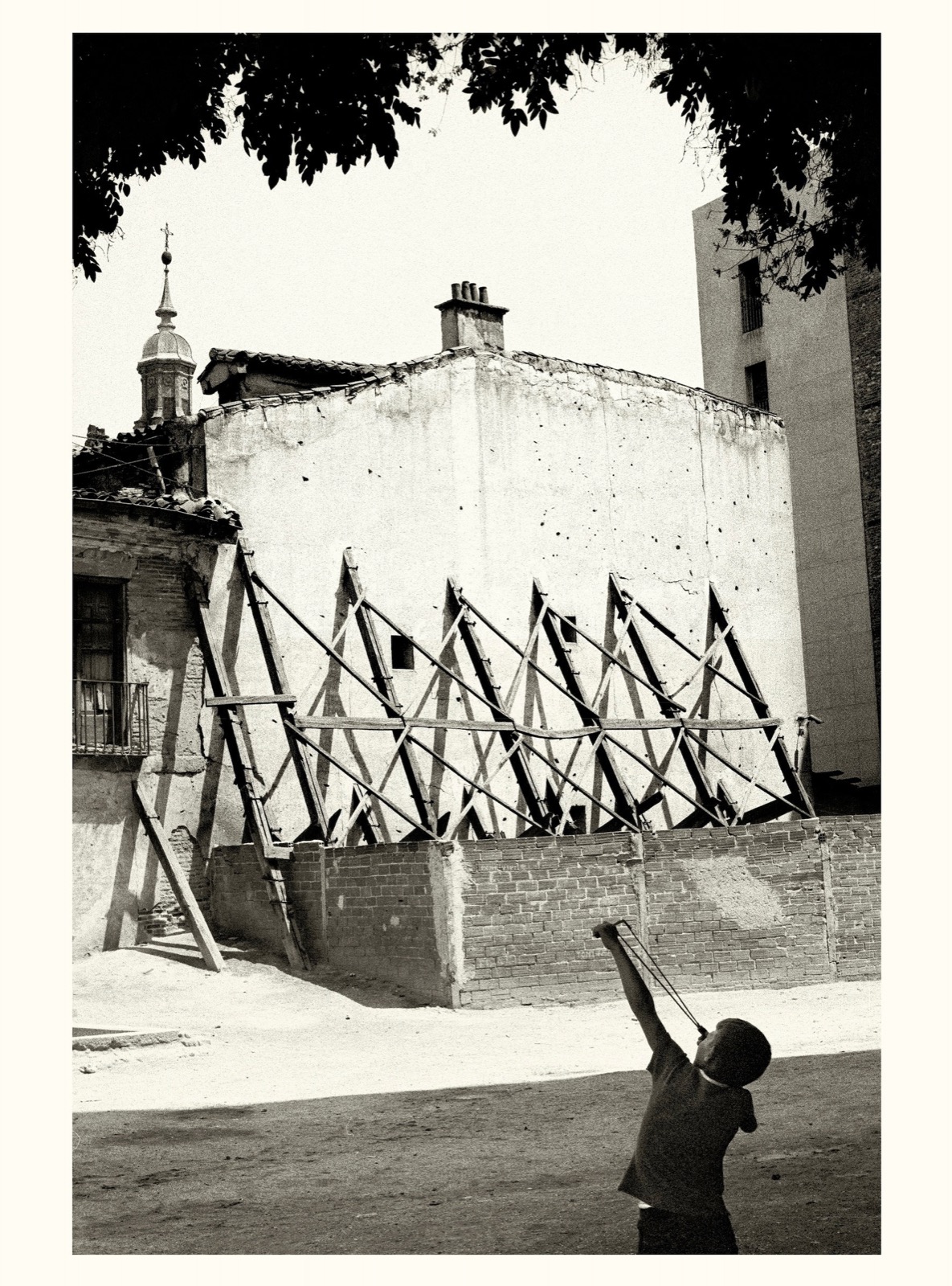
A boy stands in the shadow of a tree at the bottom right of the frame, arm raised, pulling back a slingshot at something above and out of sight. In front of him is a low brick wall, and behind it the blank side of an old house held up by a row of timber props, leaning struts and cross-braces that zigzag across the plaster like a drawing of teeth. A small domed lantern with a cross rises at the top left; a newer apartment block closes the right edge. Leaves hang across the top of the picture like a curtain.
The scene seems to explain itself. The wall is propped because it would fall; the house is old and the block is new; the boy is a boy, and boys aim at birds. But look at how neatly it all agrees. The timbers repeat the angle of his raised arm, his shadow joins the shadow of the tree, the dome answers the chimney. A picture this composed is already an interpretation, and the word documentary covers more than it admits.
Masats was working inside a country that liked its images of itself tidy, and this frame could pass for a small allegory: tradition shored up, modernity waiting at the side, a child aiming at the sky. I prefer to read it as an honest trick. The photographer does not claim the boy is hitting anything, and we never see the target. What he shows is the gesture and the structure around it, and he leaves us to invent the rest, which is exactly what every photograph asks of us.
