Ramón Masats Spanish, 17/03/1931–4/03/2024
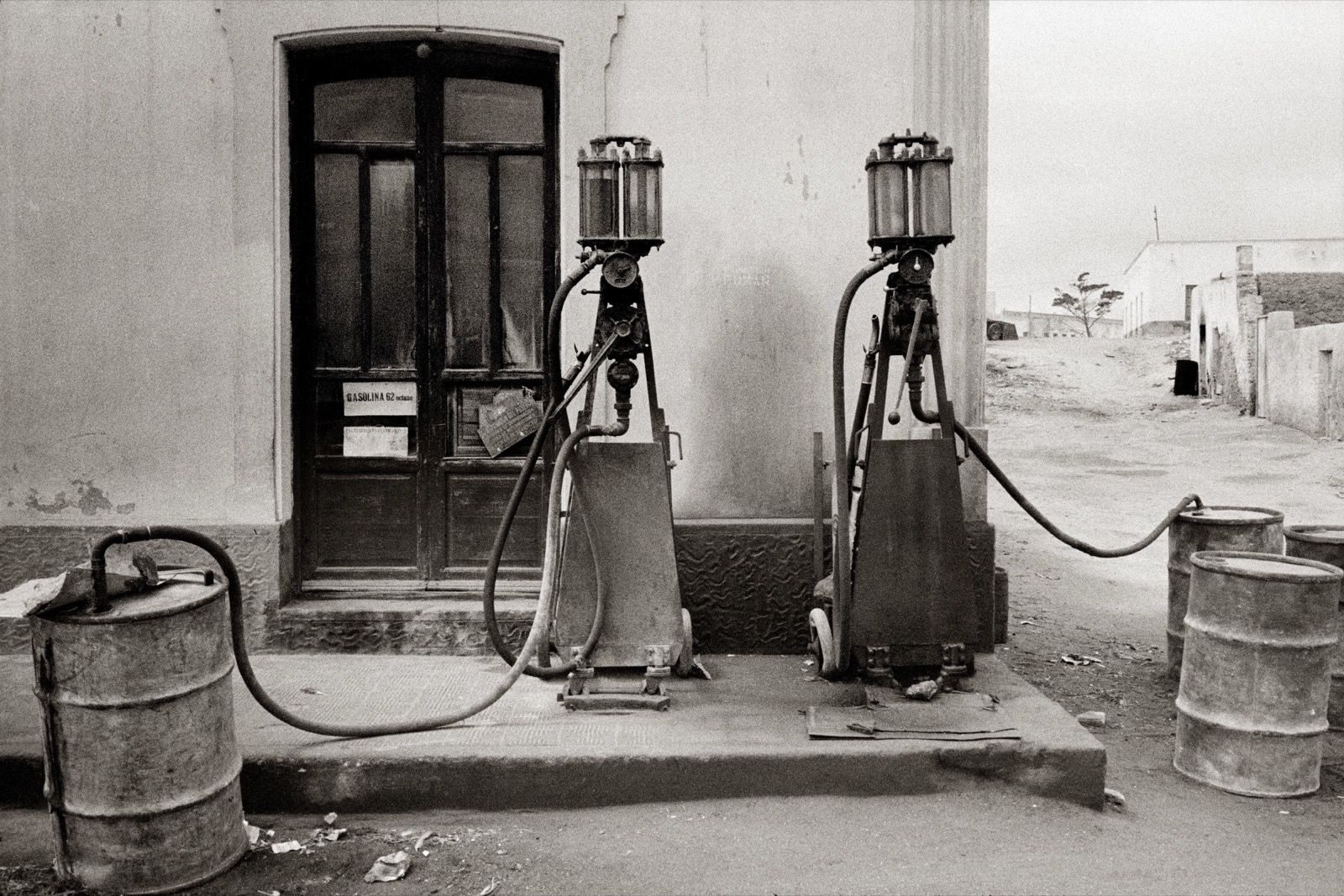
A few minutes before this exposure, someone fed the long hose into the drum at the left and walked away; nothing since has moved. The photograph holds a petrol station between arrivals: two hand-cranked pumps waiting on their concrete plinth, glass measuring cylinders raised like lamps, hoses looping to battered drums on either side. The tall glazed door behind them is shut, its panes dark. Whoever tends this place is elsewhere, and the machines keep their posts.
A paper notice on the door promises GASOLINA 62 octanos, a modest number that dates the scene as surely as any caption. The composition is frontal and exact, in the manner Walker Evans made honorable: whitewashed wall streaked with damp, the dark door dividing the frame, one pump to each side like figures in a double portrait. To the right the village slips away down a dirt street, low white buildings and a single wind-bent tree under a blank sky. The tonal scale runs from chalk to tar, with the pumps’ worn metal carrying the middle greys.
Masats came this way in 1961, one of the AFAL generation then renewing Spanish photography; the eye he trained on the eloquent ordinary would earn him the Premio Nacional de Fotografía in 2004. This gelatin silver print keeps the scene’s dry light and documentary tact, every gauge, rivet and looping hose legible. Evans’s pumps spoke of a roadside continent filling its tank; these two, with their sixty-two octanes, tell a leaner story, and tell it standing absolutely still.
