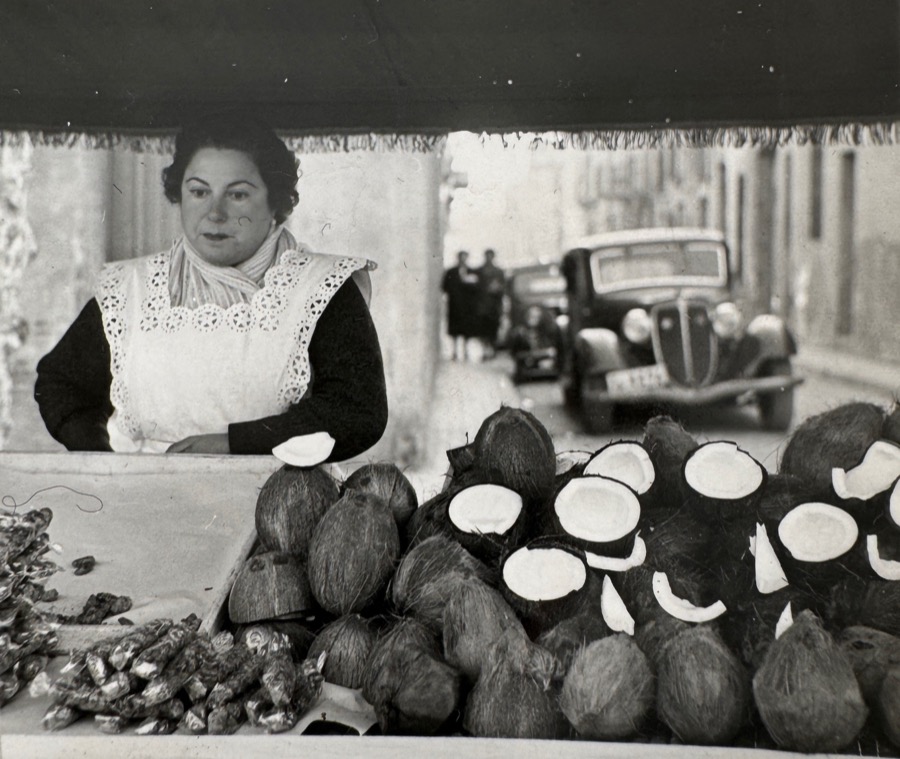
Ramón Masats Spanish, 17/03/1931–4/03/2024
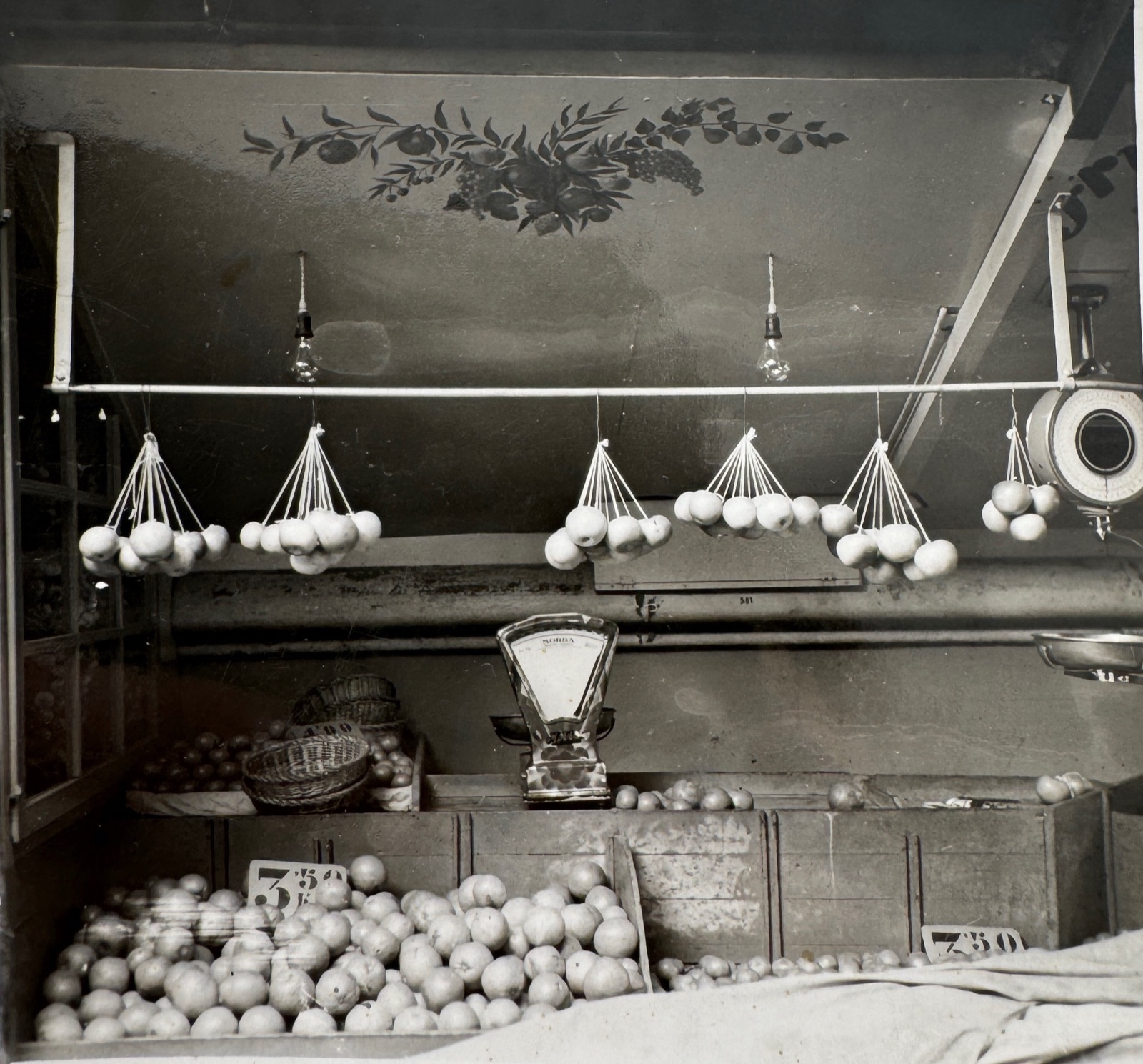
A greengrocer's stall in Barcelona, 1953, shot square and head-on like a shop window because that is what it is. Oranges hang from a wire in string nets, six bunches strung up like chandeliers, and two bare bulbs dangle between them on their cords. A shop scale sits on the counter, a second scale hangs at the right edge, and the fruit below is heaped in wooden bins with hand-cut price cards reading 3.50. Above it all, someone has painted a garland of fruit and leaves on the ceiling, a little flourish of ambition in a room that is otherwise all commerce.
What I love here is the symmetry of the stringing, the way the shopkeeper has turned inventory into display without ever having heard the word. The oranges in their nets are arranged by someone with an eye, and Masats has answered that eye with his own, centring the scale, letting the price cards sit where they fall, allowing the painted garland its place of honour. It is a picture about the ordinary theatre of selling, and about how a poor country in a hard decade still wanted its shopfronts to look like something.
The print is tiny, a nine-centimetre square, a contact from a medium-format negative, and that intimacy is part of the point. This is not a picture made for a wall; it was made to be held, checked, perhaps filed. That it has survived as a vintage print, made by Masats himself, gives it the weight of a first draft: the moment before the photographer knew which of his pictures would matter, when a shop full of oranges was reason enough.