Louis Faurer American, 1916–2001
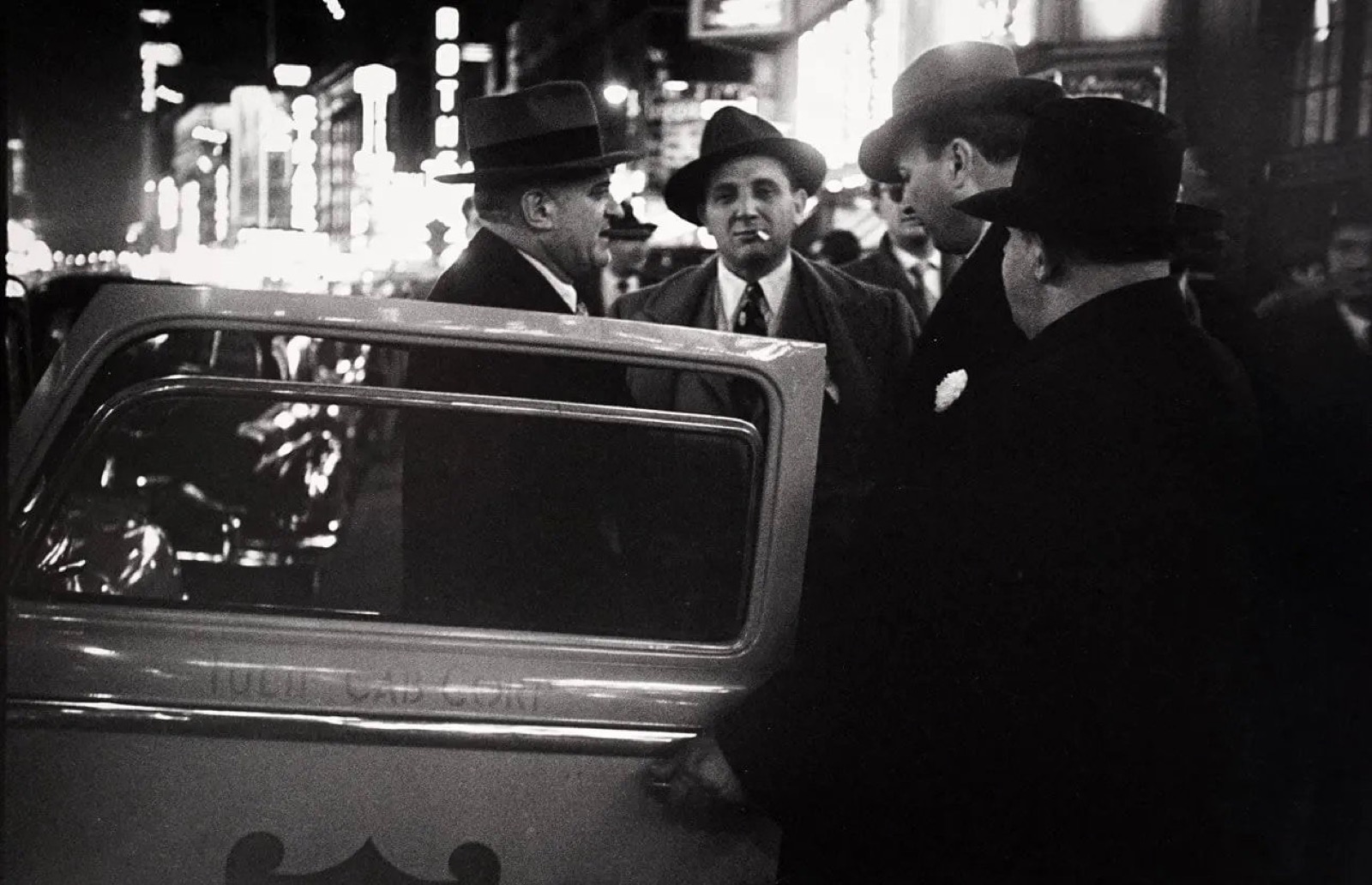
Four men in overcoats and felt hats stand around the open rear door of a taxi at night. The door swings wide into the lower left of the frame with the cab company's name half legible along it. One man, at the left, is in profile with his mouth open, mid-sentence. Facing him, a man in a dark fedora listens with a cigarette burning at his lip. The other two have their backs and their hat brims to us. Behind all of them the neon of the street has run into long soft streaks of light.
You can tell who is talking and you can tell who is being talked to, and the two with their backs turned are there to close the circle so that nobody else can join it. It is a shape men make on pavements at one in the morning outside somewhere they have just left or are about to leave. Nobody is going anywhere yet. The cab is waiting with its door open and has been for a while.
In the middle of all that dark wool there is a white carnation in a lapel. Somebody dressed up tonight. It is the one bright soft thing in a photograph otherwise made of hats, glass and neon, and it says that whatever this conversation is, it is happening at the end of an occasion rather than the beginning of one. Faurer worked these streets for years and this is what he was after: not the lights, which anyone can photograph, but four men and a flower and an idling engine.