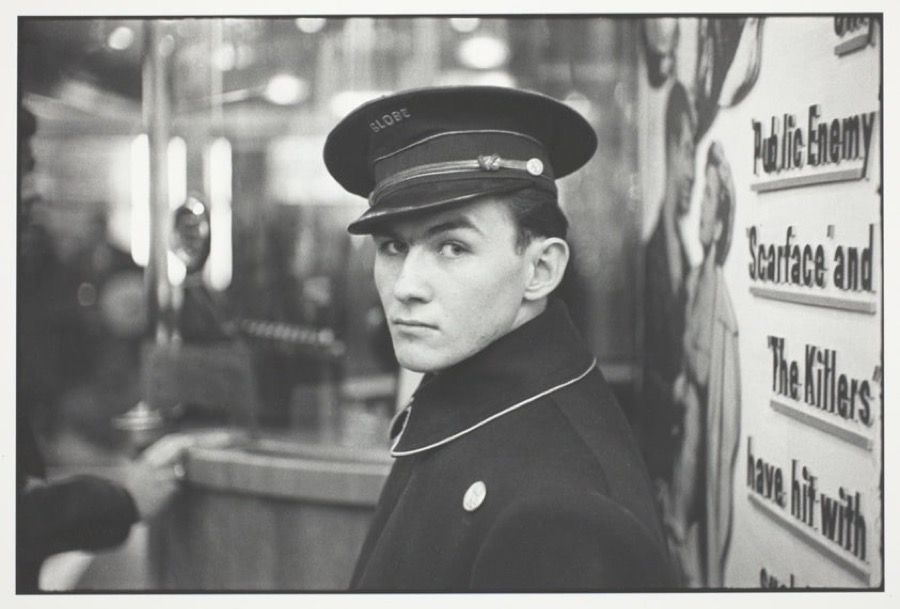
Louis Faurer American, 1916–2001
Tonelli and Gossage, Louis Faurer: Photographs from Philadelphia and New York, 1937-1973 (Art Gallery, University of Maryland, 1981), pl. 40
Tucker, Louis Faurer, p. 133
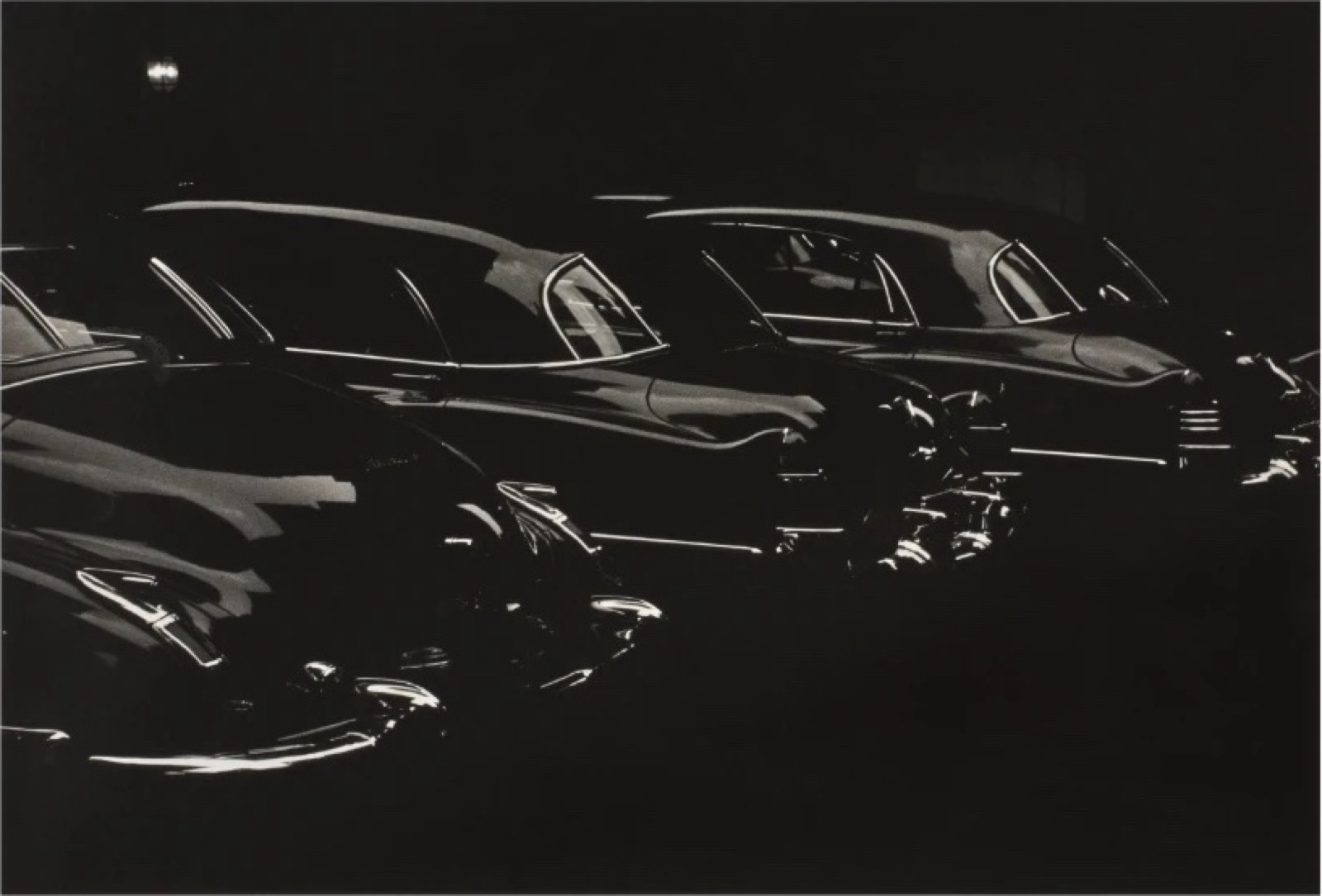
A row of parked sedans stands in near-total darkness. Almost nothing of them is described: the line of a roof, the chrome frame of a window, a strip of side trim, a cluster of stacked chrome bars, a script nameplate catching a little light. A single light burns at the upper left. The lower half of the picture is black, and the nearest car, cut by the left edge, exists only as pale reflections that slide across its flank like shapes on dark water.
The title puts us in a garage on Park Avenue in 1950. The photograph confirms almost none of it. With the shadows left to go black, the cars lose their weight and become drawings in light, lines that the eye completes into doors and fenders because it already knows what a car is. Take that knowledge away and what remains is a choreography of glints, closer to a cinema screen at night than to a record of property.
Here lie the photographer's freedom and the viewer's credulity. The camera registers whatever is in front of it; the photographer decides how much of it will be allowed to appear. Faurer hands us a document made mostly of omission, and we accept it as a garage because a caption says so. What he trusts is not the scene but the light that falls on it: the city's automobiles reduced to the only parts of them that answer back.