Joel Meyerowitz American, b. 6/3/1938
Edition of 20
Edition of 10
Edition of 5
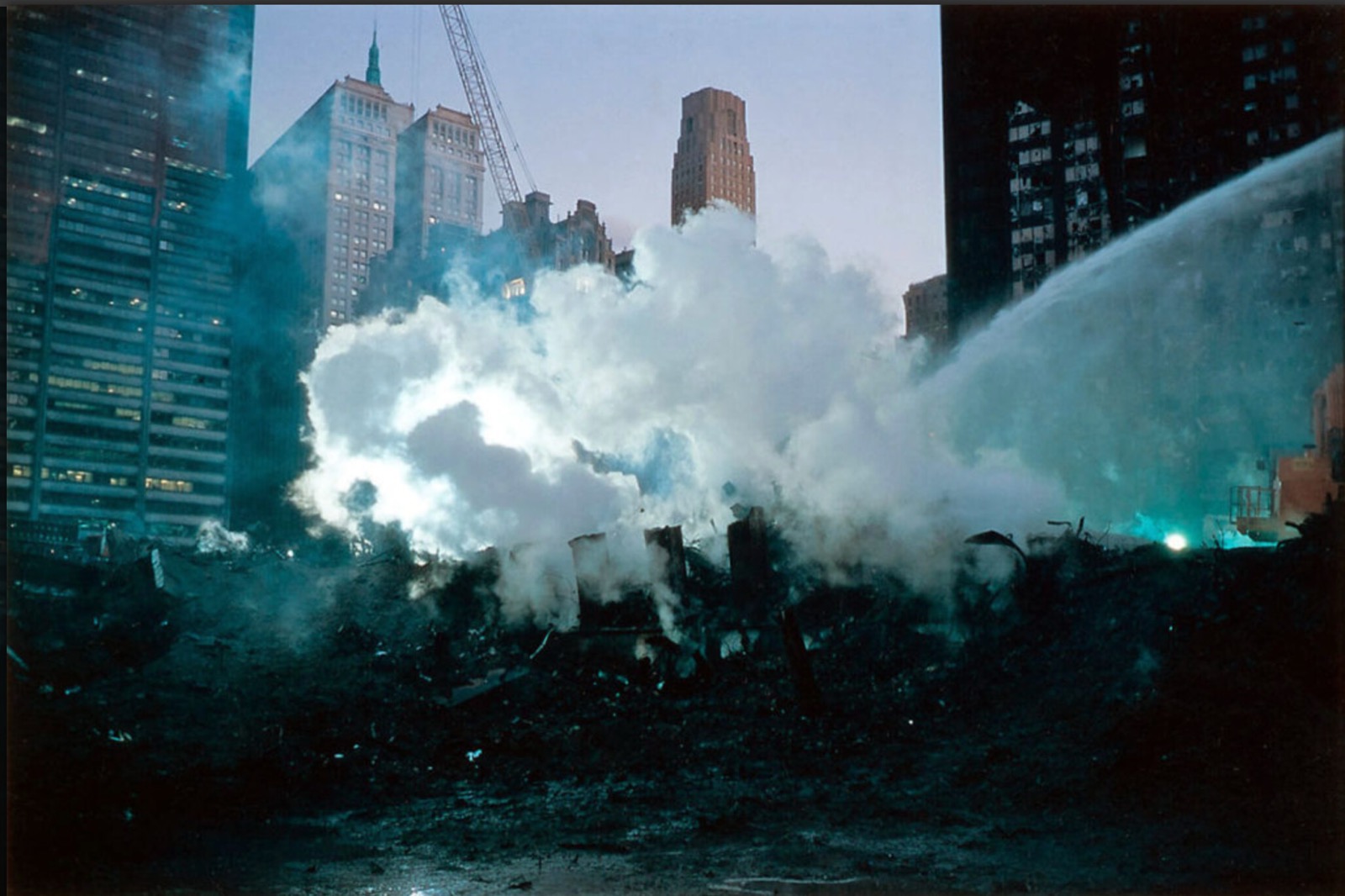
Dusk settles over lower Manhattan, and what should be a skyline reads instead as a wound: a mound of blackened debris fills the foreground, its silhouette jagged and low, while behind it a cloud of illuminated steam billows upward, caught mid-motion by a long exposure. To the right, a firefighting cannon arcs a stream of water clear across the frame, its spray glowing faintly turquoise under work lights. Farther back, the city continues as if nothing had happened, office towers lit floor by floor, a crane still standing, an ornate prewar spire holding its place against the darkening sky.
I recognize the studium at once: a photojournalist's fact, the reconstruction site at Ground Zero recorded by the one photographer granted sustained access after the towers fell. But it is the water's arc that supplies the punctum, that small violent detail that will not let the eye rest, a gesture of ordinary firefighting, banal in any other context, transformed here into something closer to a benediction cast over the ruins, lit for no one's benefit but the camera's.
What troubles me most is the picture's beauty, its blues and its glow, achieved without any intention to console. The smoke could be mistaken for atmosphere in a nocturne, the debris for abstraction, and yet I know what I am looking at, and that knowledge refuses to let the image resolve into mere composition. This is what photography does that memory cannot: it holds the eye at the site of loss and will not release it, long after the fires themselves went out.