Joel Meyerowitz American, b. 6/3/1938
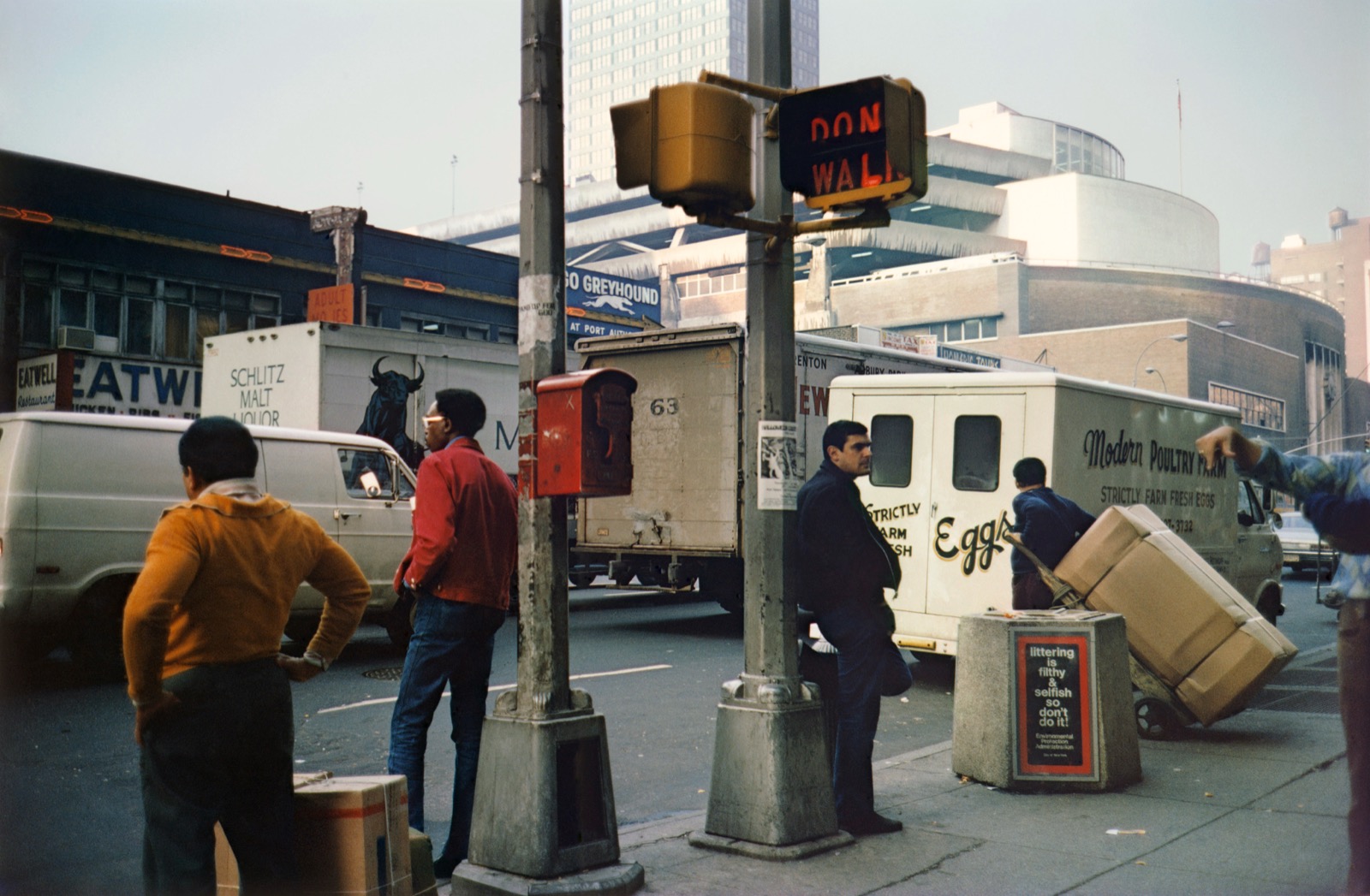
A corner in New York, crowded to the edges. Two posts divide the frame: one carries a red fire-alarm box and a torn sticker, the other a signal glowing DON'T WALK in red, some of its letters dark. A man in a mustard sweater stands with his back to us, one hand on his hip, a carton at his feet; a man in a red jacket and tinted glasses waits at the kerb. Behind them a man leans into a hand truck loaded with cartons, and from the right edge an arm in a patterned sleeve reaches in, pointing. The street is solid with lettering: a Schlitz Malt Liquor truck with its black bull, a van for Modern Poultry Farm, Strictly Farm Fresh Eggs, a sign for Adult Movies, Go Greyhound at Port Authority and, on a concrete block, a city notice: littering is filthy & selfish so don't do it!
It is a city speaking in imperatives. Don't walk, don't litter, go Greyhound; of the sticker on the post only AND UP FOR GOD survives. Nobody seems to be taking orders from any of it. They stand, with boxes at their feet and a hand truck in motion, under the red signal.
This is New York in 1975, the year the city came close to bankruptcy, and a year before Hilton Kramer, in The New York Times, called William Eggleston's colour pictures at the Museum of Modern Art "perfectly banal, perhaps". Meyerowitz was already out on corners like this with colour film. The red of the alarm box and the jacket, the mustard of the sweater, the orange of the Adult Movies sign, the grimy cream of the trucks: this is the palette of a tired, working, unglamorous city, and colour lets it speak. In black and white it would have been a document. In colour it is a mood, and the mood is the mid-seventies: cheap, loud, commercial and very much alive.
