Joel Meyerowitz American, b. 6/3/1938
Edition of 20
Edition of 10
Edition of 5
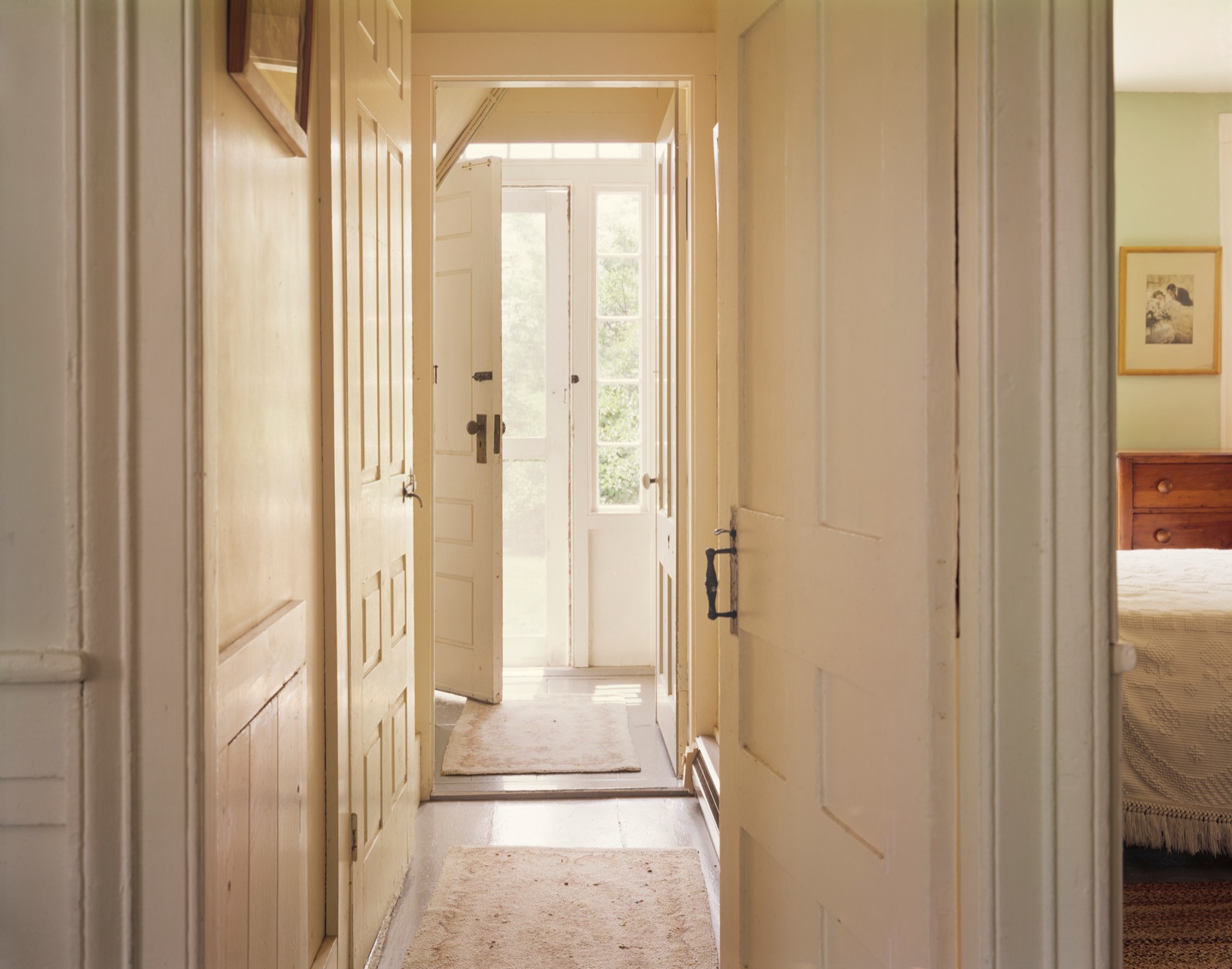
From a narrow hallway we look through a sequence of open doors. Doors and walls are painted cream; the nearest door, at the right, has a black iron thumb latch; a mirror in a wooden frame tilts out from the wall at the top left; worn rugs lie on painted floorboards. At the end, past an inner door standing open, a glazed door and a tall window of small panes give onto leaves washed nearly white by the light. Through a doorway at the right we glimpse a bedroom with pale green walls: a wooden chest of drawers with round knobs, a bed under a white fringed spread and, on the wall, in a light wooden frame, a small sepia picture of a couple, flowers massed in front of the woman, the man leaning his head towards her.
The house is shown as a set of thresholds, and the eye is pulled down the hall to the brightest place, where the inside gives way to the garden. Nothing looks arranged for us. The latch, the rugs, the tilted mirror and the picture on the bedroom wall are simply there, worn by use, the way things are in a house that has been lived in.
I keep returning to that little sepia picture. At this distance I cannot tell whether it is a photograph or a printed reproduction, a family wedding or a sentimental image bought for its frame, and it hardly matters. It belongs to the vast class of pictures that people hang in bedrooms, less to be looked at than to be lived with, and that the history of photography has largely ignored. Meyerowitz's own picture is of another kind, but it pauses to take in one of those humble images in its natural habitat, above a chest of drawers. Art photography usually passes such pictures by; this one lets the vernacular keep its place on the wall.