Joel Meyerowitz American, b. 6/3/1938
76 x 101 cm / 30 x 40 in
121 x 152 cm / 48 x 60 in
Umbrella edition of 25
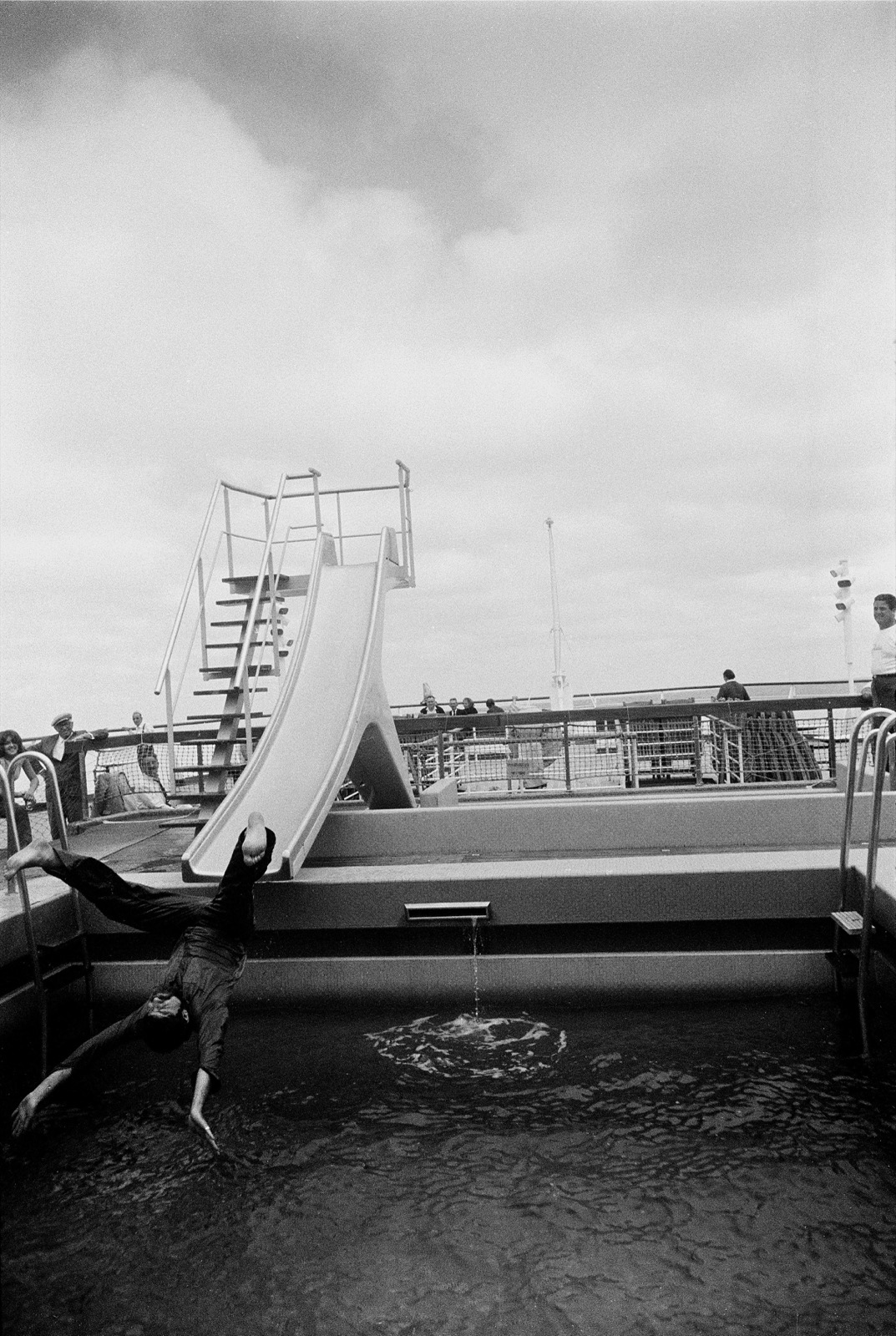
A man in a dark shirt and trousers, barefoot, falls sideways into a ship's swimming pool, one leg thrown straight up, the other stretched back towards the edge he has just left, his arms spread and a hand already reaching into the water. His wet clothes cling to him. Behind him a white slide sweeps down towards the pool, its ladder climbing into a sky of heavy cloud that fills nearly half the frame. A thin stream of water falls from an outlet in the wall and churns a pale ring on the dark surface. At the edges the audience is sparse: a young woman and an old man in a cap at the left, a man stretched out behind the netting, a smiling young man in a white shirt at the far right, a few passengers along an upper rail.
The picture is built on diagonals. The body cuts across the frame from the upper left to the water, the slide answers it in the opposite direction, and the two meet at the man's raised foot, which sits exactly against the curve of the chute. The dark water at the bottom and the white sky at the top hold the action between them like the pages of a book.
Photography has long been drawn to the body in the air, from Henri Cartier-Bresson's man leaping a puddle behind the Gare Saint-Lazare in 1932 to countless divers and dancers since. Meyerowitz takes the figure out of the heroic register and sends it into the water fully dressed. The leap here is not graceful; it is clumsy, sociable, and a little absurd, and the camera honours it with the same precision it would give to a champion. What interests him is where form turns up, and he is willing to find it in the least dignified instant of a sea crossing.
