Joel Meyerowitz American, b. 6/3/1938
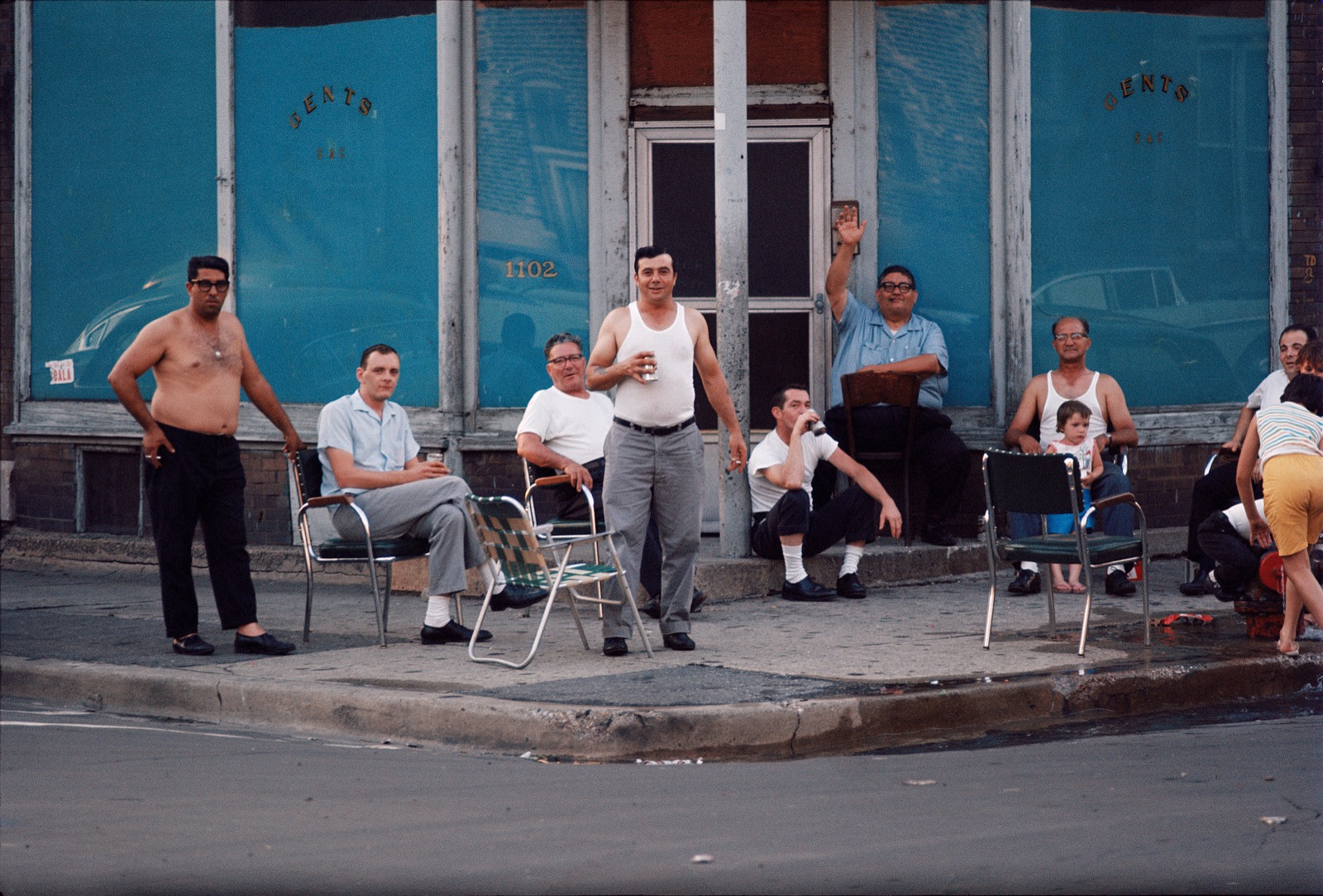
A corner storefront in Chicago has been turned into a front porch. Its tall windows are backed with turquoise, the word GENTS arched across two of them in gold, the number 1102 on a third, and the glass holds faint reflections of cars parked across the street. On the pavement the men have brought out their chairs: aluminium kitchen chairs with green seats, a webbed folding lawn chair, a wooden chair one of them leans on like a lectern. Undershirts, slacks, white socks, black shoes. At the right edge a girl in yellow shorts bends over a fire hydrant, and water darkens the kerb.
Each man has decided, in the second before the shutter, how much of himself to give. The one without a shirt keeps a hand on a chair back and his face closed. The young man in the pale blue shirt crosses his legs and waits. The man in the vest at the centre smiles with a can in his hand; behind him a heavy man in glasses raises his whole arm and waves, as if the camera were a neighbour coming home. A small child stands between a bald man's knees and studies the stranger with complete seriousness. In the foreground one chair is empty, its back to us, as though someone had just stood up to see who was coming.
What the picture records is belonging, and the way men perform it for an outsider. The windows say GENTS, and the gentlemen are all here, soft bellies and a tattoo or two, showing an ease that is also a claim: this corner is ours, and you may look because we allow it. I am moved less by the wave than by the shirtless man's reserve, and by the child, who has not yet learned which face to wear. Meyerowitz stands far enough back to take them all in, and close enough to be looked at in return.
