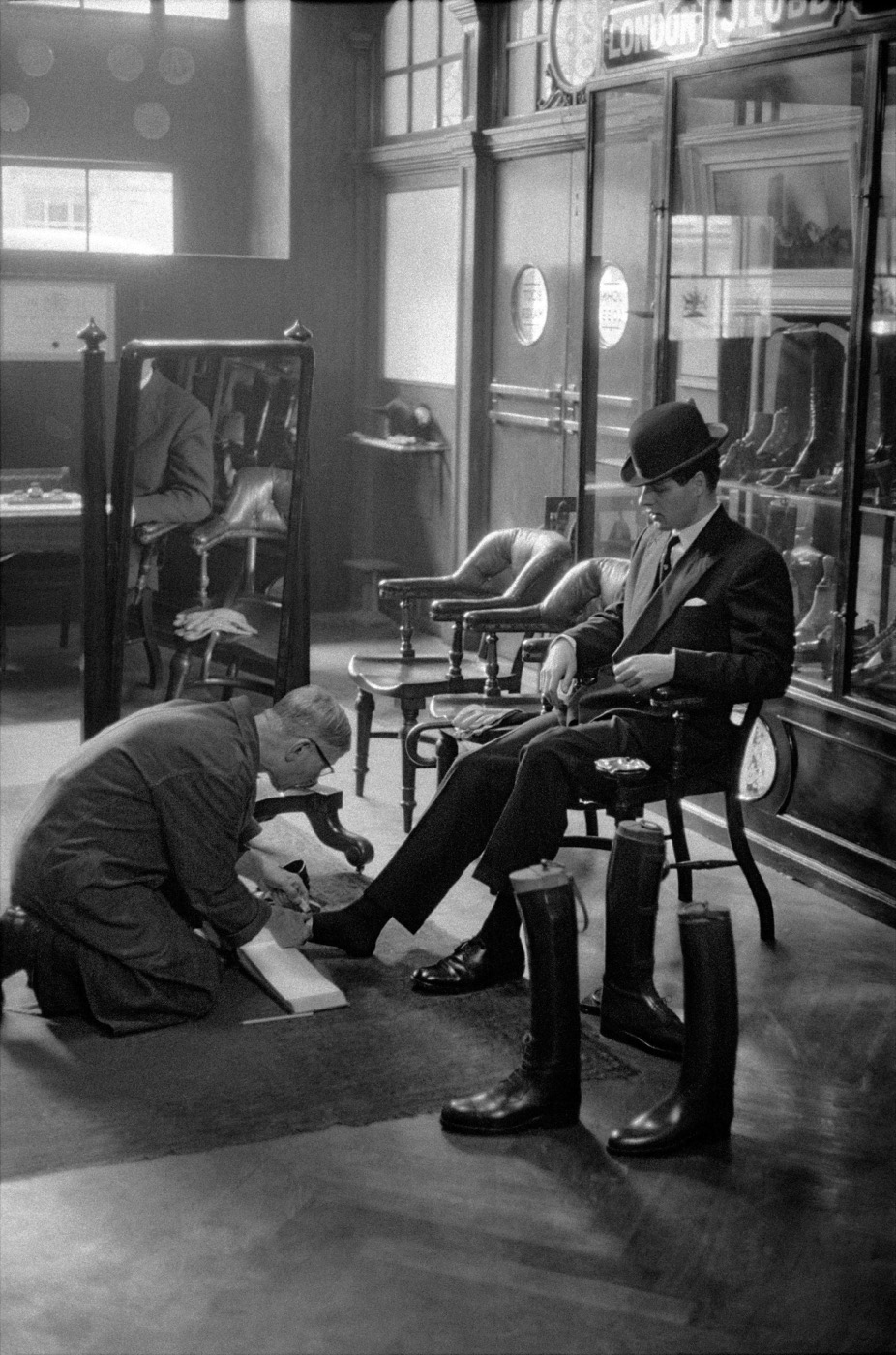
Frank Horvat Italian, 28/04/1928–21/10/2020
Edition of 30
Edition of 12
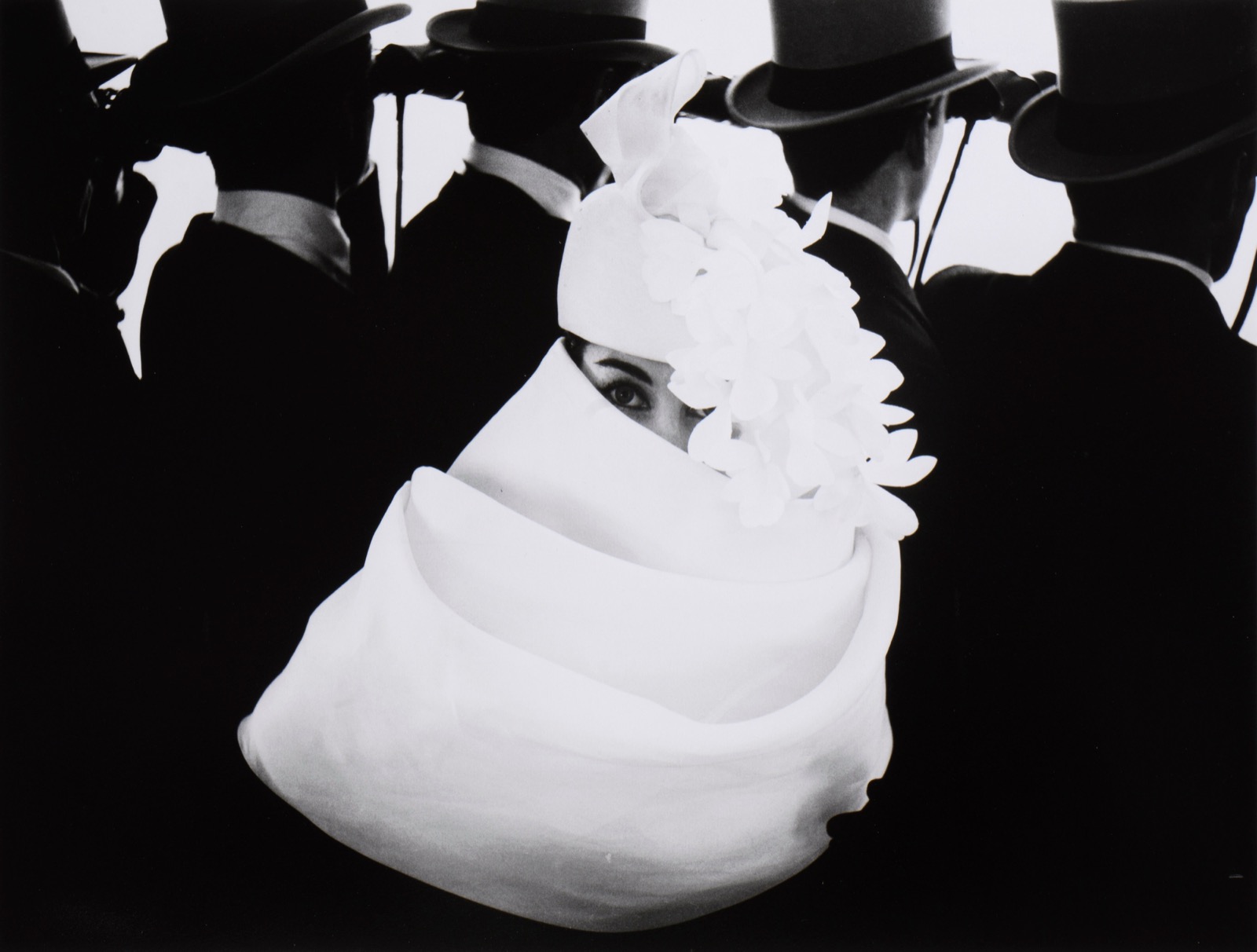
A field of black: the backs of men in morning coats and top hats, a phalanx seen from behind against a burned-out white sky, the brim of each hat a hard ellipse. In front of them, filling the lower half of the frame, a Givenchy hat in white organza, wrapped and swagged like a turban and topped with a cascade of white orchids. Out of the fold, just above the veil, one dark eye and its brow look straight back at us. Nothing else of the woman is visible.
Horvat had come to fashion from reportage, and he was candid that the idea for this one was not his: the magazine's art director sketched it beforehand. What Horvat brought was the reporter's way of executing it, out of the studio and into the crowd at the Longchamp races, where the racegoers' hats become a black chorus for the white one. The composition is a single reversal, dark mass above, light mass below, and a single point of contact, the eye, which does the work a whole face usually does. The orchids are almost too much, and that is the point; Givenchy's clients did not buy restraint.
This is 1958, made for Jardin des Modes at a moment when the fashion picture was loosening its grip on the studio. The print is gelatin silver, later, and the blacks are as deep as the negative allows, which is why the hat seems lit from within. It is a fashion photograph that behaves like a still from a film we have not seen, and it is the eye, not the hat, that we remember.