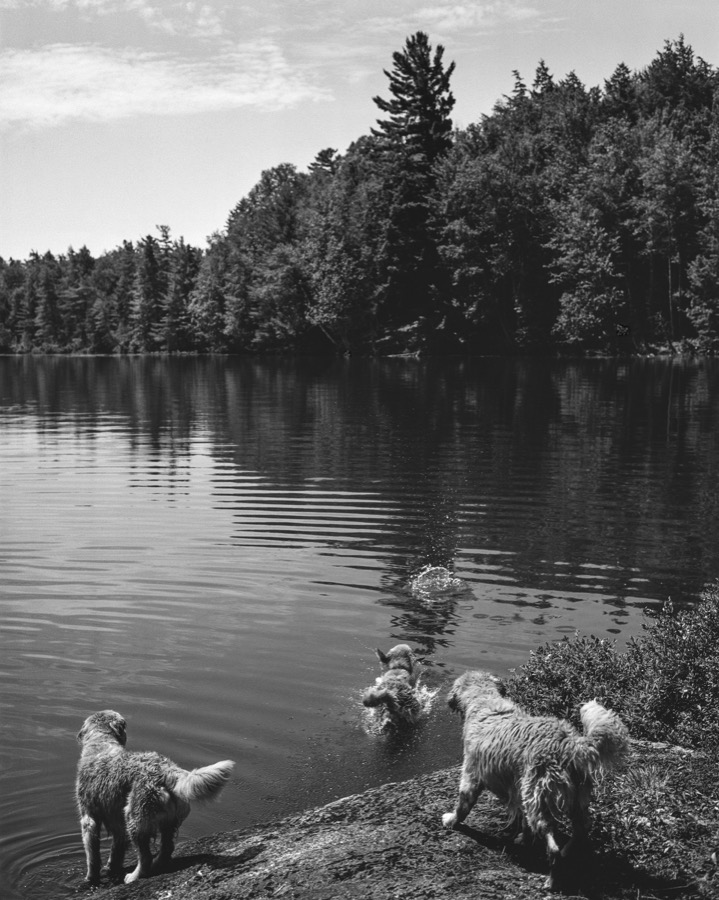
Bruce Weber American, b. 29/3/1946
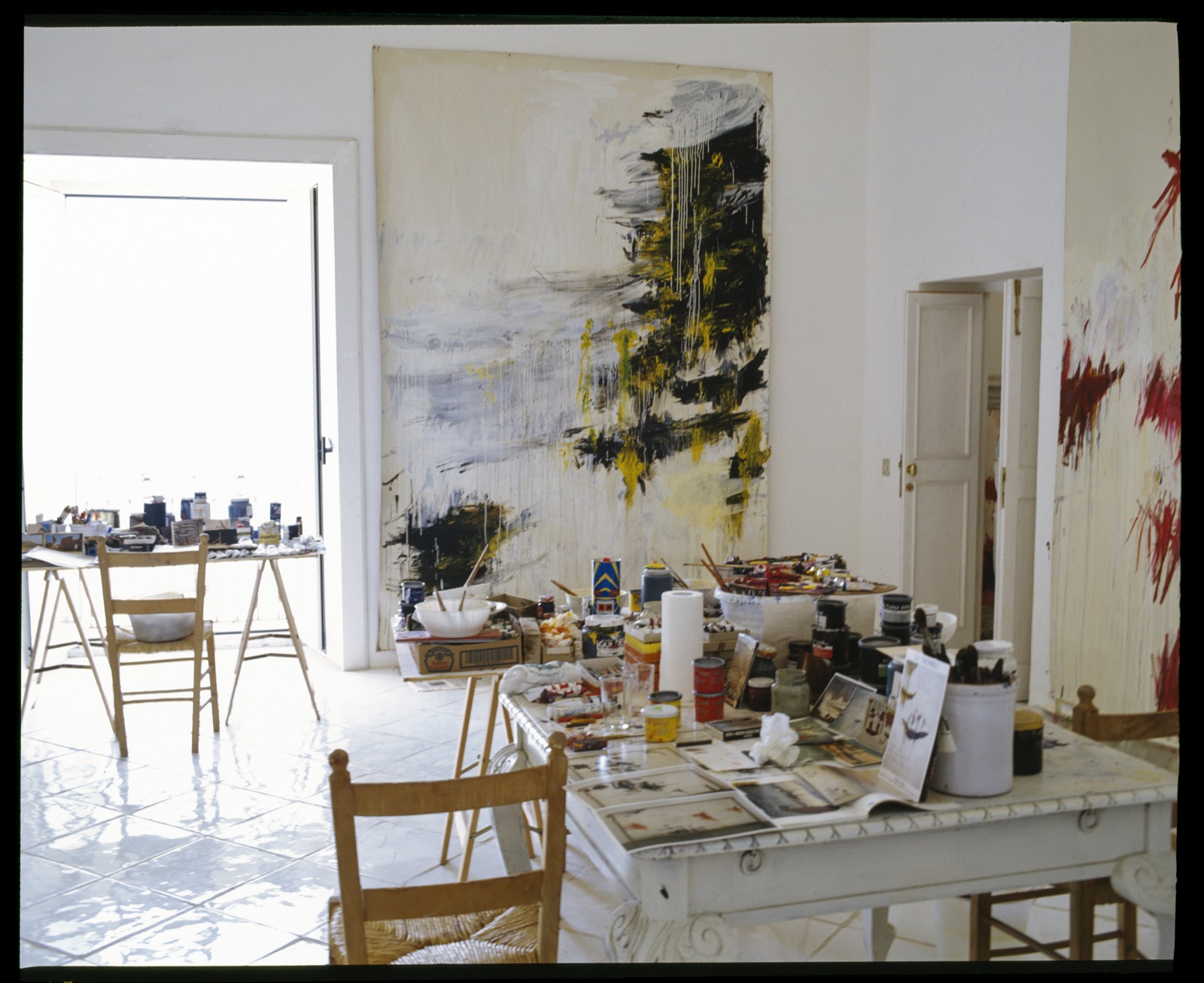
Bruce Weber photographs Cy Twombly’s Rome studio in 1994 as a room caught mid-thought: a monumental unstretched canvas tacked to the wall, its dark storm of black and yellow shedding thin white rivulets toward the floor; a second wall, glimpsed to the right, already scrawled with red. In the foreground a white carved table disappears under paint tins, jars bristling with brushes, an open magazine, a roll of paper towels; straw-seated chairs stand at casual angles, and through the open door the Roman light pours across the tiled floor to a trestle table of more supplies. The painter himself is nowhere in the frame.
That absence is the picture’s subject. Weber, a portraitist by instinct, lets the room sit for its occupant: every surface is testimony, from the drips that have strayed past the canvas onto the wall to the crusted rims of the cans and the page left open as if consulted a moment ago. The studio appears not as an atelier arranged for visitors but as a working organism, interrupted. One reads the space the way one reads a face — the clutter as candor, the stains as biography — and the great canvas presides over it all like a thought not yet finished.
To photograph a studio is to convert process into possession. The camera cannot show work, only what work leaves behind, and so an image of a room where painting is happening becomes at once a relic of painting having happened. That is the seduction such pictures trade in: the promise that if we inventory the residue — the tins, the brushes, the interrupted page — we somehow hold the act itself, and the man. Weber offers that consoling fiction with unusual tact, and its melancholy: a studio preserved at working pitch also records a moment already passing as the shutter closed.