Bruce Weber American, b. 29/3/1946
Edition of 10
Edition of 5
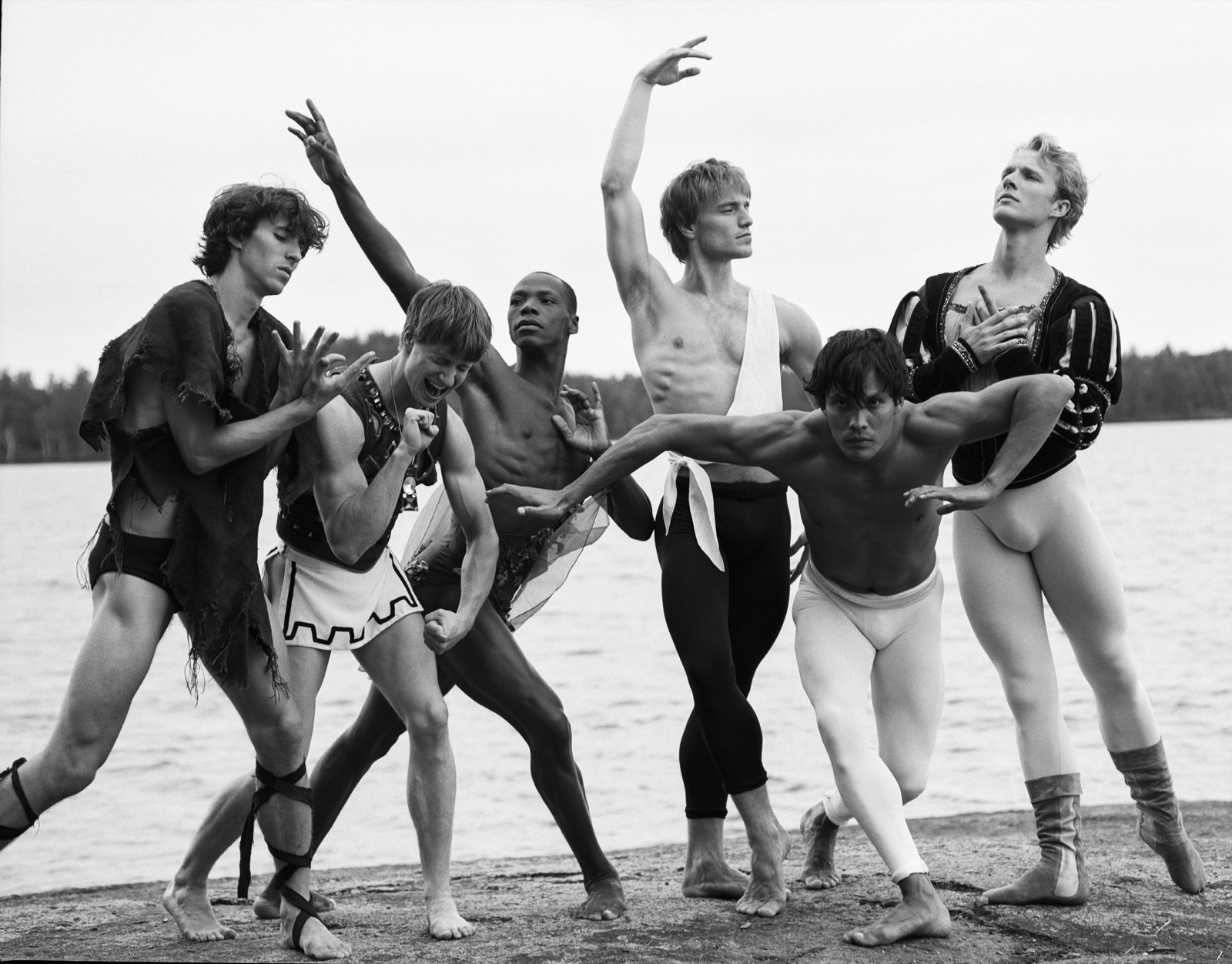
A Greek key runs along the hem of one dancer’s short white skirt, that ancient meander stitched as a border, and it tells you at once what code the picture is speaking: classicism, theatre, the body as ornament. Six male dancers assemble on the rocky shore at the lake’s edge, arms flung into balletic lines against a pale sky. Their costumes quote centuries at once, a ragged tunic, a Renaissance doublet, a white sash over a bare chest.
What holds them together is not narrative but gesture, fingers splayed, wrists broken at exact angles, a lunge caught with one palm pressed flat to the chest. Photography records this the way it records everything, indifferently and completely, so that the frayed threads of the torn tunic and the meander’s crisp geometry receive the same silver attention. The medium does not know that one costume is noble and another destitute; it registers only edges, tones, the grain of cloth against skin. This is its democracy and its cruelty.
On the Adirondack shore, the six dancers turn an uneven patch of ground into a stage. Bent knees and pointed feet give weight to the hands reaching beyond the cluster. Each costume suggests a different performance, yet no single story accounts for the group. The lake continues quietly behind them. That indifference lets the play remain visible: six men holding their invented worlds together for the duration of a photograph.