Series: Hero, Father, Friend.
Archival pigment print mounted on aluminium Dibond.
Edition of 3
127 x 91.4 cm / 50 x 36 in
Hand-signed by the artist, with title, date, and edition number inscribed in ink on an archival label affixed to the reverse side of the mounted photograph
© The Artist
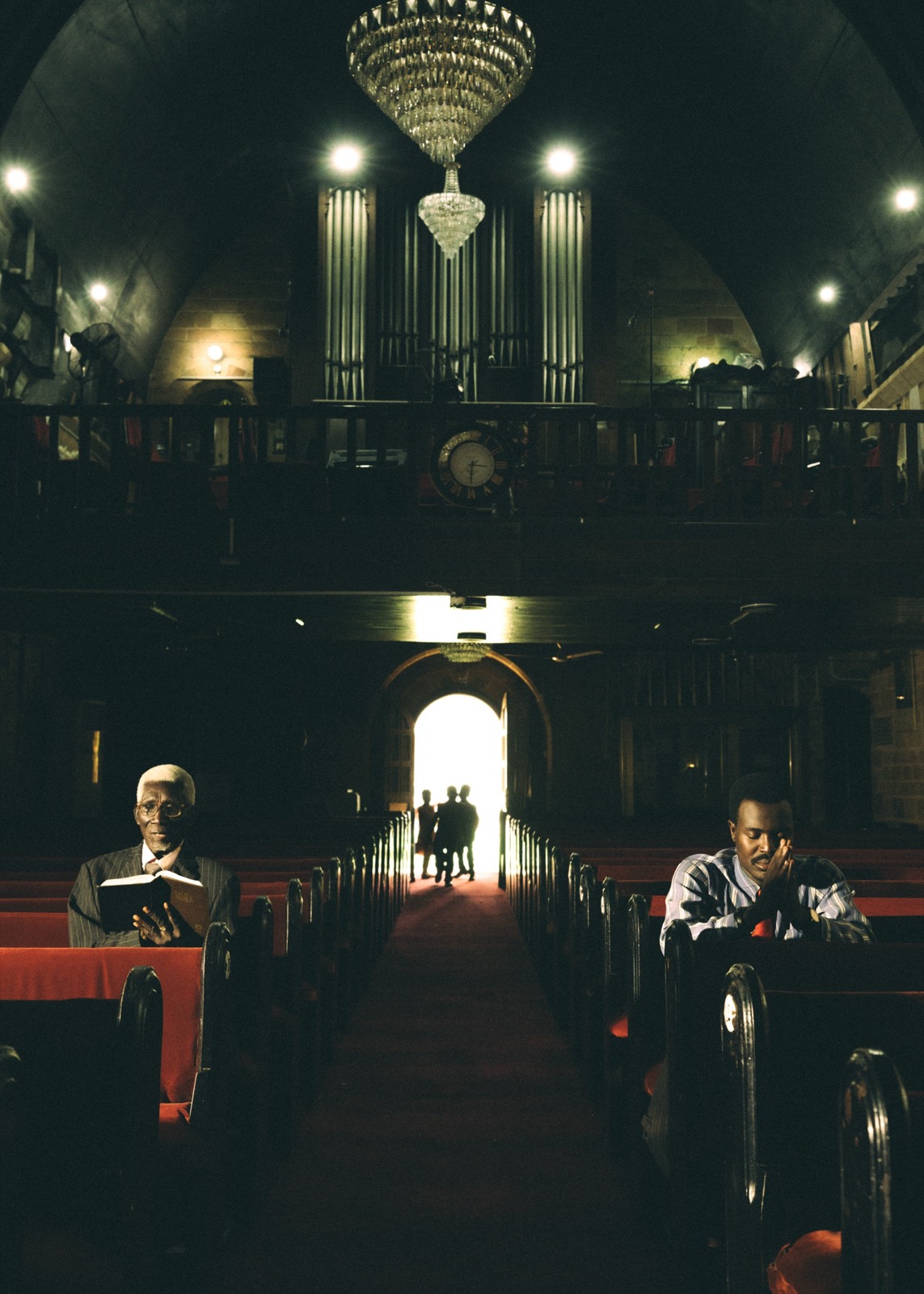
Two men hold the lower corners of the frame like the weights at the bottom of a net, and between them the aisle runs back into a doorway of pure daylight. On the left, an older man in a pale jacket bends into an open Bible, his glasses catching what little light reaches him, lips parted around words he has clearly said before. On the right, a younger man leans onto the pew's end, one hand pressed to his temple, his face turned down into itself. They do not look at each other. The red runner between them is both the thing that joins them and the distance they keep.
Idun-Tawiah understands that a church holds more than one kind of time at once. Above the men, the crystal chandelier and silver organ pipes and the small clock on the gallery keep the long institutional hours, the centuries of Sundays. Below, in the near dark of the empty benches, each man keeps his own private hour, which no architecture can enter. The photograph refuses to resolve them into a congregation. It lets them be solitary together.
And then the doorway. At the far end of the aisle the light is so full that three or four figures standing in it have surrendered their features and become silhouette, caught between the street and the nave, the ordinary world and this cooler interior one. They are arriving, or leaving, or merely talking; we cannot know. That uncertainty is the picture's grace. Made in Accra in 2024, it belongs to a body of work in which Idun-Tawiah photographs Ghanaian life with the patience of someone who knows that devotion is mostly quiet, mostly unwitnessed, and worth the long look anyway. What he gives us is not a service but the space a service leaves behind in a person: the bowed head, the moving lips, the light one is always walking toward.