Carlos Idun-Tawiah Ghanaian, b. 1997

White Belt, Accra, Ghana, 2024.
Series: Hero, Father, Friend.
Archival pigment print mounted on aluminium Dibond.
Edition of 3
40.6 x 61 cm / 16 x 24 in
Hand-signed by the artist, with title, date, and edition number inscribed in ink on an archival label affixed to the reverse side of the mounted photograph
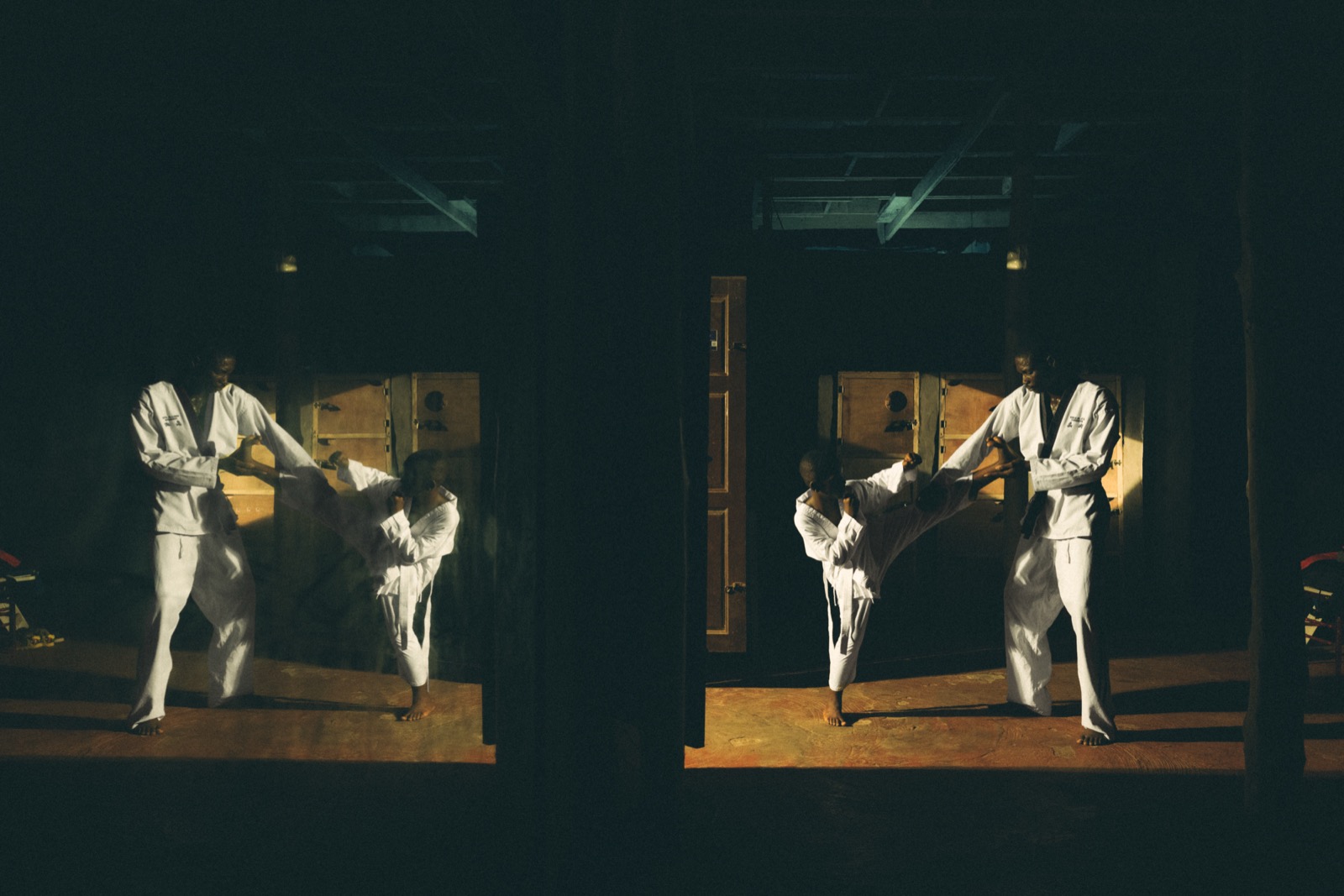
Idun-Tawiah has built the picture as a pair, two panels of the same lesson set side by side, and the doubling is the first thing the eye must reason with. In each half a man in a white dobok steadies a small boy through a high kick, catching the raised foot at the top of its arc; in one panel the boy’s leg is folded and gathered, in the other it is fully extended into a wall of shadow. Everything outside the instruction falls away into near-black: a warm shaft of floor light, the plywood cabinets behind, bare feet planted on a worn wooden floor. The frame keeps only what the exercise requires.

What the diptych proposes is not a decisive moment but a sequence the photograph declines to resolve into one image. Read left to right it becomes a demonstration of cause and consequence, the coiled body and then its release, as though a single kick had been split into its before and after and pinned open for study. The man’s grip is the constant across both halves; the child’s leg is the variable. Idun-Tawiah lets the medium’s habit of stopping time work against itself, insisting that the meaning lives in the interval between the two exposures rather than inside either one.

The white uniforms do the compositional labour, carrying the only strong light in a hall the camera has otherwise surrendered to darkness. Within the fiction of a son mourning his father, the belt of the title reads plainly: the beginner’s rank, the earliest grade, the stage at which everything is still being handed down. What the picture describes is less a fight than a transmission, an older man’s patience measured out in a raised foot he refuses to drop. The photograph asks to be looked at twice because it was made twice, and because instruction, like grief, is a thing repeated until it holds.