Series: Sunday Special.
Archival pigment print mounted on aluminium Dibond.
Edition of 3
50.8 x 40.6 cm / 20 x 16 in
Hand-signed by the artist, with title, date, and edition number inscribed in ink on an archival label affixed to the reverse side of the mounted photograph
© The Artist
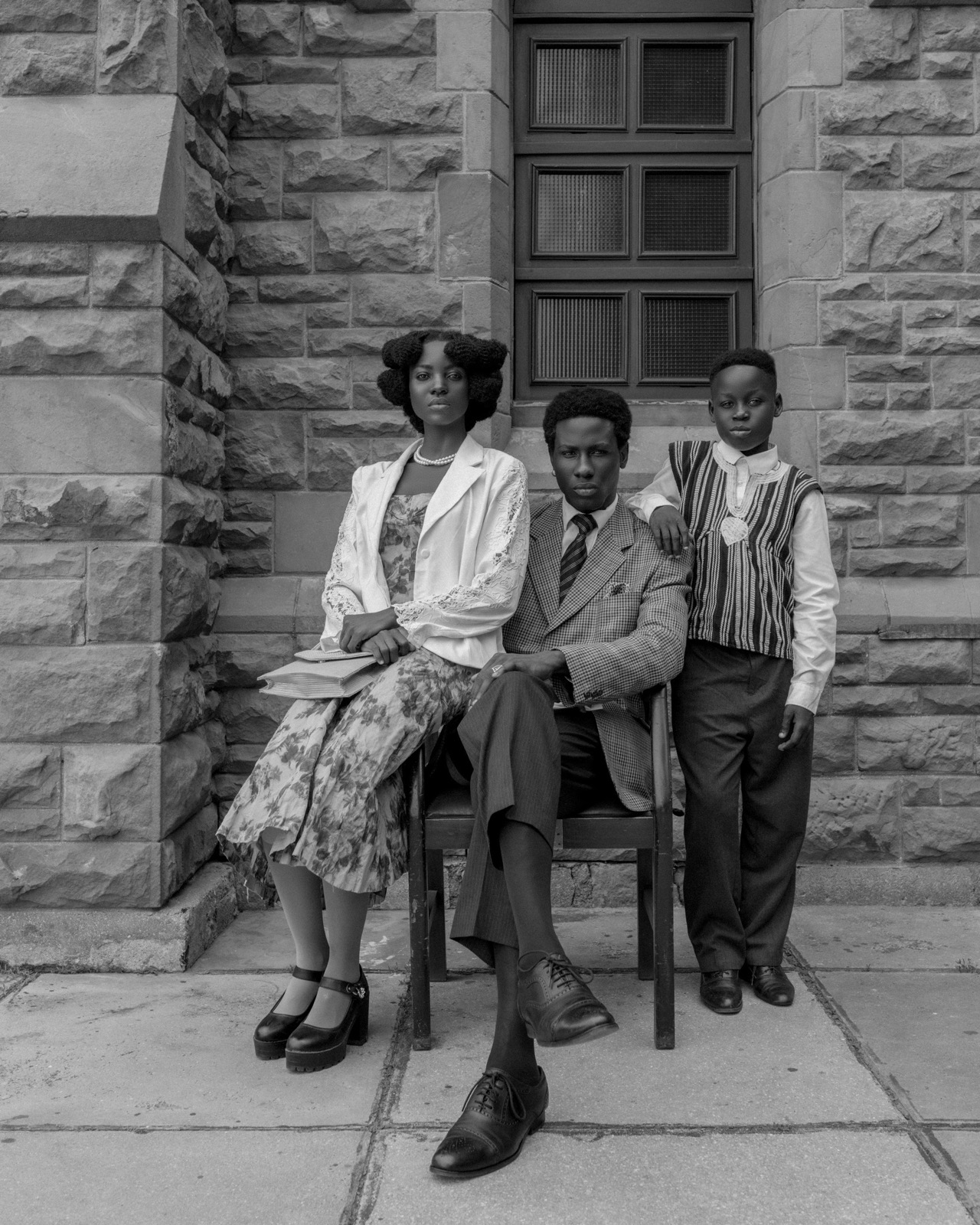
The grammar here is the grammar of the studio backdrop, only the studio has been turned inside out. Where a mid-century portraitist would have unrolled a painted scene of columns and drapery, Idun-Tawiah simply walks his family to a real wall of rough-cut stone and lets the building stand in for the painted illusion. The recessed paneled door behind the seated man does the work a backdrop once did, framing him like a niche frames a saint. It is a picture that knows the history of the thing it is doing.
What it is doing is reconstruction. The clothes — the woman's floral dress under a white jacket, her hair rolled and pinned high; the man's checked suit and narrow striped tie; the boy's vertically striped sweater vest with its small white pin — assemble a 1970s that the photograph never lived through. This is staging, not documentation, and the stillness is the point. Everyone holds. The man sits with one polished oxford crossed over the knee, his trouser cuff riding up to show the sock, while the woman rests a folded sheet of paper in her lap as if she has just been handed the order of a ceremony. Nobody quite smiles.
That refusal to smile is what carries it past pastiche. The family portrait, as a form, was always an act of address to the future, a message sent forward in the certainty of being looked at later. Here the address is doubled: a young Ghanaian artist, working in Accra in 2022, photographing the studio portrait as a subject in its own right, part of a project that treats memory and the Black family album as material to be rebuilt rather than merely recovered. The boy's steady gaze into the lens is the oldest gesture in photography and, in this print, the most current.