Carlos Idun-Tawiah Ghanaian, b. 1997

Can we Take the Long Way Home?, Accra, Ghana, 2023.
Series: Boys Will Always Be Boys.
Archival pigment print mounted on aluminium Dibond.
Edition of 3
81.3 x 81.3 cm / 32 x 32 in
Hand-signed by the artist, with title, date, and edition number inscribed in ink on an archival label affixed to the reverse side of the mounted photograph
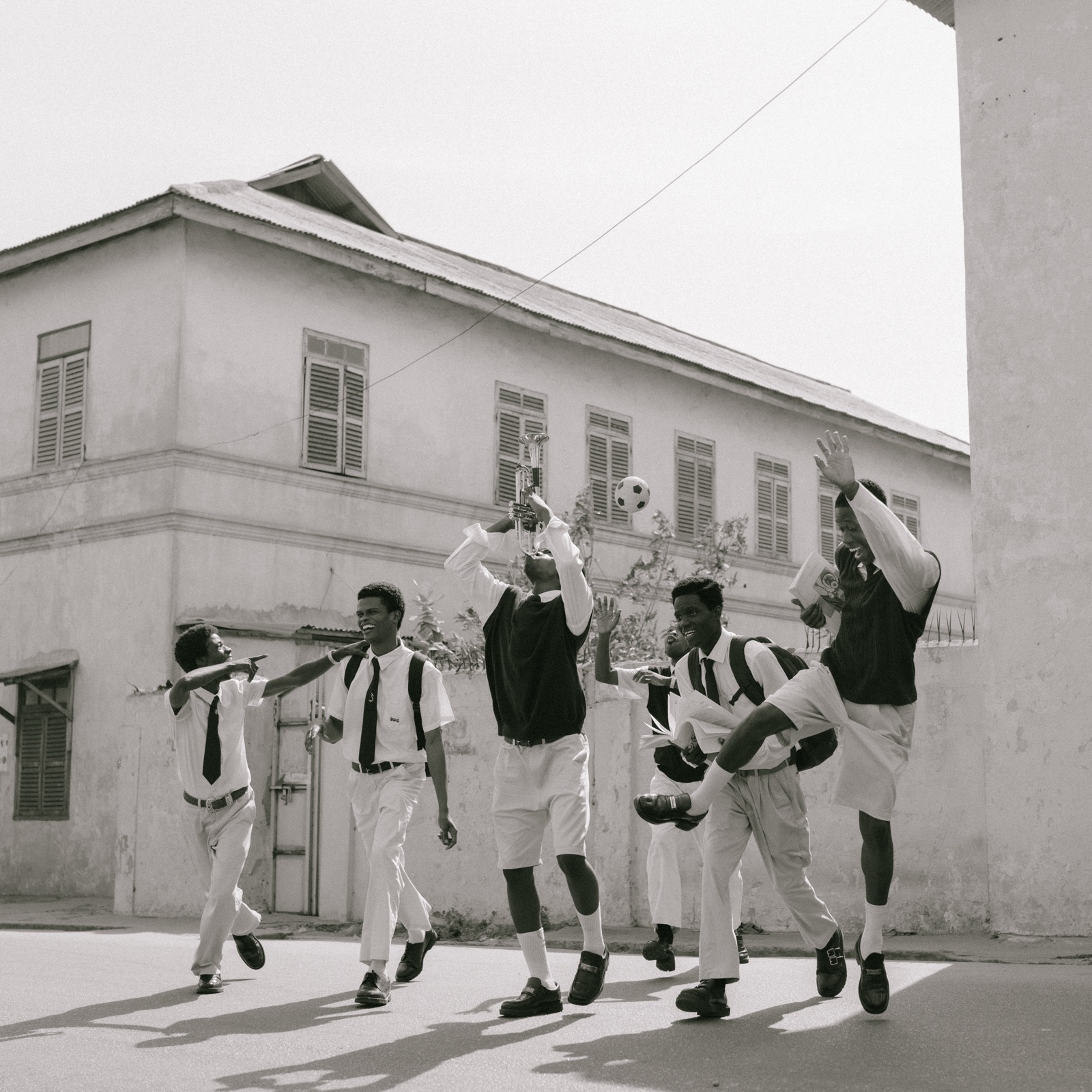
A white soccer ball hangs against the chalky façade, exactly at the apex of its arc, and the whole frame is built to hold it there. Seven schoolboys in white shirts and dark ties move across the road in a loose diagonal — one dabbing, one cradling his face, one stretched into a full vertical leap with a satchel still on his shoulder — and the ball is the pivot the choreography turns on. Idun-Tawiah is not catching an accident here. The picture is staged the way the contemporary tableau is staged: the street becomes a shallow proscenium, the low afternoon light flattens the plaster wall behind into a blank backdrop, and the figures are spaced like a frieze so that no gesture overlaps another. Each boy is given his own pocket of air.

This is the constructed image working in the register of the everyday. The title's question — about taking the long way home — names the premise the photograph performs: the deliberate stretching of unsupervised time into a small spectacle. What positions the work among current practices is its refusal of documentary alibi. It belongs to "Boys Will Be Boys," Idun-Tawiah's ongoing reframing of Ghanaian boyhood, and it borrows the visual grammar of memory — the silver tonality, the heat-bleached uniforms — while keeping the action firmly present-tense, directed, composed.

The long horizontal shadows reaching toward the lower edge are doing real compositional labour, anchoring the airborne bodies to the asphalt so the leap reads as buoyancy rather than fall. It is a generous, precisely managed image: tenderness given the structure of a picture, the casual dignified into form.