Carlos Idun-Tawiah Ghanaian, b. 1997

An Apple A Day, Accra, Ghana, 2024.
Series: Hero, Father, Friend.
Archival pigment print mounted on aluminium Dibond.
Edition of 3
40.6 x 50.8 cm / 16 x 20 in
Hand-signed by the artist, with title, date, and edition number inscribed in ink on an archival label affixed to the reverse side of the mounted photograph
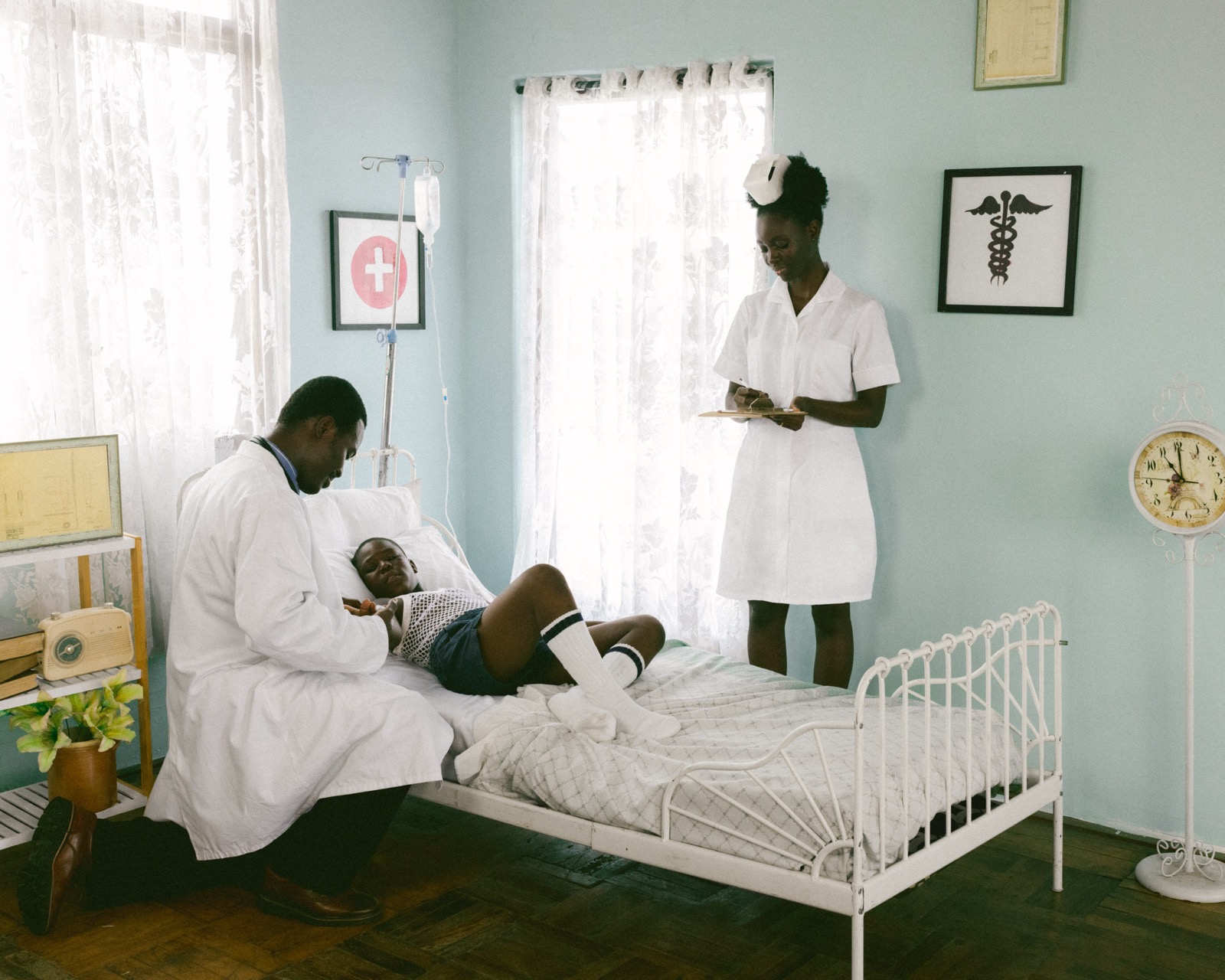
Nothing in this room was found; everything was placed. The walls are a soft mint that reads as institutional and domestic at once, the curtains a heavy floral lace that filters the daylight into a flat, even glow. On the wall a red cross in a frame, a caduceus in another, an Eiffel Tower clock on a wrought stand, a vintage radio on the shelf. Idun-Tawiah builds his hospital the way a set designer builds one, prop by prop, each object chosen to summon a period that may never have existed in exactly this form. The IV stand is real enough to hang saline; the bed is a child’s white iron frame. Verisimilitude here is a decision, not an accident.

At the centre, a boy lies propped against a pillow in a navy mesh jersey and shorts, his long white tube socks striped at the top, one leg drawn up. His father, in the white coat and stethoscope of a physician, leans in close and tends to him with both hands. A young nurse in a starched white uniform and cap stands slightly apart, writing on a clipboard, her eyes lowered to the page. The tableau is choreographed so that care flows in a single direction, from the standing adults toward the reclining child, and the composition holds that hierarchy the way a Renaissance altarpiece holds its saints.

What the staging protects is a wish. In a series grieving an absent father, this constructed clinic lets the father return as the one who heals, who sits at the bedside and does not leave. The fiction is unashamed of being a fiction; the polished parquet and the ornamental clock signal that we are inside memory or fantasy rather than documentary fact. Idun-Tawiah understands that the invented scene can carry a truth the candid one cannot, and he lets the artifice do the emotional work, presenting devotion as something built, furnished, and lit on purpose.