Series: Hero, Father, Friend.
Archival pigment print mounted on aluminium Dibond.
Edition of 3
40.6 x 50.8 cm / 16 x 20 in
Hand-signed by the artist, with title, date, and edition number inscribed in ink on an archival label affixed to the reverse side of the mounted photograph
© The Artist

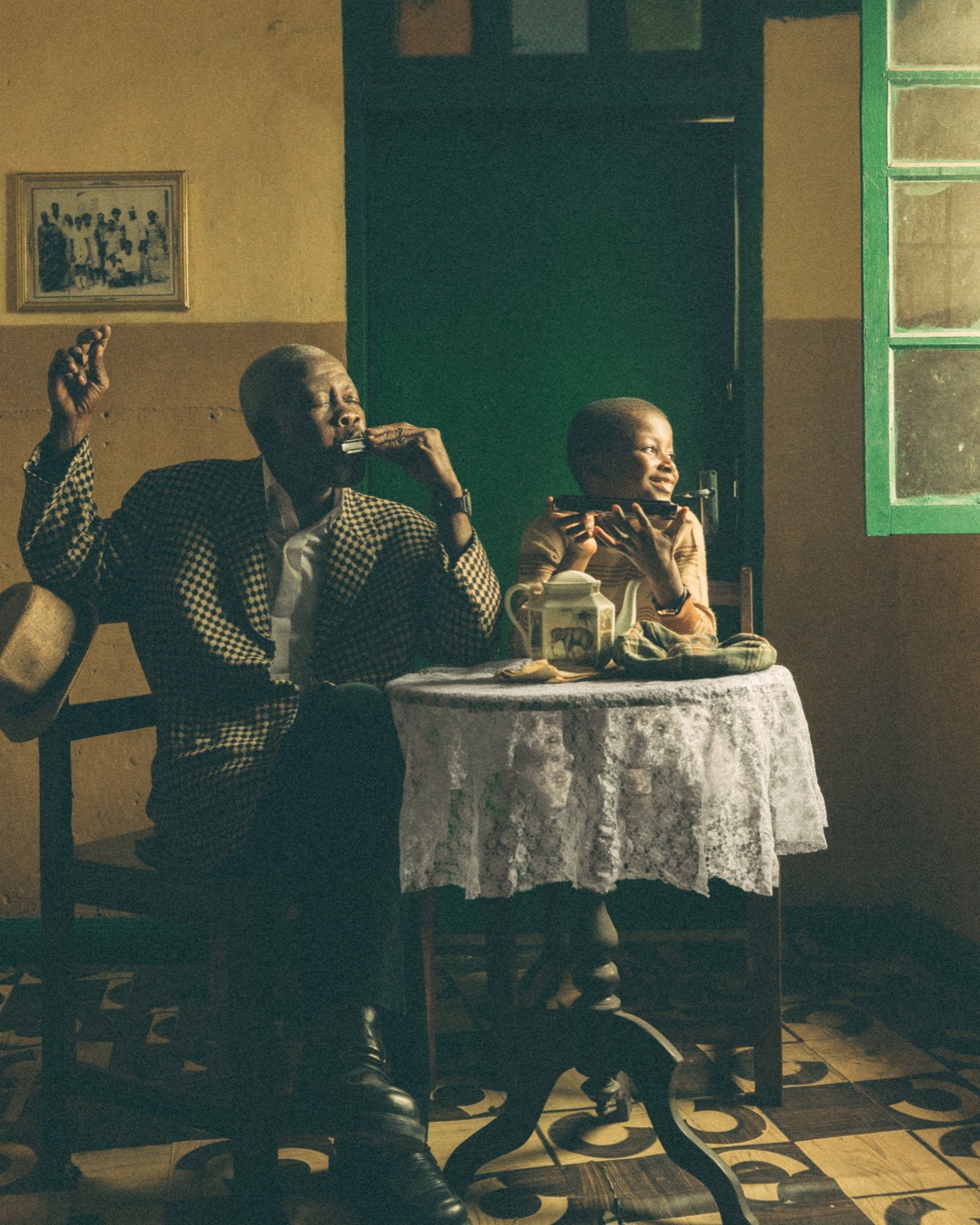
Two harmonicas, one interior, a great deal of gold. An older man in a houndstooth jacket has tipped his wooden chair back on two legs, his straw hat hooked over the chair’s shoulder, eyes closed, one hand lifted as the other presses the harmonica to his mouth; beside him a boy at a small round table, its lace cloth catching the light, holds a second harmonica in both hands and grins toward something outside the frame. Idun-Tawiah gives us the room entire, the green door and green-sashed window, the patterned floor, a framed group portrait keeping its own dim company on the wall.
I keep returning to that photograph within the photograph, the faded print of many people that hangs at the upper left like a caption the picture will not translate. It sets the whole scene in a longer line, so that the man’s music seems addressed backward as much as forward, to the assembled dead as much as to the child at his elbow. In a series that grieves a father, this is the room’s argument: the elder does not instruct the boy so much as let him overhear, and the boy answers by lifting the same small instrument, as if joining a tune already underway before he arrived.
The pleasure of the image is in its ordinary props raised to the pitch of ceremony, a teapot, a lace cloth, a hat that will not be worn just now. Nothing is staged toward pathos; the two simply play, or pretend to, in the amber light of a Ghanaian afternoon that Idun-Tawiah has coaxed until the walls themselves seem to hum. The title’s melody is carried in the heart, not the ear, and the picture accepts that its own music is silent. What survives on the print is the posture of transmission, one generation breathing into an instrument while the next figures out where to put its hands.