Series: Sunday Special.
Archival pigment print mounted on aluminium Dibond.
Edition of 3
127 x 91.4 cm / 50 x 36 in
Hand-signed by the artist, with title, date, and edition number inscribed in ink on an archival label affixed to the reverse side of the mounted photograph
© The Artist
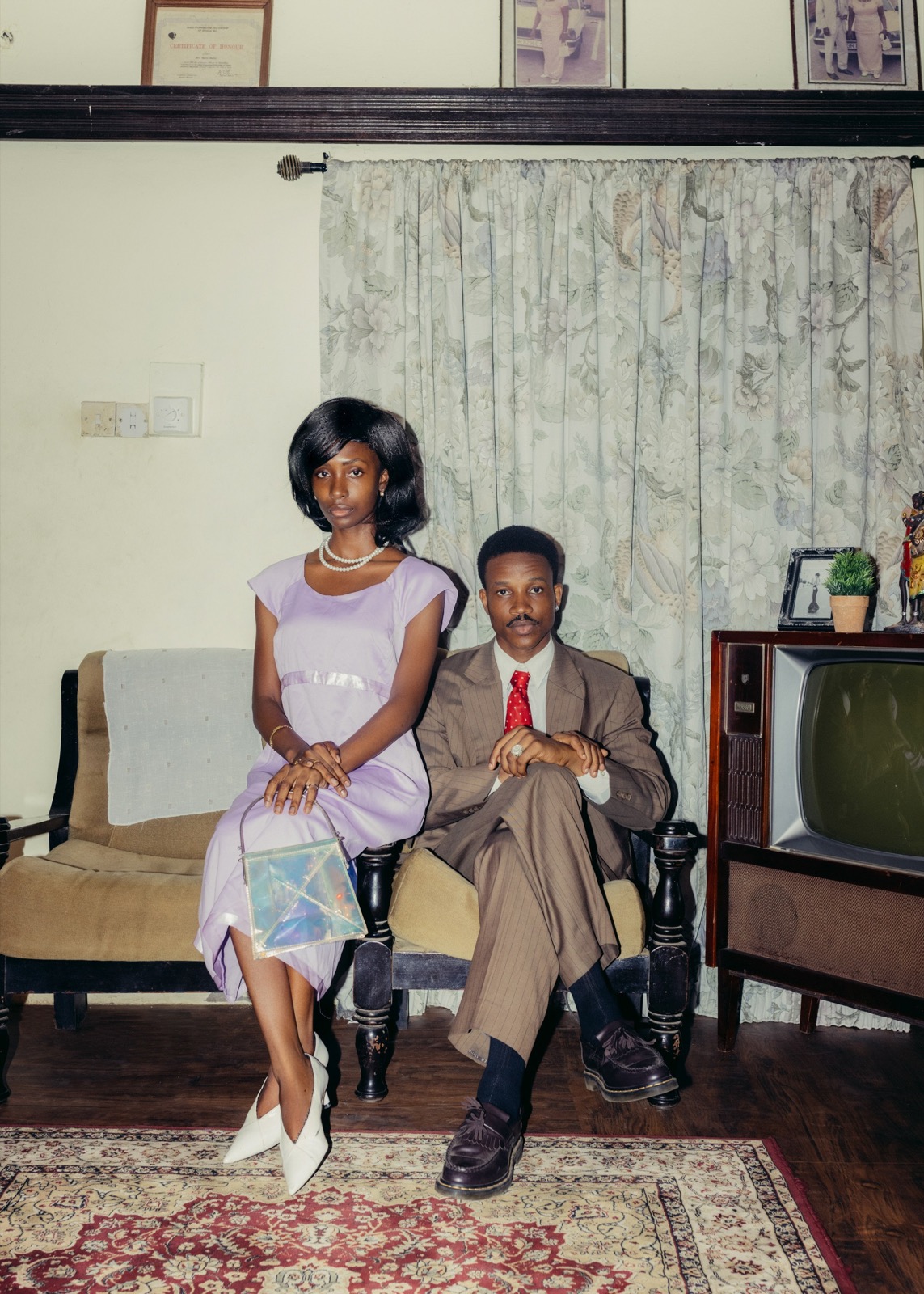
A room in Accra, and two people who have agreed to be looked at. She sits forward, lilac against the worn gold of the sofa, pearls cool at her throat; he leans back with one arm laid along the cushion behind her, a man composed into stillness. The wood-cased television, the floral lace at the window, the studio portraits hung high near the ceiling where ancestors are kept — everything has been gathered toward one remembered decade. And then, on her lap, the clutch: holographic, iridescent, refusing the year it has been placed in. The eye snags there. It is the present, smuggled in, insisting that this past is a thing being made now, by hand, for us.
What moves me is how the picture knows it is a picture. Carlos Idun-Tawiah builds these interiors the way memory builds them, in the warm faded color of an album left in the sun, and titles this one as if it were already an object in a family's keeping — "Daddy's Polaroid," an heirloom we are permitted to hold. The seams show on purpose. To restage the look of mid-century West African studio and home photography, the world of Seydou Keïta and Malick Sidibé, is not nostalgia but a claim: that Black domestic life, family, faith, the ordinary dignity of two people on a sofa, deserves to be composed with this much care, and remembered with this much light.
Issued in an edition of three, mounted on aluminium Dibond, this archival pigment print holds its invented past steady enough that you could mistake it for your own.