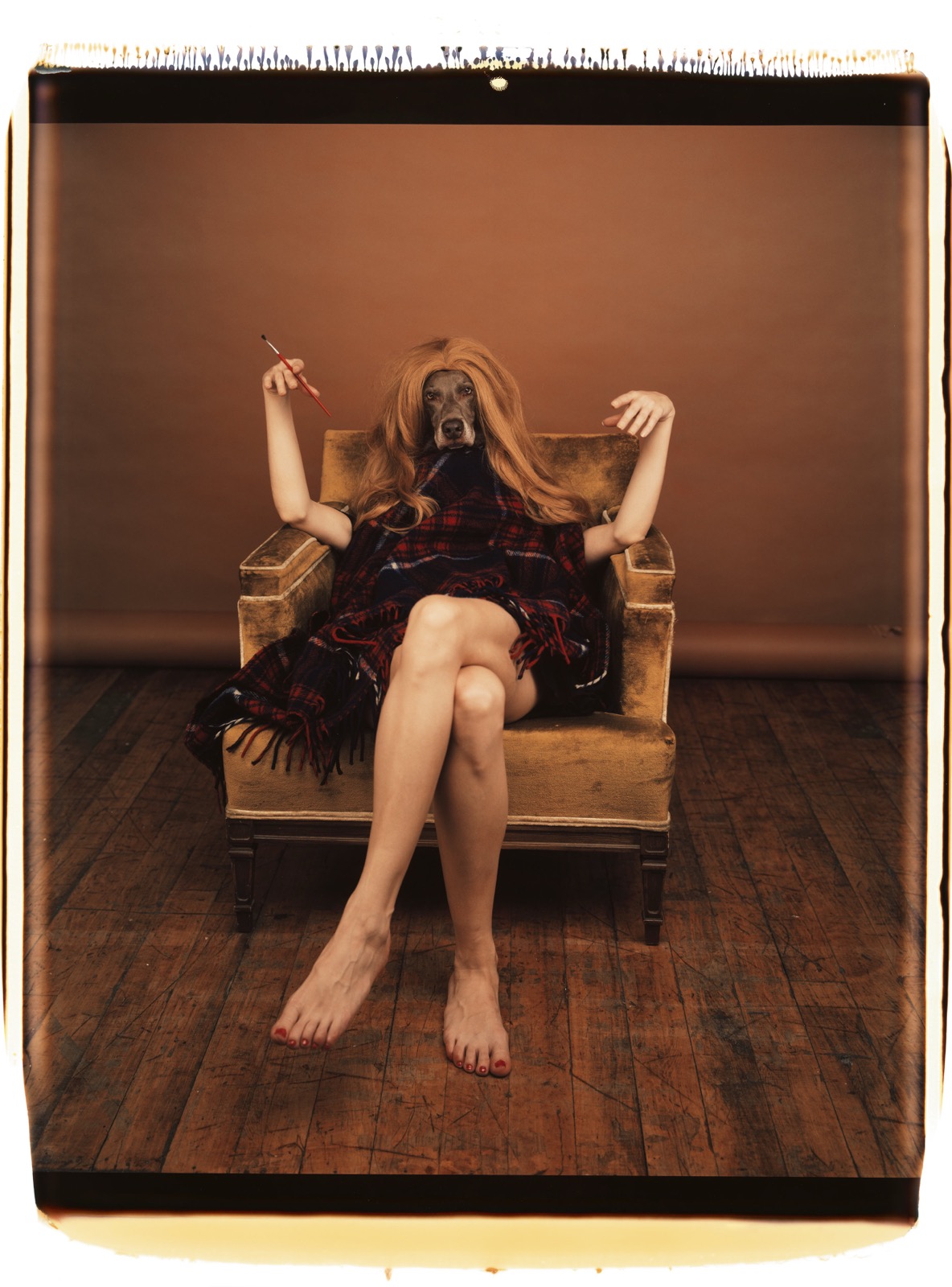
William Wegman American, b. 1943

Untitled, 1994.
Unique Color Polaroid.
61 x 50.8 cm / 24 x 20 in
Titled and signed by the Artist on recto

Gold velvet, worn to a sheen at the arms; red and black tartan, heavy with fringe; the auburn cascade of a long wig — these surfaces carry the picture before any reading of it begins. The colour is too saturated, too exact, to be quite comfortable, and that exactness is the point. Out of the blanket a grey muzzle protrudes, a slender paintbrush raised between two fingers, mid-gesture, as if interrupted at the easel. The dog is not merely dressed up; it is being cast as a maker of images. The joke folds back on the photographer, who is doing the same thing: composing a body, arranging a pose, deciding when to stop.

The picture works because almost nothing in it is concealed. Human arms emerge from the blanket; human legs cross and dangle, painted toenails resting on scuffed floorboards. The illusion is only the head, and the head is enough. We supply the rest, knowing it is a Weimaraner and seeing a woman, holding both readings at once. This is the particular comedy of the large-format Polaroid: a single unrepeatable sheet, developed on the spot, so precise in its colour and surface that the absurd is rendered with the gravity of a society portrait.

That scale matters. Wegman made these on the room-sized 20x24 Polaroid camera, one of a handful in existence, a machine that turns instantaneous photography into something slow, deliberate, and unique. Each frame is an object, not an edition. The torn band of emulsion across the top, the warm vignette at the corners, are the print declaring its own chemistry. Begun in homage to Man Ray and continued through Fay Ray and her line, this is portraiture that knows portraiture is a costume, and wears it lightly.