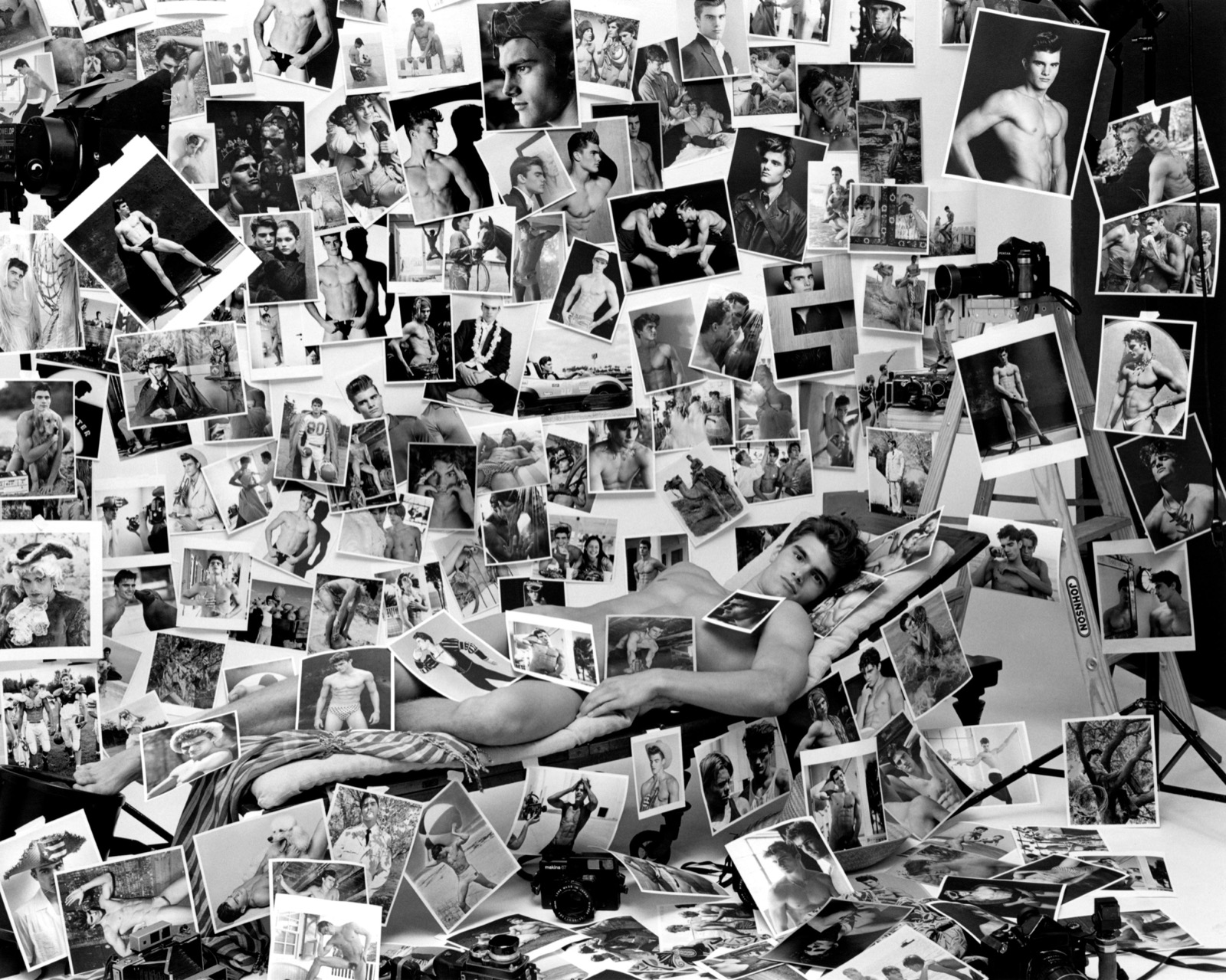
A man lies along the bottom of the frame, naked, his body the one continuous thing in a wall papered edge to edge with photographs of other men. He has not been set against the pictures so much as enrolled among them: his outstretched arm rests on a stack of prints, his shoulder dissolves into the pinned grid behind it, and only the warmth of his single skin distinguishes him from the hundreds of skins already fixed and flattened around him. To photograph him here is to add one more image to a surface already saturated with images — and the picture knows this. The camera on its tripod stands openly at the right, not hidden but confessed, a reminder that every body on this wall was once a living body in this room.
What the collage proposes is an argument about appetite. Each clipping isolates a torso, a glance, a pose; together they accumulate into the thing desire actually is — not a person but an inventory, endlessly extended, never satisfied by any single example. The reclining figure is both the latest entry and the implied viewer, lying among his predecessors as if to ask whether being looked at this much is a form of being possessed or a form of disappearing. Weber, whose studio mythology of male beauty made him one of the defining image-makers of his era, lets the answer stay double.
The intimacy is real, and so is the unease. We are shown the machinery that manufactures longing — print, pin, lens, the patient horizontal repetition of an ideal — and shown a man content, for now, to lie down inside it. The photograph does not redeem the wall; it completes it.
A man lies along the bottom of the frame, naked, his body the one continuous thing in a wall papered edge to edge with photographs of other men. He has not been set against the pictures so much as enrolled among them: his outstretched arm rests on a stack of prints, his shoulder dissolves into the pinned grid behind it, and only the warmth of his single skin distinguishes him from the hundreds of skins already fixed and flattened around him. To photograph him here is to add one more image to a surface already saturated with images — and the picture knows this. The camera on its tripod stands openly at the right, not hidden but confessed, a reminder that every body on this wall was once a living body in this room.
What the collage proposes is an argument about appetite. Each clipping isolates a torso, a glance, a pose; together they accumulate into the thing desire actually is — not a person but an inventory, endlessly extended, never satisfied by any single example. The reclining figure is both the latest entry and the implied viewer, lying among his predecessors as if to ask whether being looked at this much is a form of being possessed or a form of disappearing. Weber, whose studio mythology of male beauty made him one of the defining image-makers of his era, lets the answer stay double.
The intimacy is real, and so is the unease. We are shown the machinery that manufactures longing — print, pin, lens, the patient horizontal repetition of an ideal — and shown a man content, for now, to lie down inside it. The photograph does not redeem the wall; it completes it.