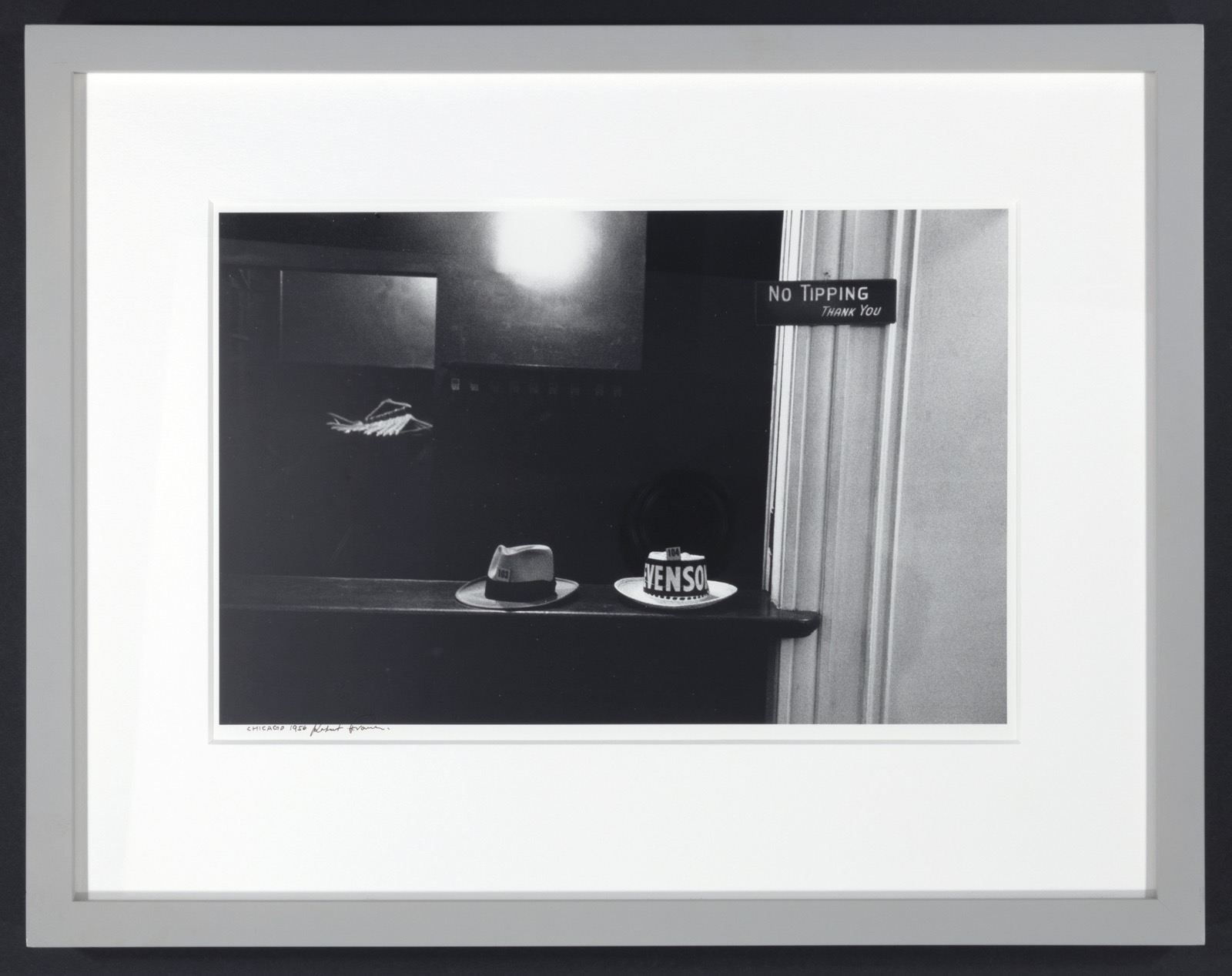
A coat-check counter at the end of an evening, and the two objects left on it tell a small American story. To the left, a man's gray felt fedora rests crown-up on the dark ledge, brim catching the only soft light. To the right, on a round white dish, sits a doorman's cap whose band reads in fragments — VENSO — the rest swallowed by shadow, the dish unmistakably a vessel for coins. Above them, bolted to the bright doorframe, a placard insists: NO TIPPING, THANK YOU. The picture turns on that contradiction, the tip dish beneath the refusal of tips, and Frank lets it stand without comment.
The light is the other protagonist. A single bulb burns at the top of the frame like a low moon, and everything else recedes into a velvety, granular dark you feel as much as see. On the left wall hangs a black mirror or panel, blank as a switched-off screen, and across the deep tone someone has left a pale scrawl in the gloom. The room is emptied of people, yet the two hats hold their absent owners with uncanny patience, the way a glove keeps the shape of a hand.
This is Frank in 1956, mid-journey through the country that would become The Americans, finding the nation not in its faces but in its leftover signage and tired furniture. His pencil signature sits at the lower left of the sheet. A vintage print from these road years — his archive now at the National Gallery of Art — carries the grain of its making, irreplaceable evidence of a vision that taught photography to feel.
A coat-check counter at the end of an evening, and the two objects left on it tell a small American story. To the left, a man's gray felt fedora rests crown-up on the dark ledge, brim catching the only soft light. To the right, on a round white dish, sits a doorman's cap whose band reads in fragments — VENSO — the rest swallowed by shadow, the dish unmistakably a vessel for coins. Above them, bolted to the bright doorframe, a placard insists: NO TIPPING, THANK YOU. The picture turns on that contradiction, the tip dish beneath the refusal of tips, and Frank lets it stand without comment.
The light is the other protagonist. A single bulb burns at the top of the frame like a low moon, and everything else recedes into a velvety, granular dark you feel as much as see. On the left wall hangs a black mirror or panel, blank as a switched-off screen, and across the deep tone someone has left a pale scrawl in the gloom. The room is emptied of people, yet the two hats hold their absent owners with uncanny patience, the way a glove keeps the shape of a hand.
This is Frank in 1956, mid-journey through the country that would become The Americans, finding the nation not in its faces but in its leftover signage and tired furniture. His pencil signature sits at the lower left of the sheet. A vintage print from these road years — his archive now at the National Gallery of Art — carries the grain of its making, irreplaceable evidence of a vision that taught photography to feel.