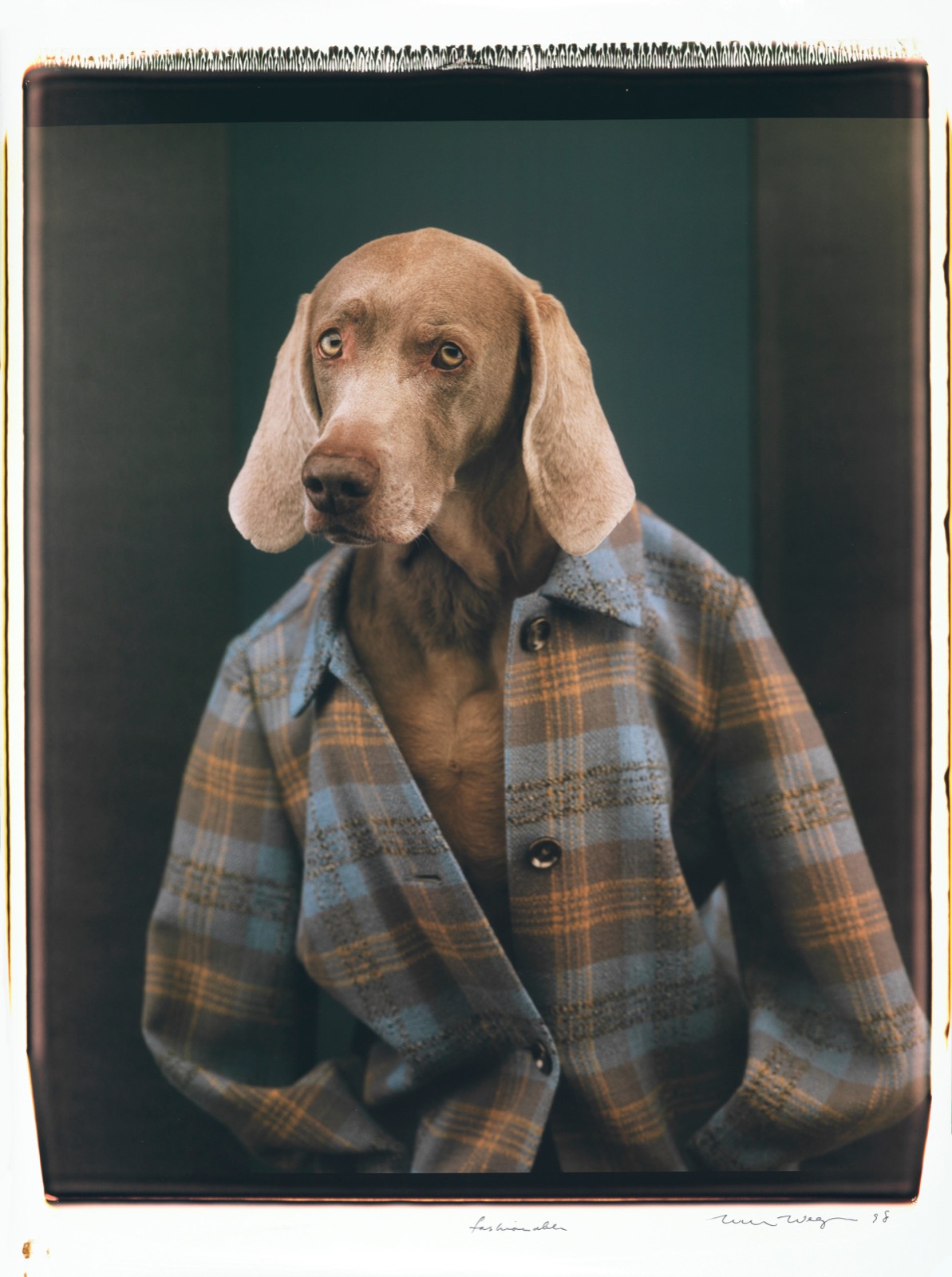
“Fashionable” reimagines portraiture through William Wegman’s distinctive balance of elegance, humor, and conceptual precision.
Created in 1998 as a unique color 20 × 24 Polaroid, the work depicts a poised Weimaraner wearing a tailored blue-gray plaid jacket, producing an arresting fusion of animal presence and sartorial grace that is central to Wegman’s enduring visual language.
The use of the monumental Polaroid process is integral to the work’s character: Wegman valued the medium for its immediacy and for the fact that it allowed no revision or cropping, qualities that resonate with his ability to combine spontaneity with formal control.
Here, the dog’s pale gray-silver coat harmonizes with the muted plaid, while its dignified pose carries a subtle absurdity consistent with the artist’s fascination with anthropomorphism, transformation, and wit.
Bathed in soft studio light against a dark, neutral backdrop, “Fashionable” invokes the conventions of classical portraiture while gently undermining them. The garment becomes more than costume: it acts as a threshold between animal and human, instinct and performance, portrait and masquerade.
“Fashionable” exemplifies Wegman’s singular gift for giving his canine collaborators a striking human-like presence without erasing their essential animal nature, and its Polaroid materiality heightens its significance as a singular object bound to the instantaneity of its making.
“Fashionable” reimagines portraiture through William Wegman’s distinctive balance of elegance, humor, and conceptual precision.
Created in 1998 as a unique color 20 × 24 Polaroid, the work depicts a poised Weimaraner wearing a tailored blue-gray plaid jacket, producing an arresting fusion of animal presence and sartorial grace that is central to Wegman’s enduring visual language.
The use of the monumental Polaroid process is integral to the work’s character: Wegman valued the medium for its immediacy and for the fact that it allowed no revision or cropping, qualities that resonate with his ability to combine spontaneity with formal control.
Here, the dog’s pale gray-silver coat harmonizes with the muted plaid, while its dignified pose carries a subtle absurdity consistent with the artist’s fascination with anthropomorphism, transformation, and wit.
Bathed in soft studio light against a dark, neutral backdrop, “Fashionable” invokes the conventions of classical portraiture while gently undermining them. The garment becomes more than costume: it acts as a threshold between animal and human, instinct and performance, portrait and masquerade.
“Fashionable” exemplifies Wegman’s singular gift for giving his canine collaborators a striking human-like presence without erasing their essential animal nature, and its Polaroid materiality heightens its significance as a singular object bound to the instantaneity of its making.