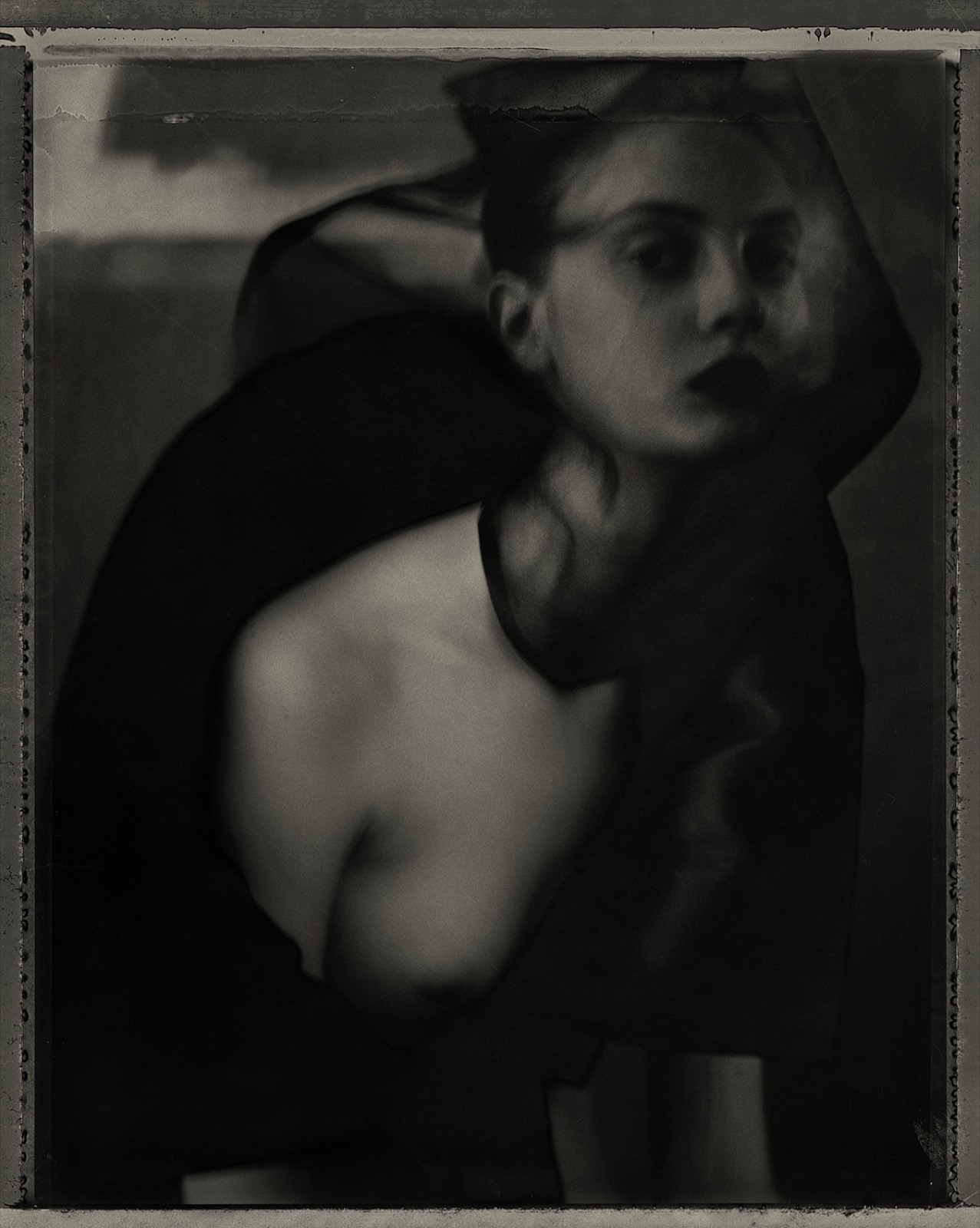
What anchors Femme voilée I is the gesture: both arms lifted to crown the head with a black tulle that she holds rather than wears, so the veil reads less as costume than as a thing being arranged in front of us. The picture is staged as a question about exactly that staging. The face floats free and sharp-eyed at the upper right, dark mouth set, while the bared shoulder and breast below dissolve into a pale, granular hush — one body delivered at two different resolutions, the constructed image admitting its own seams.
Sarah Moon works deliberately against the documentary contract. The ragged dark border, the bloom and scratch riding across the emulsion, the way the grey ground behind the figure is more weather than wall — these are not flaws but the declared vocabulary of a picture that wants to be understood as fabrication, an echo of the world rather than a record of it. Positioned within the tableau tradition of the constructed photograph, this is a sitter who looks back, composing herself for the lens instead of being composed by it; the veil becomes a prop she authors, concealment turned into agency.
That self-possession is the whole strategy of the frame. Moon, who turned from modelling to a singular practice across fashion, film and the gallery, made the silver print her field for this kind of staged interiority, and the medium here is exact: a gelatin silver print whose tonal softness is method, not accident. Few of her constructed nudes carry the charge of this one — the lifted arms, the held veil, the gaze that refuses to be merely beautiful.
What anchors Femme voilée I is the gesture: both arms lifted to crown the head with a black tulle that she holds rather than wears, so the veil reads less as costume than as a thing being arranged in front of us. The picture is staged as a question about exactly that staging. The face floats free and sharp-eyed at the upper right, dark mouth set, while the bared shoulder and breast below dissolve into a pale, granular hush — one body delivered at two different resolutions, the constructed image admitting its own seams.
Sarah Moon works deliberately against the documentary contract. The ragged dark border, the bloom and scratch riding across the emulsion, the way the grey ground behind the figure is more weather than wall — these are not flaws but the declared vocabulary of a picture that wants to be understood as fabrication, an echo of the world rather than a record of it. Positioned within the tableau tradition of the constructed photograph, this is a sitter who looks back, composing herself for the lens instead of being composed by it; the veil becomes a prop she authors, concealment turned into agency.
That self-possession is the whole strategy of the frame. Moon, who turned from modelling to a singular practice across fashion, film and the gallery, made the silver print her field for this kind of staged interiority, and the medium here is exact: a gelatin silver print whose tonal softness is method, not accident. Few of her constructed nudes carry the charge of this one — the lifted arms, the held veil, the gaze that refuses to be merely beautiful.