Series: Where it all began
Gelatin Silver Print.
Printed later.
Image: 30 x 30 cm / 11 3/4 x 11 3/4 in / Paper: 50 x 40 cm / 19 3/4 x 15 3/4 in
Masats Estate dry stamp, signed and authenticated by Sonia Masats with title and edition number in pencil on label affixed to print verso
© The Artist

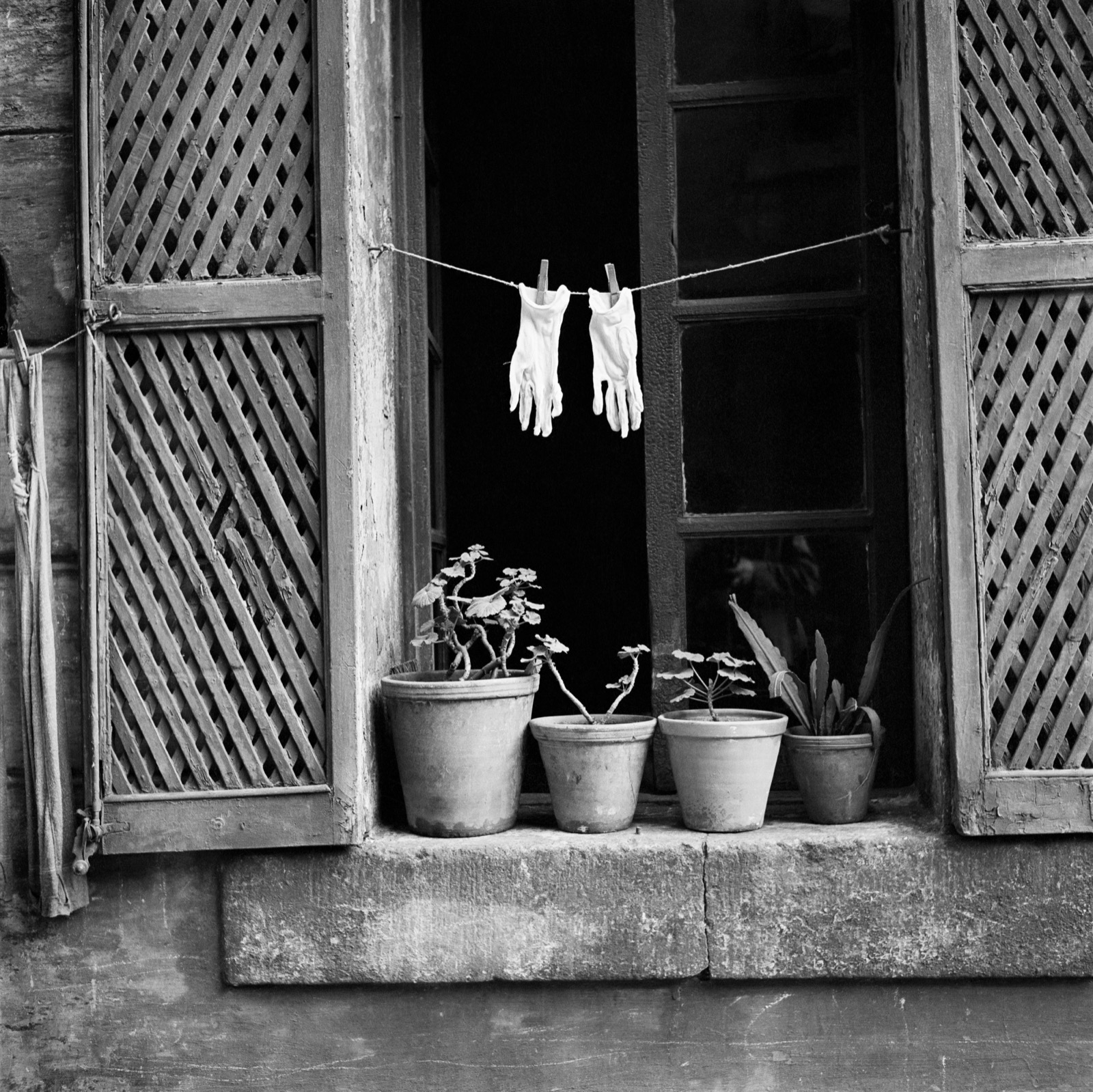
It's the gloves that get you, of course, but it took me a while to work out why. They're pinned to a length of string slung between two shutters, drying — fine, ordinary, the sort of thing you'd walk past in Terrassa in 1953 without a second glance. Except they're not drying like socks dry. They hang there with their fingers slightly spread, palms toward us, as if someone had pegged up a pair of hands and stepped back inside. A small surrealist accident, entirely unstaged. Whoever owned them is right there behind the dark glass, invisible, getting on with the afternoon.
What Masats does — and he's twenty-two when he does it, which is faintly outrageous — is let the architecture do the heavy lifting while the gloves do the haunting. The latticework of the shutters slices the light into all those diamonds, a rigid grid, very Franco-era, everything in its place; and then down on the sill the four clay pots refuse to line up properly, the geraniums leaning whichever way they like. Order above, a small disobedience of leaves below. He didn't put any of it there. He just saw that it rhymed.
This is the thing about the early Masats, the man who'd shortly help drag Spanish photography out of its soft-focus pictorialist sulk and into the actual street: he photographs absence better than most people photograph presence. No face, no figure, and yet the picture is crowded with someone. You keep checking the window. Prints of this period, made later from his negatives, are not thick on the ground, and this is one of the good ones — a domestic nothing that turns out, the longer you stand with it, to be about everything that's just left the room.