Joel Meyerowitz American, b. 1938

San Cristóbal de las Casas, México, 1971.
Series: 35 mm - Color
Archival pigment print. Printed later.
Umbrella edition of 25
20 x 24 in / 50 × 60 cm / 30 x 40 in / 76 × 101 cm

Edition of 5
48 x 60 in / 121 × 152 cm

Edition of 3
60 x 75 in / 152.4 x 190.5 cm
Hand-signed by artist, mounted, titled, editioned and print date in ink label affixed to mount verso
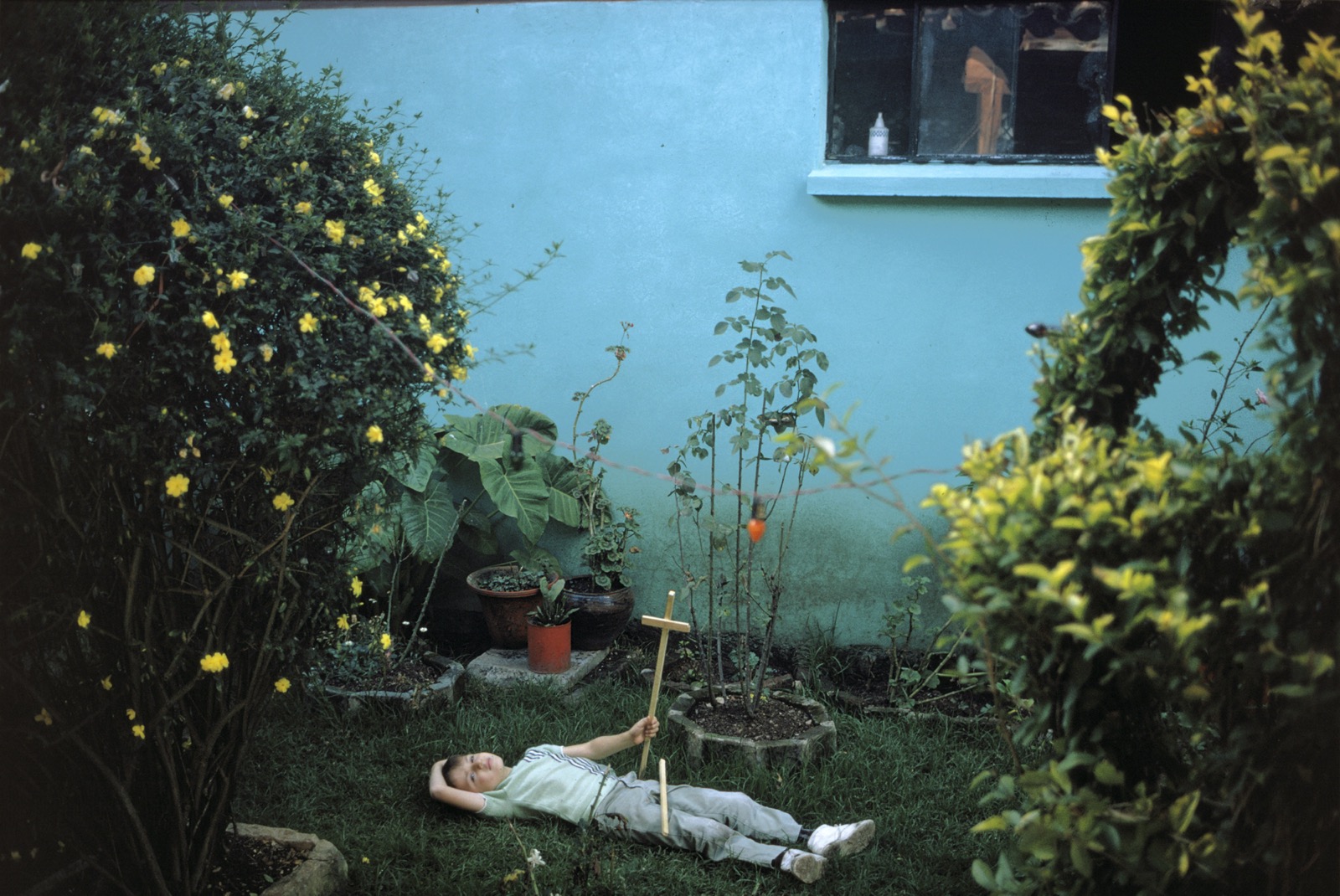
The boy has laid himself out full-length on the grass and lifted a thin wooden cross above his face, holding it the way a child holds a found thing up to the light to study it. That single gesture organizes the whole frame. Meyerowitz made this photograph in San Cristóbal de las Casas, in the Chiapas highlands, in 1971, during the years he was teaching himself to think in color on the road, and the picture already shows the discipline that would define him: he lets the small staked plants, the terracotta pots set on stone, and the boy's reclining body fall into a loose diagonal rather than forcing a center.

What holds the eye is the wall — a chalky, almost aquatic blue that flattens the courtyard into a shallow stage and turns the surrounding shrubs, heavy with yellow blossom, into the only warmth in the field. This is the chromatic intelligence that placed Meyerowitz, with Eggleston and Shore, at the founding of color photography's acceptance as a serious art; here the blue is not background but the picture's emotional key, cool and enclosing, against which the upraised cross reads as a fragile flare of attention.

He worked these early travels — Spain, Mexico, the American street — by waiting on the world rather than arranging it, and the proof is in the upper window, where a dark interior and a single pale bottle hold the adult, domestic life just out of the frame's reach. The boy at his solitary play, the makeshift cross, the garden closing around him: Meyerowitz finds the threshold between the ordinary and the rapt without ever crossing into sentiment, trusting the light and the long grass to carry the feeling.