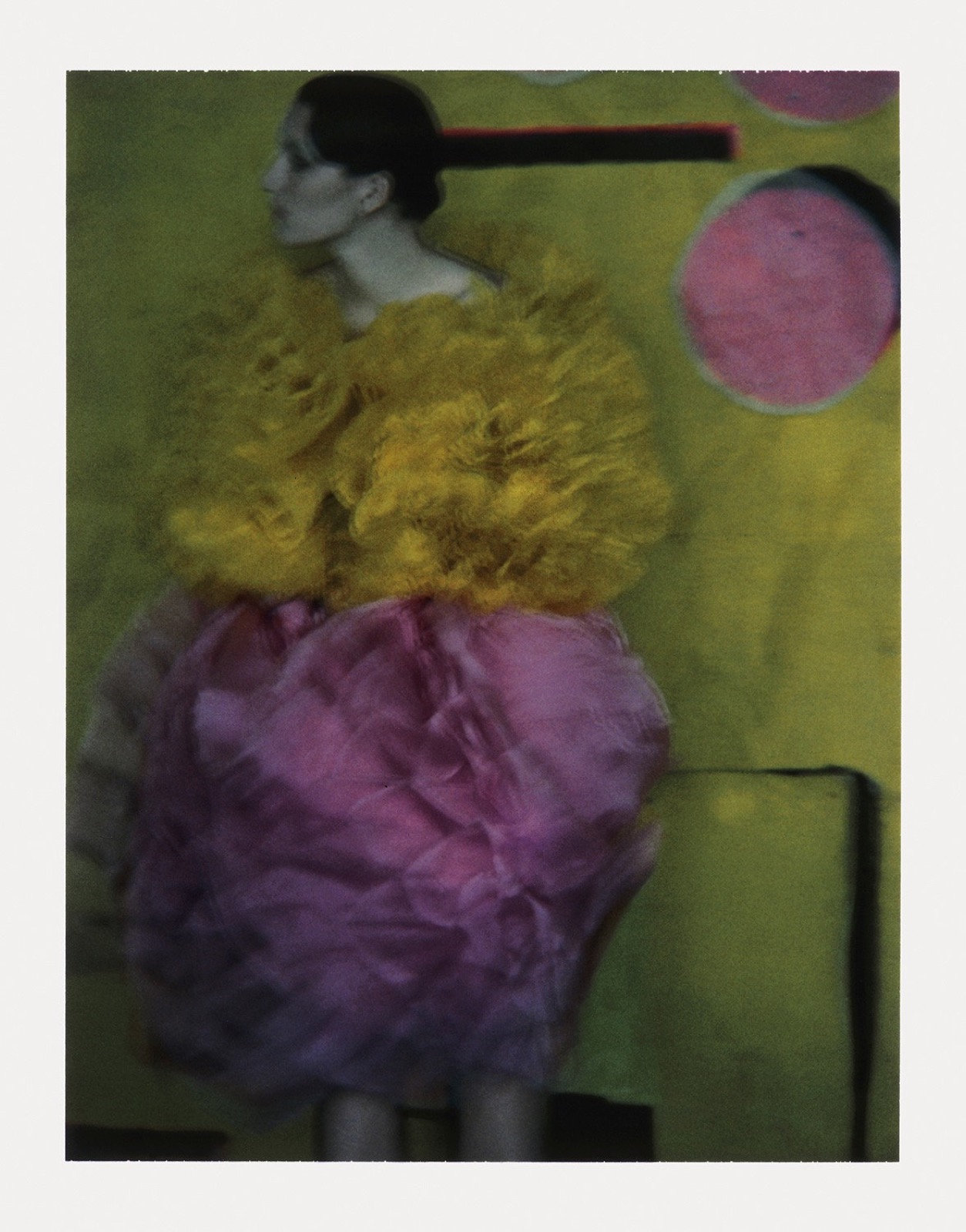
She turns away. That is the first thing, and almost the whole thing: Adriana gives us only her profile, eyes lowered, the dark hair pulled tight, while the dress does the speaking. A bodice of yellow feathers erupts at her shoulders like something half-bird, half-fire, and beneath it a vast bell of lilac tulle swells out and downward, crushed and luminous, too large for any room. The acid-green ground behind her is not a wall so much as a field of weather. Two pink discs hover at the upper right, moons or fruit or stains of light, refusing to explain themselves.
Everything is slightly out of focus, and the softness is not failure but conviction. The carbon print holds these colors the way memory holds them—saturated, granular, a little feverish, as if the image had been left out in the sun of someone's longing. You feel you are seeing the dress through gauze, or through years. The blur does not hide the figure; it releases her from the present tense. She becomes less a woman wearing a Watanabe gown than the afterimage of one, a shape the eye keeps after the body has gone.
There is an ethics in this looking. To photograph fashion is usually to command attention, to make the face sell. Here the face withdraws, and what we are given instead is interiority—the privacy of a person who will not perform for us. The dress flares with desire; the woman stays her own. Moon, who turned the commission into one of the great private languages in photography, lets commerce dissolve into something closer to dream, and trusts us to follow her into it.
She turns away. That is the first thing, and almost the whole thing: Adriana gives us only her profile, eyes lowered, the dark hair pulled tight, while the dress does the speaking. A bodice of yellow feathers erupts at her shoulders like something half-bird, half-fire, and beneath it a vast bell of lilac tulle swells out and downward, crushed and luminous, too large for any room. The acid-green ground behind her is not a wall so much as a field of weather. Two pink discs hover at the upper right, moons or fruit or stains of light, refusing to explain themselves.
Everything is slightly out of focus, and the softness is not failure but conviction. The carbon print holds these colors the way memory holds them—saturated, granular, a little feverish, as if the image had been left out in the sun of someone's longing. You feel you are seeing the dress through gauze, or through years. The blur does not hide the figure; it releases her from the present tense. She becomes less a woman wearing a Watanabe gown than the afterimage of one, a shape the eye keeps after the body has gone.
There is an ethics in this looking. To photograph fashion is usually to command attention, to make the face sell. Here the face withdraws, and what we are given instead is interiority—the privacy of a person who will not perform for us. The dress flares with desire; the woman stays her own. Moon, who turned the commission into one of the great private languages in photography, lets commerce dissolve into something closer to dream, and trusts us to follow her into it.