William Wegman American, b. 1943

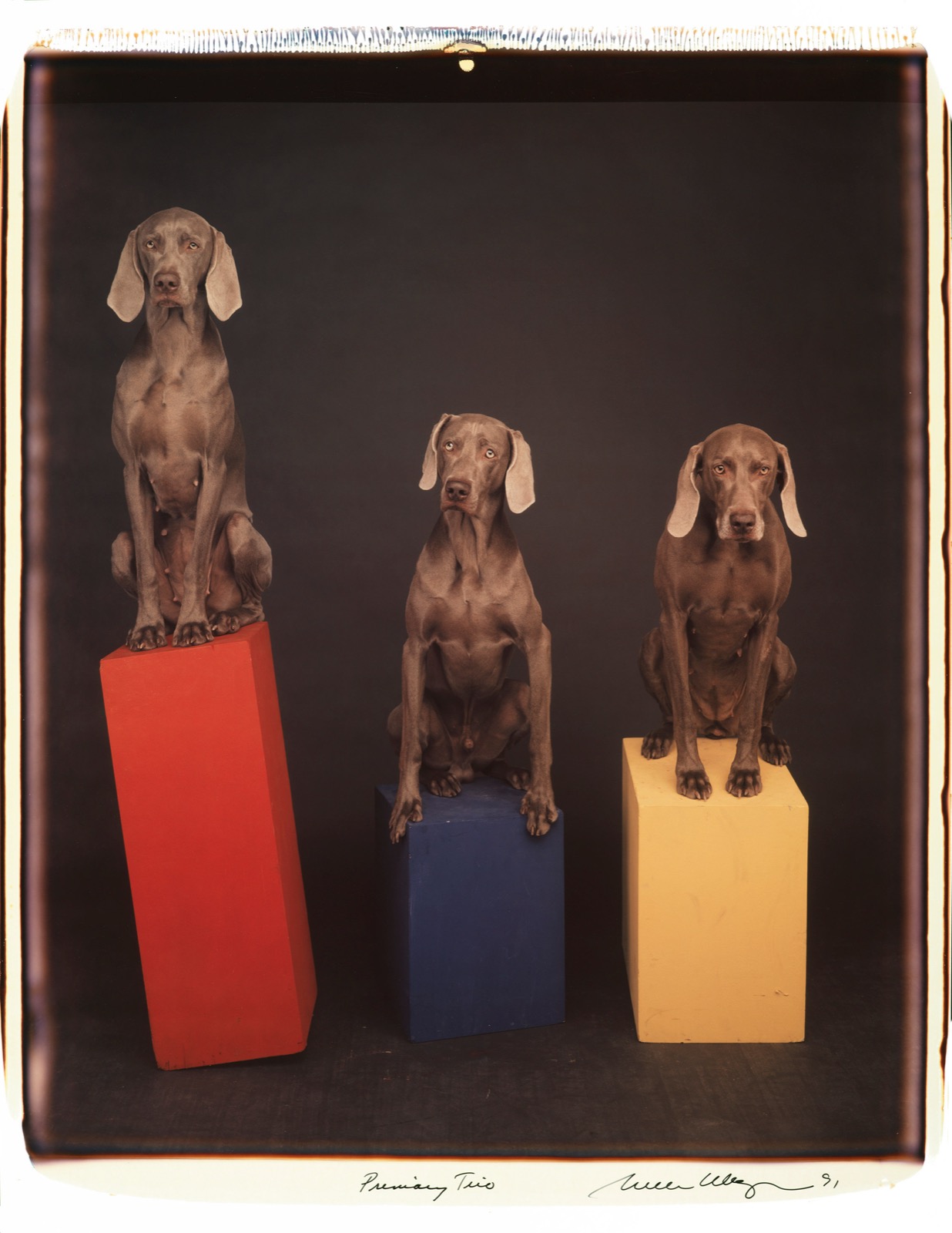
Primary Trio, 1991.
Unique Color Polaroid.
61 x 50.8 cm / 24 x 20 in
Titled and signed by the Artist on recto

The red plinth stands tallest, the blue a notch lower, the yellow lower still, so that the three Weimaraners step down across the frame like a chart of something — a podium, a bar graph, a colour wheel laid on its side. Wegman lets the joke sit there without insisting on it. What the picture is actually doing is simpler and stranger: it is using the studio's most basic equipment — coloured boxes, a grey sweep, three patient dogs — to test how little it takes to make an image hold still and mean.

It means by way of the 20-by-24 Polaroid, and that matters here. This is a unique object, not a negative awaiting prints. The exposure happened once, in the time it took these animals to settle and look up, and the warm, slightly torn edge of the film at the top of the sheet keeps that fact visible. You are not looking at a copy of a photograph; you are looking at the photograph, the actual surface the light reached in 1991. The large-format camera that made it — one of only a handful ever built — gives the dogs' silver coats a density that feels less printed than deposited.

Look at how differently each animal occupies its colour. The dog on red sits fully, paws gathered; the one on blue grips the front edge as if the box were small for it; the one on yellow leans into a soft, uncertain tilt. Three sitters, one pose, three refusals to be identical. That is the quiet argument of the picture, and the reason it survives its own wit: the system is rigid, the creatures are not. Wegman's long work with the breed — held by the Whitney, the Centre Pompidou, the Polaroid Collection — keeps returning to exactly this gap between order imposed and order felt.