Todd Hido American, b. 1968

11857-5754, 2018.
Series: 8 - Bright Black World
Archival pigment print mounted on aluminium Dibond.
Edition of 10 + 3 AP
30 x 20 in / 76.2 x 50.8 cm

Edition of 5 + 1 AP
45 x 30 in / 114.3 x 76.2 cm

Edition of 3 + 2 AP
57 x 38 in / 144.8 x 96.5 cm

Edition of 1 + 1 AP NFS
88 1/2 x 59 1/2 in / 224.8 x 151.1 cm
Signed, titled, numbered, and dated on a label affixed to the verso of the mount
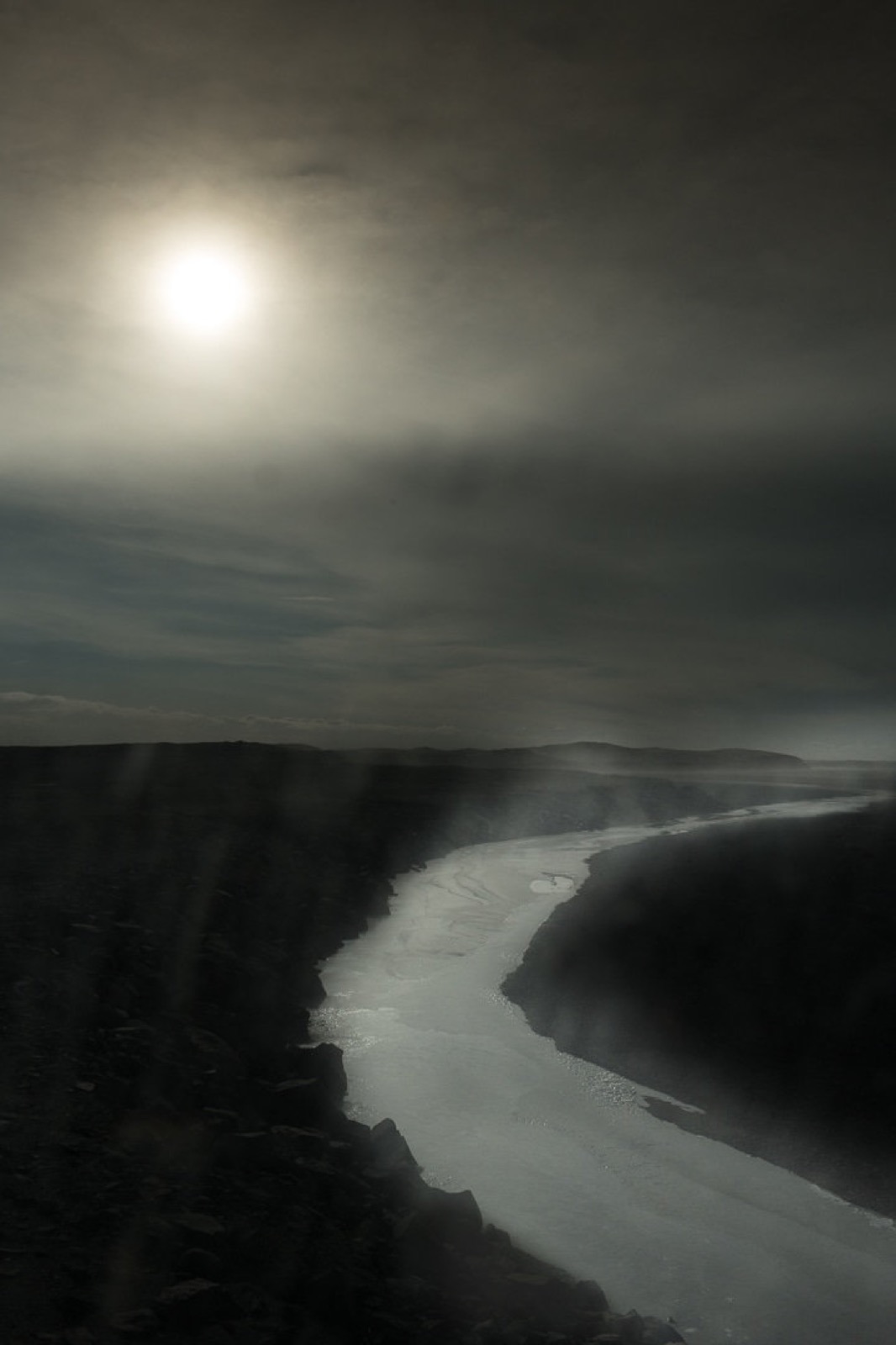
A river of pale light carves an S through black ground, and the eye follows it the way it would follow a tracking shot — drawn upstream toward the smeared sun that hangs, veiled, in the upper left. The water is the only thing that carries brightness; everything around it has been pulled down into a near-monochrome of basalt and cloud. Look at the lower edge and the illusion of a window: vertical streaks of haze rake across the dark rock, the residue of a frame shot through glass. The picture admits the apparatus that made it.

That admission is the point. Todd Hido works the boundary where the photograph stops behaving like a document and starts behaving like weather, or memory, or a still lifted from a film whose plot we never learn. This frame belongs to Bright Black World, the series in which he left the lit American windows of his earlier work for the tundra of Iceland and the Nordic north, photographing — often from a moving car — a landscape he loaded with the myth of Fimbulwinter, the long sunless winter that precedes Ragnarök. The reference is doom, but the image withholds catastrophe. What it gives is duration: a long grey exhalation, a sun that neither rises nor sets.

What makes it hold is the refusal to resolve. The river could be ice or current; the distant headland could be cliff or cloud. Hido lets the camera describe just enough and no more, so the threshold of the photograph and the threshold of the world stay the same line. It is among the most quietly sustained pictures of his recent project, and it earns its scale.