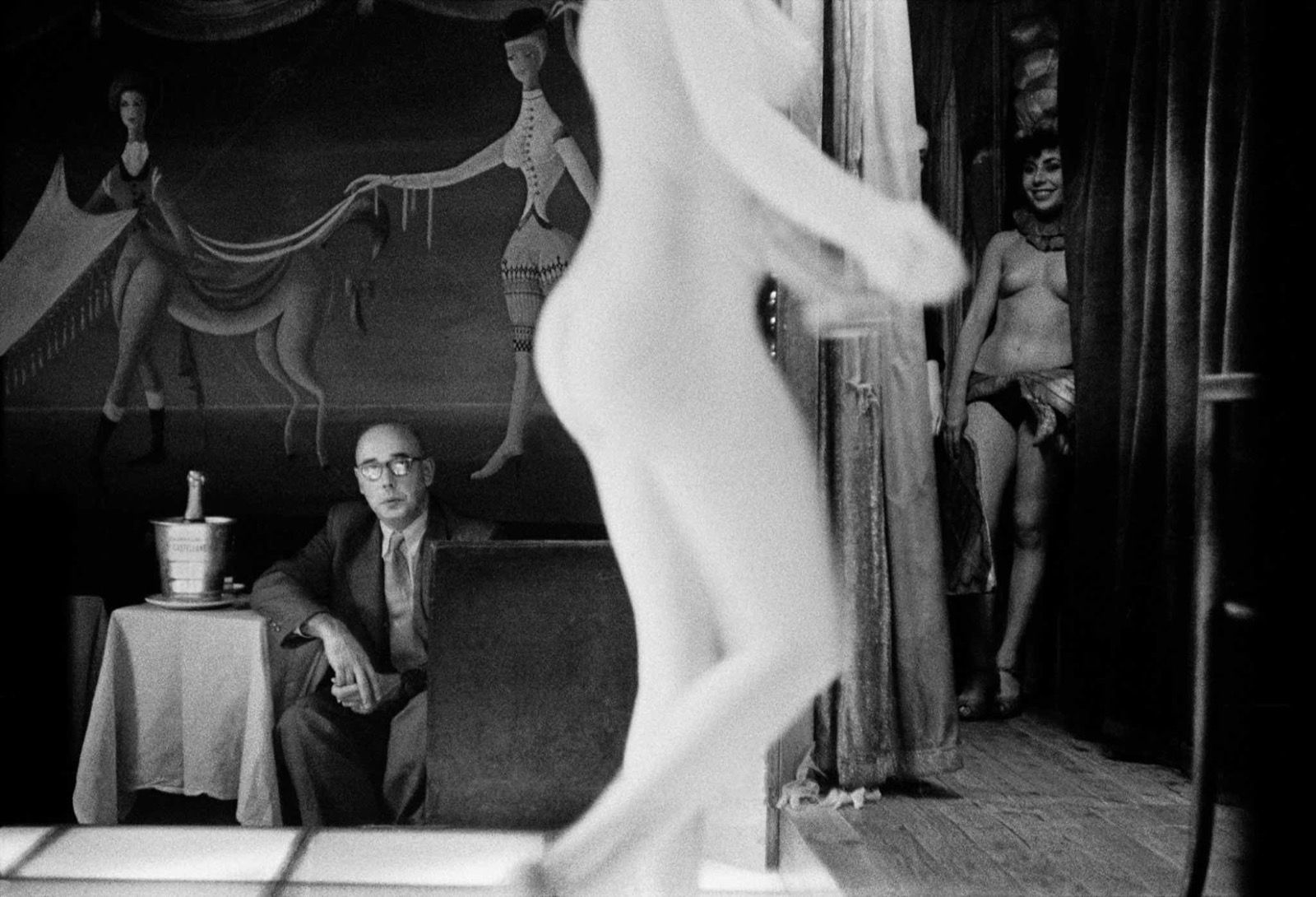
A dancer crosses the foreground so close to the lens that she dissolves into a column of pale, unfocused light, splitting the frame and pushing everything legible to its edges. To her left, deep in focus, a bespectacled man in a dark suit sits alone behind a small clothed table, a champagne bucket at his elbow, watching with the composure of someone who has watched before. To her right, half-swallowed by a velvet curtain, a second performer leans in the wings and smiles. Horvat builds the picture on this gap between the blurred body that occupies the most space and the two clothed presences who hold our attention—description doing the work that spectacle refuses.
Made at Le Sphynx in 1956, the photograph belongs to the early reportage with which Horvat, soon to be among the defining figures of postwar fashion photography for Jardin des Modes and the British and French press, taught himself to read a room. He worked here on borrowed time, admitted only briefly before the staff turned him out, and the constraint shows in the image's economy: one champagne bucket, one painted mural of stylized cabaret nudes behind the seated man, one fall of curtain. Nothing is arranged, yet everything answers to the rectangle.
What endures is the candor of the looking. The naked dancer is rendered abstract while the dressed observers are given their full particularity, so that the strip club becomes, in Horvat's hands, a study of attention itself—who is seen, who sees, and the quiet distances the camera measures between them. Printed later as a gelatin silver print and held in the artist's lineage of humanist street and stage work, it remains a precise and scarce record of a vanished Paris.
A dancer crosses the foreground so close to the lens that she dissolves into a column of pale, unfocused light, splitting the frame and pushing everything legible to its edges. To her left, deep in focus, a bespectacled man in a dark suit sits alone behind a small clothed table, a champagne bucket at his elbow, watching with the composure of someone who has watched before. To her right, half-swallowed by a velvet curtain, a second performer leans in the wings and smiles. Horvat builds the picture on this gap between the blurred body that occupies the most space and the two clothed presences who hold our attention—description doing the work that spectacle refuses.
Made at Le Sphynx in 1956, the photograph belongs to the early reportage with which Horvat, soon to be among the defining figures of postwar fashion photography for Jardin des Modes and the British and French press, taught himself to read a room. He worked here on borrowed time, admitted only briefly before the staff turned him out, and the constraint shows in the image's economy: one champagne bucket, one painted mural of stylized cabaret nudes behind the seated man, one fall of curtain. Nothing is arranged, yet everything answers to the rectangle.
What endures is the candor of the looking. The naked dancer is rendered abstract while the dressed observers are given their full particularity, so that the strip club becomes, in Horvat's hands, a study of attention itself—who is seen, who sees, and the quiet distances the camera measures between them. Printed later as a gelatin silver print and held in the artist's lineage of humanist street and stage work, it remains a precise and scarce record of a vanished Paris.