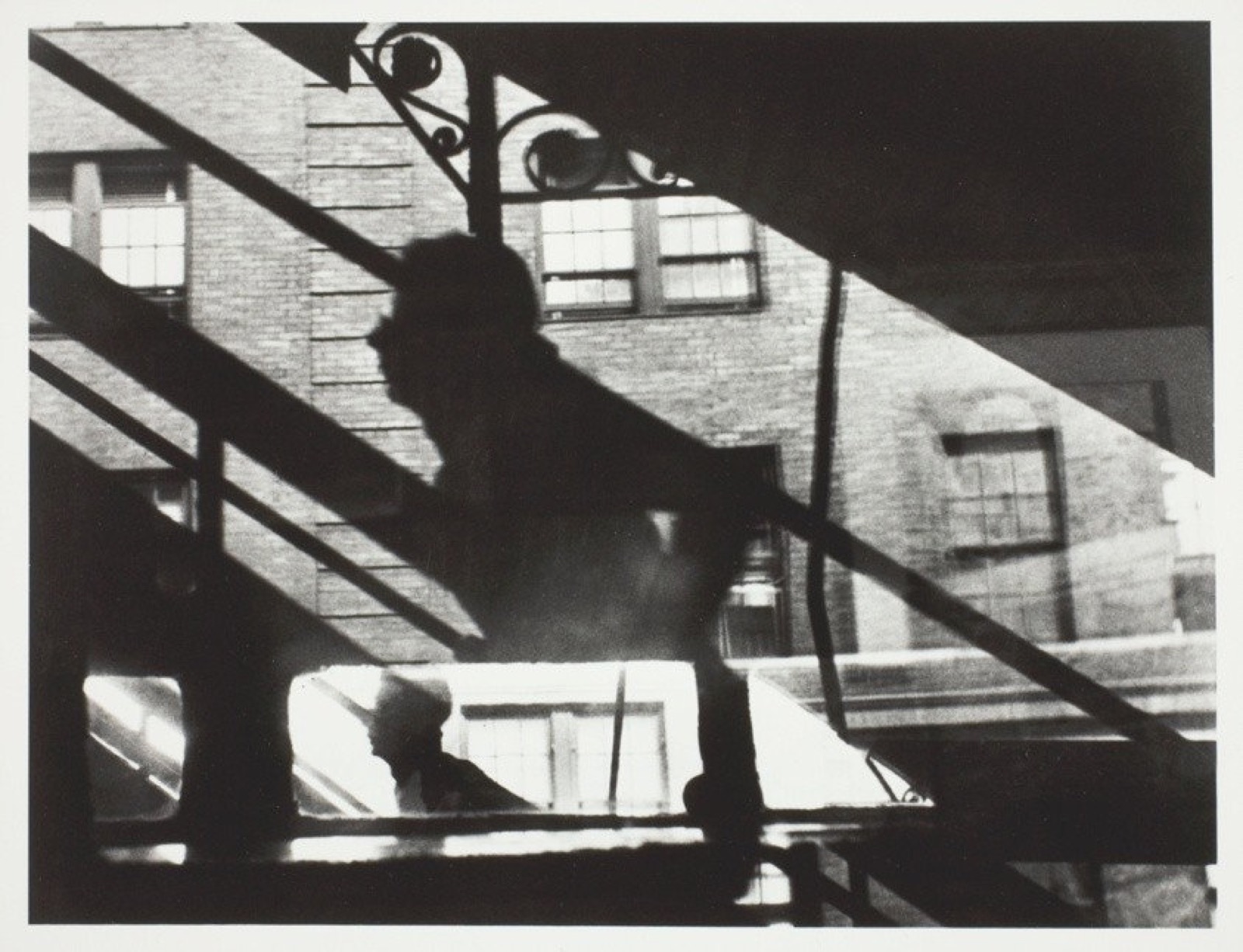
A photograph can be staged without a studio, and Faurer proves it here by treating a tenement backyard as a set already built for him. The frame is bisected by hard diagonals — the underside of a wooden stair sloping down from the upper right, the cast iron of a fire-escape railing climbing the left — and between them a man stands in near-total silhouette, his head and shoulders dissolving into shadow against a brick facade pricked with windows. It reads less as a candid street snapshot than as a deliberate composition, a self-conscious arrangement of light, architecture and a single anonymous body.
The blackness of the figure is the picture's real subject. Faurer underexposes the man so completely that he becomes a cut-out, a flat absence pasted onto the granular grey of the wall behind him, while a wash of pale light pools across the lower windows and a smaller, brighter head emerges below him like a double or an afterthought. This is New York in 1947 rendered as pure graphic event: the city not as document but as a problem of figure and ground, presence and erasure, worked out in silver.
Printed decades later by Chuck Kelton from Faurer's negative, the image keeps that constructed quality — the deep velvety shadow, the precise tonal staging that lets a man become a sign of himself. The title borrowed from the racetrack, Win, Place, and Show, hangs over the scene with a sly irony, ranking a figure who has placed himself nowhere we can name, in a yard that is everywhere and no one's.
A photograph can be staged without a studio, and Faurer proves it here by treating a tenement backyard as a set already built for him. The frame is bisected by hard diagonals — the underside of a wooden stair sloping down from the upper right, the cast iron of a fire-escape railing climbing the left — and between them a man stands in near-total silhouette, his head and shoulders dissolving into shadow against a brick facade pricked with windows. It reads less as a candid street snapshot than as a deliberate composition, a self-conscious arrangement of light, architecture and a single anonymous body.
The blackness of the figure is the picture's real subject. Faurer underexposes the man so completely that he becomes a cut-out, a flat absence pasted onto the granular grey of the wall behind him, while a wash of pale light pools across the lower windows and a smaller, brighter head emerges below him like a double or an afterthought. This is New York in 1947 rendered as pure graphic event: the city not as document but as a problem of figure and ground, presence and erasure, worked out in silver.
Printed decades later by Chuck Kelton from Faurer's negative, the image keeps that constructed quality — the deep velvety shadow, the precise tonal staging that lets a man become a sign of himself. The title borrowed from the racetrack, Win, Place, and Show, hangs over the scene with a sly irony, ranking a figure who has placed himself nowhere we can name, in a yard that is everywhere and no one's.