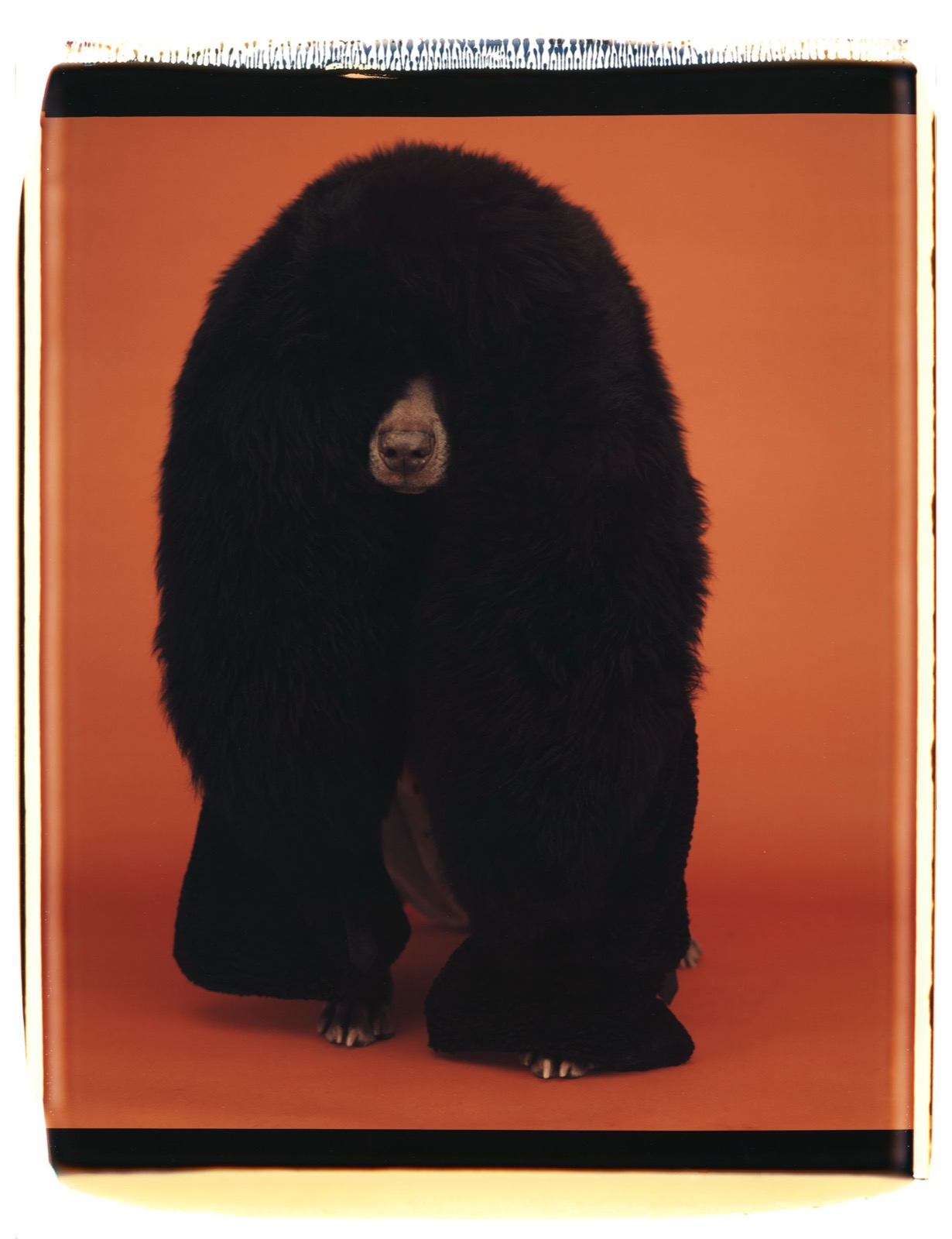
William Wegman American, b. 1943

Chow, 1994.
Unique Color Polaroid. Mounted.
61 x 50.8 cm / 24 x 20 in
Titled and signed by the Artist on recto

There is a lineage of pictures in which the figure vanishes beneath drapery and the cloth becomes the subject—the swallowing folds of a Zurbarán monk, the black sheen of a Sargent gown—and this Polaroid joins it by the strangest means: the cloth is alive. A dog stands buried under a second pelt, a heavy curtain of long black fur falling from its shoulders nearly to the floor, so dense it reads as a garment and not an animal at all. What gives the masquerade away is small and physical: one pale muzzle of grey and pink, pushed out where the dark pile parts. Below, four blunt toes catch the studio light. The body has become texture; only snout and feet confess that something breathes inside.

Everything here is a fact of the apparatus. This is one of the rare 20-by-24 Polaroids made on the enormous instant camera that yields a single, unrepeatable positive—no negative, no second print, the object you see the only one that exists. The chemistry loves this register: the terracotta ground glows with a saturation peculiar to the dye-diffusion process, and the black fur drinks every value down to a matte void against which that wet nose is almost shocking. At the top edge the print declares its own making—the ragged black border, the perforations where the sheet was pulled and peeled.

Wegman's Weimaraners are among the most recognised figures in late-century photography, their gravity a foil to his deadpan wit, and the late large-format colour work sits at the centre of his standing. What the camera describes is not a costume so much as a transformation held perfectly still: the comedy of the dressed dog tipping, under that immense weight, toward something almost solemn. A unique object, and a single nose that will not let the joke close.