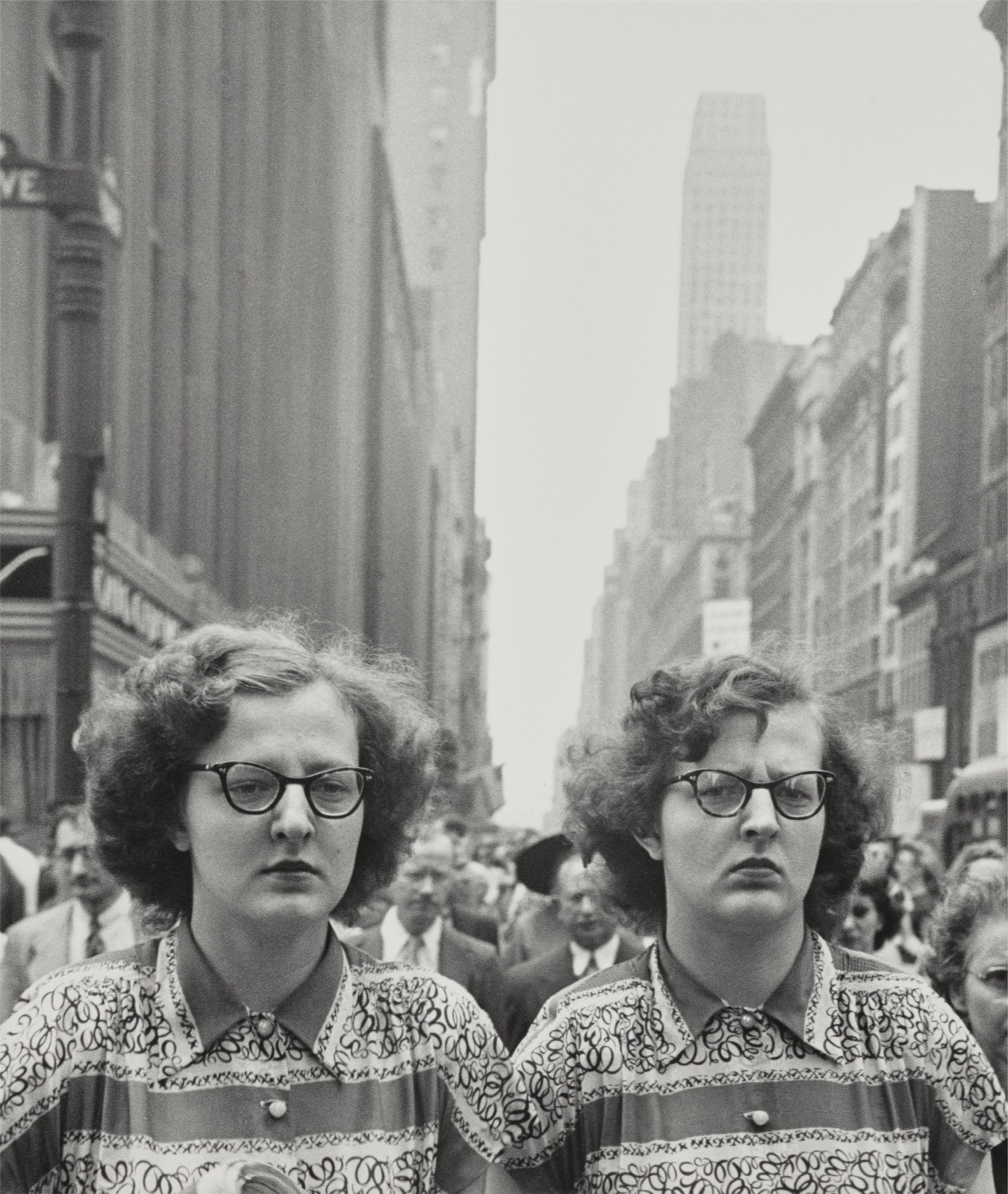
Whether they dressed alike on purpose is the one thing the two women refuse to give up. Twins, or close enough, in identical scribble-patterned blouses, identical horn-rimmed glasses, identical permed hair — they advance up the New York pavement side by side with the matched, faintly furious expressions of people who have decided not to enjoy the day. Faurer has pulled in tight and low, so their faces fill the foreground and the avenue drains away behind them into a canyon of buildings, a far tower catching sun, a crowd dissolving into grey.
The mystery isn't the matching, which after all they chose. It's the difference inside the sameness. One mouth is set; the other has the beginnings of a scowl, a crease between the brows that the first face lacks. Look long enough and the symmetry starts to come apart at exactly the seams that make us individuals — a slightly cocked head, a heavier shadow under one jaw. Faurer was drawn all his life to people who doubled, mirrored, repeated, and here the doubling is offered to him gift-wrapped on Fifth Avenue, and he takes it without sentiment.
Behind them the city carries on indifferent, men in hats sliding past, a bus, a street sign, the white sky of a summer afternoon in 1948. The women don't see Faurer, or pretend not to, and that withholding is the whole charge of the thing. They give us their faces and keep everything else — where they're going, why the matched armour, what they're braced against. Two of them, and still, somehow, unaccompanied.
Whether they dressed alike on purpose is the one thing the two women refuse to give up. Twins, or close enough, in identical scribble-patterned blouses, identical horn-rimmed glasses, identical permed hair — they advance up the New York pavement side by side with the matched, faintly furious expressions of people who have decided not to enjoy the day. Faurer has pulled in tight and low, so their faces fill the foreground and the avenue drains away behind them into a canyon of buildings, a far tower catching sun, a crowd dissolving into grey.
The mystery isn't the matching, which after all they chose. It's the difference inside the sameness. One mouth is set; the other has the beginnings of a scowl, a crease between the brows that the first face lacks. Look long enough and the symmetry starts to come apart at exactly the seams that make us individuals — a slightly cocked head, a heavier shadow under one jaw. Faurer was drawn all his life to people who doubled, mirrored, repeated, and here the doubling is offered to him gift-wrapped on Fifth Avenue, and he takes it without sentiment.
Behind them the city carries on indifferent, men in hats sliding past, a bus, a street sign, the white sky of a summer afternoon in 1948. The women don't see Faurer, or pretend not to, and that withholding is the whole charge of the thing. They give us their faces and keep everything else — where they're going, why the matched armour, what they're braced against. Two of them, and still, somehow, unaccompanied.