Long before he became beloved for his dogs, William Wegman was a conceptual artist of the 1970s, making deadpan videos and photographs that probed the absurdities of language and image. His Weimaraners — first Man Ray, then Fay Ray and her descendants — turned that cool wit warm, and his move to the rare 20x24 Polaroid, the room-sized Land camera capable of breathtaking detail, gave the collaboration its grand, singular form: pictures that exist as unique objects, impossible to reproduce.
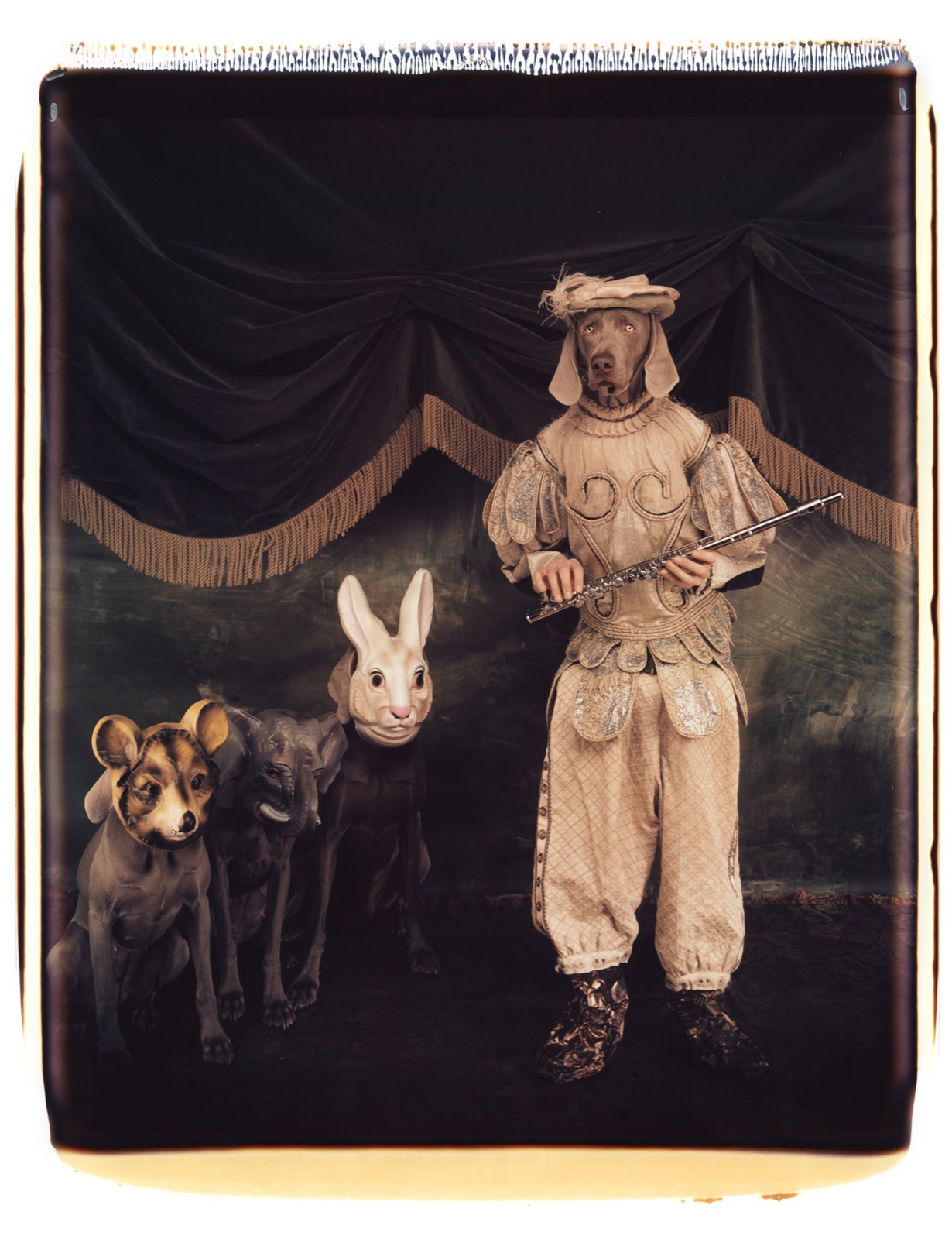
Here the dog becomes Tamino, the questing prince of Mozart's Magic Flute. Costumed in Renaissance finery and a plumed cap, flute in paw, he stands before a fringed and draped stage while a small troupe of fellow Weimaraners — masked as a mouse, a rabbit and other creatures — gathers as if drawn by the music. The scene is at once a children's-book enchantment and a sly art-historical conceit, opera staged in the body of a household pet.
Wegman's genius lies in restraint. He never mocks his animals; he lets them keep their grave, soulful dignity, so that comedy and tenderness arrive in the same breath. The result is funny and oddly moving at once — a meditation on performance, devotion and our endless wish to see ourselves in the creatures we love. Backed by the velvety depth and one-of-a-kind richness of the large Polaroid, it is also simply a marvel to behold: a virtuoso picture that wears its sophistication lightly, and that has made Wegman one of the most inventive and widely adored artists of his time. Only a handful of 20x24 cameras were ever built, and the prints they yield are unique by nature — a rarity that has carried his work into major museum collections worldwide.
Long before he became beloved for his dogs, William Wegman was a conceptual artist of the 1970s, making deadpan videos and photographs that probed the absurdities of language and image. His Weimaraners — first Man Ray, then Fay Ray and her descendants — turned that cool wit warm, and his move to the rare 20x24 Polaroid, the room-sized Land camera capable of breathtaking detail, gave the collaboration its grand, singular form: pictures that exist as unique objects, impossible to reproduce.
Here the dog becomes Tamino, the questing prince of Mozart's Magic Flute. Costumed in Renaissance finery and a plumed cap, flute in paw, he stands before a fringed and draped stage while a small troupe of fellow Weimaraners — masked as a mouse, a rabbit and other creatures — gathers as if drawn by the music. The scene is at once a children's-book enchantment and a sly art-historical conceit, opera staged in the body of a household pet.
Wegman's genius lies in restraint. He never mocks his animals; he lets them keep their grave, soulful dignity, so that comedy and tenderness arrive in the same breath. The result is funny and oddly moving at once — a meditation on performance, devotion and our endless wish to see ourselves in the creatures we love. Backed by the velvety depth and one-of-a-kind richness of the large Polaroid, it is also simply a marvel to behold: a virtuoso picture that wears its sophistication lightly, and that has made Wegman one of the most inventive and widely adored artists of his time. Only a handful of 20x24 cameras were ever built, and the prints they yield are unique by nature — a rarity that has carried his work into major museum collections worldwide.