Series: 35 mm - Color
Archival pigment print. Printed later.
Edition of 15
20 x 24 in / 50 × 60 cm
Umbrella edition of 10
30 x 40 in / 76 × 101 cm
Edition of 5
48 x 60 in / 121 × 152 cm
Edition of 3
60 x 75 in / 152.4 x 190.5 cm
20 x 24 in / 50 × 60 cm
Umbrella edition of 10
30 x 40 in / 76 × 101 cm
Edition of 5
48 x 60 in / 121 × 152 cm
Edition of 3
60 x 75 in / 152.4 x 190.5 cm
Hand-signed by artist, mounted, titled, editioned and print date in ink label affixed to mount verso
© The Artist

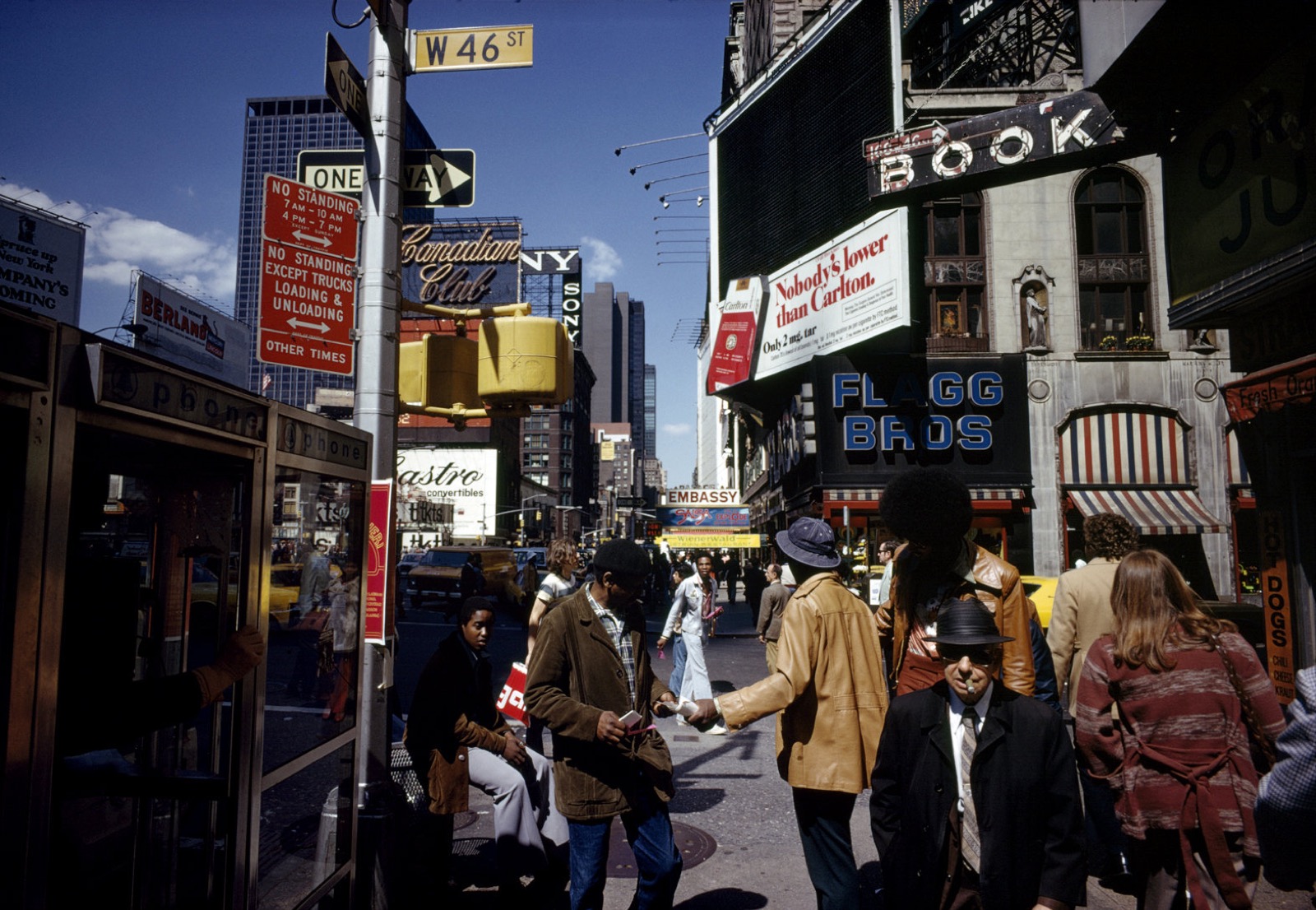
A wedge of cloudless Kodachrome blue opens above West 46th Street, so saturated it reads almost as enamel, and beneath it the cross-street sign and a thicket of regulatory placards — ONE WAY, NO STANDING EXCEPT TRUCKS LOADING UNLOADING — climb a single lamppost like a totem. Two glass phone booths anchor the left edge; deeper in, the signage of the old theatre district stacks itself into a vertical chord: Canadian Club, SONY, the marquee promising Nobody's lower than Carlton, the cobalt neon of FLAGG BROS, a bookstore's blunt BOOK. The light is mid-afternoon and raking, the kind that turns a working block into an inventory of surfaces.
Only after the street has been fully described does the crowd resolve, which is exactly how this picture wants to be read. Meyerowitz made it in 1974, in the early maturity of his commitment to color and to the large-format vantage that would culminate in Cape Light two years on. Here he is still the street photographer, but one who has decided that hue carries as much information as gesture — the tan of a bucket-hatted man's jacket, the burgundy of a coat at right, the chrome-yellow of taxis idling toward Times Square.
What gives the frame its quiet authority is its refusal of a single subject. A man in a dark suit and snapbrim hat moves through the foreground with a cigar; figures sit, wait, drift past the booths, each absorbed and unaware. The democratic distribution of attention across the whole rectangle — sign and face weighted equally — is the argument of the picture, and of Meyerowitz's place in the generation that legitimized color for serious photography. Prints of this vintage New York work, drawn from the holdings the artist has kept close, remain uncommon outside major collections.