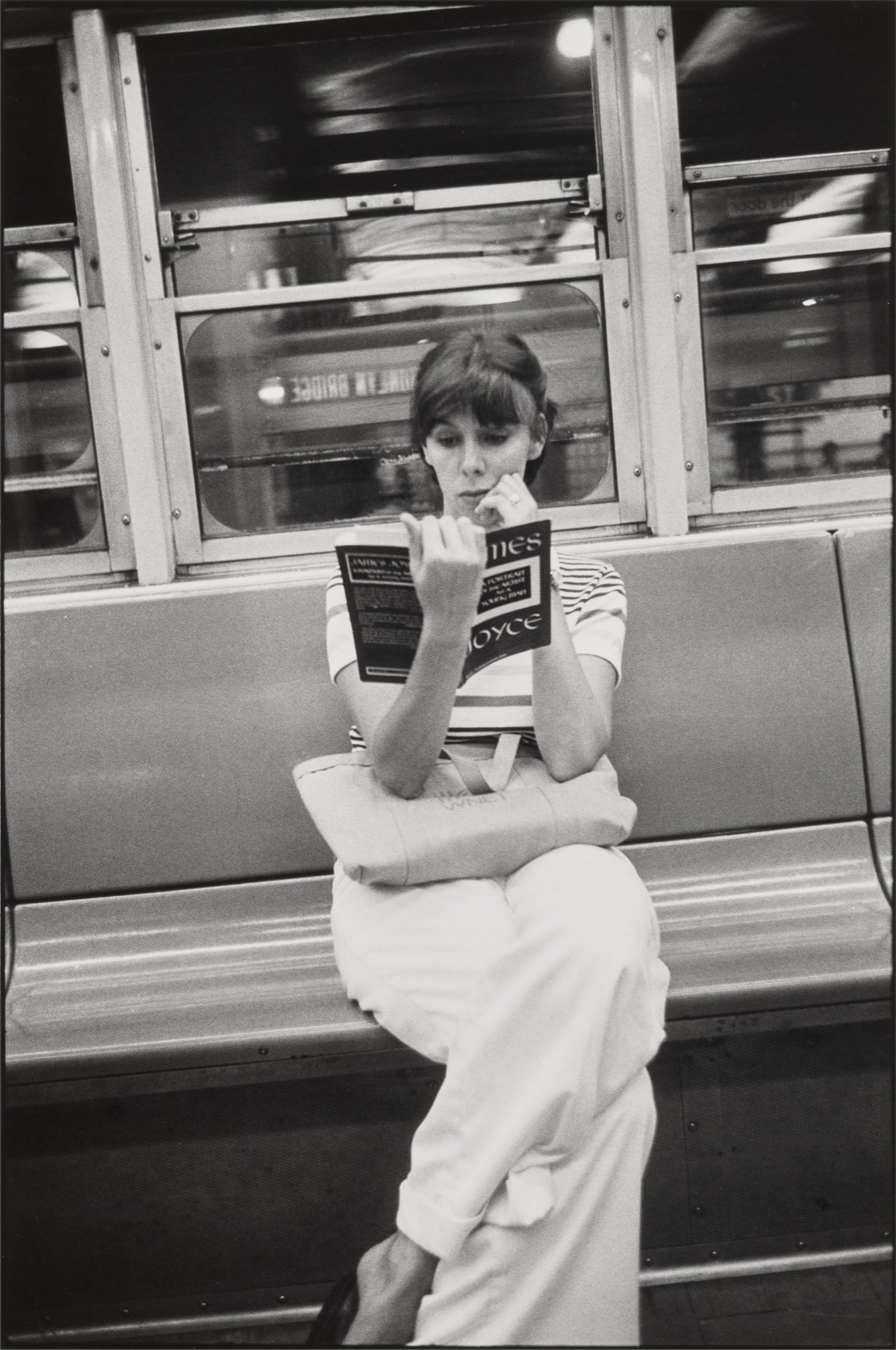
White trousers, a striped top, a canvas tote settled across the lap like a small white pillow—Faurer dresses this 1973 subway car in soft, summer tones, and the whole picture turns on that pale calm. A young woman sits alone on the gleaming bench, knees crossed, absorbed in a paperback she holds close to her face. The cover reads Dubliners, Joyce; even her reading is a kind of style, chosen, worn.
Behind her the windows go to liquid, the tunnel and the express track streaking past in long horizontal blurs, lettering on a passing car dissolving mid-word. That motion is the whole speed of the city, and she ignores it utterly. Faurer sets her stillness against the smeared rush like a held breath, one finger raised to her cheek, eyes down, sealed inside the book. The bright bench and bright clothes glow against the grimy steel.
By 1973 Faurer had been doing this for decades, finding the one composed figure in the moving machine, and his eye for the body had only sharpened—the cross of the legs, the curve of the wrist, the casual elegance of someone who doesn't know she's being seen, or pretends she doesn't. There is tenderness here, and a little hunger, the photographer's old love of a stranger glimpsed and wanted across a swaying car. She reads on, oblivious, lovely, gone before the next stop pulls the doors open.
White trousers, a striped top, a canvas tote settled across the lap like a small white pillow—Faurer dresses this 1973 subway car in soft, summer tones, and the whole picture turns on that pale calm. A young woman sits alone on the gleaming bench, knees crossed, absorbed in a paperback she holds close to her face. The cover reads Dubliners, Joyce; even her reading is a kind of style, chosen, worn.
Behind her the windows go to liquid, the tunnel and the express track streaking past in long horizontal blurs, lettering on a passing car dissolving mid-word. That motion is the whole speed of the city, and she ignores it utterly. Faurer sets her stillness against the smeared rush like a held breath, one finger raised to her cheek, eyes down, sealed inside the book. The bright bench and bright clothes glow against the grimy steel.
By 1973 Faurer had been doing this for decades, finding the one composed figure in the moving machine, and his eye for the body had only sharpened—the cross of the legs, the curve of the wrist, the casual elegance of someone who doesn't know she's being seen, or pretends she doesn't. There is tenderness here, and a little hunger, the photographer's old love of a stranger glimpsed and wanted across a swaying car. She reads on, oblivious, lovely, gone before the next stop pulls the doors open.