Todd Hido American, b. 1968

10715-7, 2011.
Series: 6 - Excerpts from Silver Meadows
Archival pigment print mounted on aluminium Dibond.
Edition of 10 + 3 AP
61 x 50.8 cm / 24 x 20 in

Edition of 5 + 1AP
96.5 x 76.2 cm / 38 x 30 in

Edition of 3 + 1AP
121.9 x 96.5 cm / 48 x 38 in
Signed, titled, numbered, and dated on a label affixed to the verso of the mount
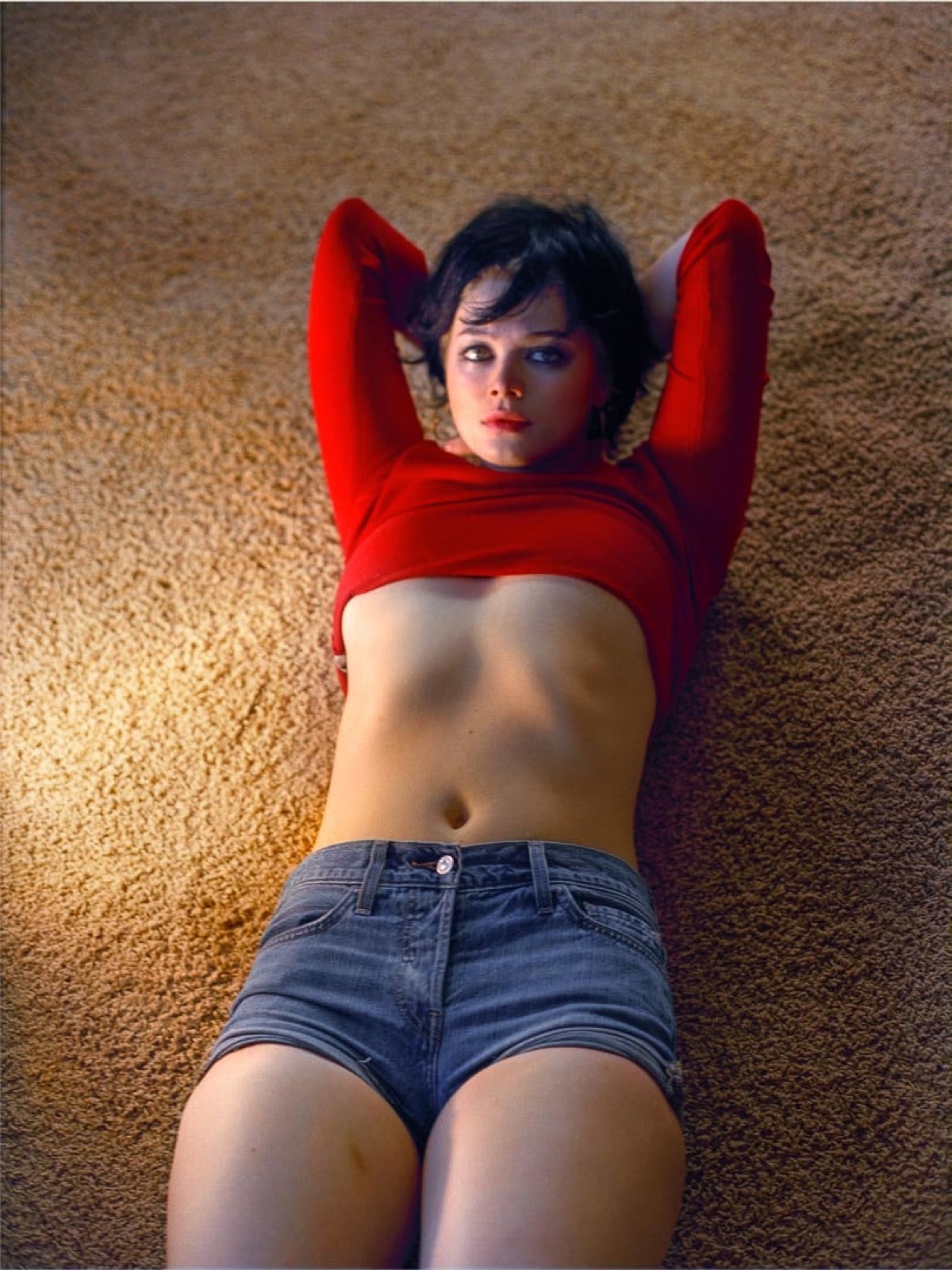
The camera is directly above her, looking straight down, and that single decision governs everything else. There is no horizon, no wall, no window — only the carpet, a dense beige pile that fills the frame edge to edge and turns, under a low raking light from the left, into something closer to a landscape than a floor. She lies on it as on sand or open ground, arms folded behind her head, the cropped red top ridden up to bare the stomach, denim shorts below. The picture is less a portrait than a question about where we are standing to look.

What interests me is how stillness is doing the work here. Hido is a photographer who has always borrowed from cinema — the saturated color, the sense of a scene paused mid-narrative — yet this frame refuses the forward motion film would supply. The overhead angle flattens the body into the plane of the carpet, so that figure and ground share one continuous surface, and time seems to pool rather than pass. Her gaze comes back up the lens at us, level and unhurried, which only sharpens the strangeness of our position somewhere above her.

The image belongs to Hido's portrait work, the looser, more charged companion to the suburban houses and roadside interiors that made his name and entered collections from SFMOMA to the Getty. Here the domestic has been emptied of its furniture; what remains is light, skin, a textured field, and the calm fact of being seen. The drama is entirely in the looking — in deciding, frame by frame, what kind of picture this is and what it asks of whoever holds the vantage.